
Last updated: May 4, 2026
In this article
- Understanding the Money Tree: What Makes It Safe
- When a “Non-Toxic” Plant Still Causes Problems
- Why Cats Chew on Money Trees and How to Manage It
- Money Tree Care Tips for Cat-Owning Households
- Other Cat-Safe Houseplants to Consider
- Common Money Tree Lookalikes: Know the Difference
- Frequently Asked Questions
Are Money Trees Toxic to Cats? The Good News Every Cat Owner Needs
If you have been anxiously Googling whether your beautiful braided money tree could be harming your cat, take a deep breath. We have genuinely good news for you.
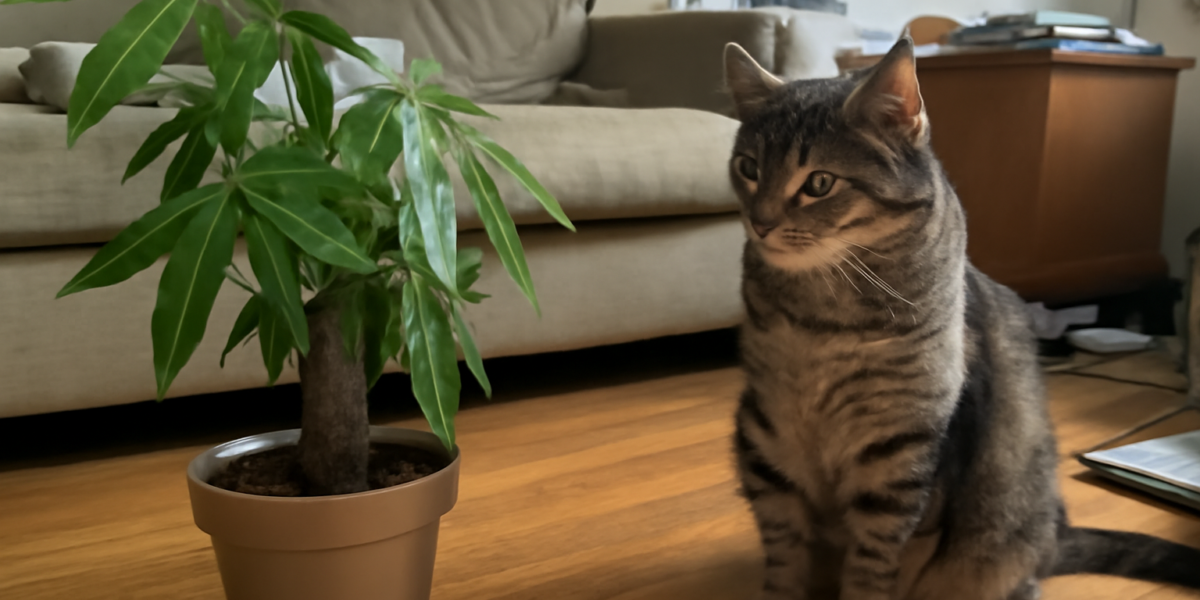
Money trees (Pachira aquatica) are generally considered non-toxic to cats. The ASPCA lists Pachira aquatica as non-toxic to cats, dogs, and horses, making it one of the rare houseplants that is both gorgeous and genuinely safe for your feline family members.
That said, “non-toxic” does not mean “zero concerns.” Even safe plants can cause mild issues if your cat decides to turn them into a salad. In this comprehensive guide, we will explore everything you need to know about money trees and cats, from the science behind their safety to practical tips for harmonious coexistence between your plants and your pets.
Understanding the Money Tree: What Makes It Safe
The money tree, scientifically known as Pachira aquatica, is a tropical wetland tree native to Central and South America. In its natural habitat, it can grow up to 60 feet tall, but as a houseplant, it is typically maintained at a manageable three to six feet. It is widely recognized by its distinctive braided trunk and large, glossy, palmate leaves with five to nine leaflets arranged like an open hand.
Money trees are popular houseplants for several reasons beyond their beauty. In feng shui tradition, they are believed to bring good luck and financial prosperity, which is how they earned their common name. They are also relatively easy to care for, tolerating a range of indoor conditions.
From a toxicological perspective, Pachira aquatica does not contain any of the dangerous compound classes that make other houseplants toxic to cats. It lacks:
- Calcium oxalate crystals (found in philodendrons, peace lilies, and dieffenbachia)
- Toxic alkaloids (found in amaryllis, autumn crocus, and oleander)
- Saponins at harmful levels (found in aloe vera and English ivy)
- Cardiac glycosides (found in oleander and foxglove)
This clean toxicological profile is what earns the money tree its non-toxic designation. However, it is important to distinguish the money tree (Pachira aquatica) from the jade plant (Crassula ovata), which is sometimes also called a “money plant” or “money tree” and is toxic to cats. Learn more about jade plant toxicity in cats to make sure you have the right plant identified.
When a “Non-Toxic” Plant Still Causes Problems
While money trees are genuinely safe for cats, it is important to understand that “non-toxic” does not mean “eat as much as you want with zero consequences.” Here are some situations where a money tree might still cause your cat some discomfort:
Gastrointestinal upset from overeating plant material. Cats are obligate carnivores, meaning their digestive systems are designed for meat, not plant fiber. If your cat eats a significant amount of money tree leaves, they may experience mild vomiting, soft stools, or decreased appetite as their GI tract deals with the unfamiliar material. This is not a toxic reaction but rather a natural response to eating something their body is not designed to process in quantity.
Choking or blockage risk. Large pieces of leaf or stem could potentially cause choking, particularly in kittens or small cats. While this risk is low, it is worth mentioning because any non-food item that a cat chews and swallows carries some mechanical risk.
Pesticide or fertilizer exposure. This is often a bigger concern than the plant itself. If your money tree has been treated with pesticides, fungicides, or chemical fertilizers, your cat could ingest these potentially harmful substances when chewing on the leaves. Always use pet-safe plant care products and consider switching to organic fertilizers if you have cats that nibble on your plants.
Soil ingestion. Some cats are attracted to the soil around houseplants. Potting soil can contain fertilizers, perlite, vermiculite, and other materials that are not ideal for cat consumption. Additionally, moist potting soil can harbor molds and bacteria that could upset your cat’s stomach.
Why Cats Chew on Money Trees and How to Manage It
If your cat has taken a liking to your money tree, you might be wondering why. Understanding the motivation behind plant-chewing behavior can help you address it effectively.
Instinctive grazing behavior. Many cats have an instinct to nibble on greenery. In the wild, cats occasionally eat grass and plants, possibly to aid digestion or obtain certain nutrients like folic acid. Indoor cats may turn to houseplants as a substitute for outdoor vegetation.
Boredom and stimulation-seeking. Cats that are under-stimulated may chew on plants simply because it gives them something to do. The rustling leaves and interesting textures of a money tree can be appealing to a bored cat.
Texture and play appeal. The large, fan-shaped leaves of a money tree move enticingly in air currents and have a satisfying texture for chewing. Some cats treat them as toys rather than food.
Strategies to manage plant chewing:
- Provide cat grass. Offering a dedicated pot of cat grass (wheatgrass or oat grass) gives your cat a safe, appropriate outlet for their grazing instincts and may reduce their interest in your money tree.
- Increase enrichment. Interactive toys, puzzle feeders, window perches, and regular play sessions can reduce boredom-driven plant chewing.
- Use deterrent sprays. Pet-safe bitter apple spray applied to leaves can discourage chewing. Reapply regularly as the taste fades.
- Strategic placement. While cats are excellent climbers, placing your money tree in a location that is less accessible or less interesting to your cat can help. Sometimes simply moving the plant to a different room reduces feline attention.
- Provide alternative textures. Cat-safe plants like spider plants, Boston ferns, or catnip can offer the textural experience your cat is seeking.
Money Tree Care Tips for Cat-Owning Households
Having both a money tree and a cat is entirely feasible with a few smart adjustments to your plant care routine.
Choose pet-safe fertilizers. Opt for organic or pet-safe fertilizers rather than chemical ones. If you use liquid fertilizer, wait until it has been thoroughly absorbed and the soil surface has dried before giving your cat access to the area.
Cover the soil. Place decorative stones, pine cones, or a layer of rough mulch on top of the soil to discourage cats from digging in it or using the pot as a litter box. This also helps prevent soil ingestion.
Clean fallen leaves promptly. While money tree leaves are non-toxic, removing fallen leaves prevents them from becoming a cat toy that could be chewed into small pieces and potentially cause mild GI upset.
Secure the pot. A heavy, stable pot or a pot placed in a weighted planter sleeve prevents your cat from knocking the tree over, which could injure your cat and damage your plant.
Monitor your plant’s health. A healthy money tree is a safe money tree. Stressed or diseased plants may develop mold on their soil or produce compounds in response to stress that could potentially be irritating. Keep your money tree healthy with proper watering, light, and drainage.
Other Cat-Safe Houseplants to Consider
If you love the idea of filling your home with greenery that will not harm your cat, you are in luck. The money tree is just one of many beautiful, cat-safe options. Here are some excellent companions for your money tree collection:
Spider plant (Chlorophytum comosum) is one of the most popular cat-safe houseplants. Its arching leaves and trailing babies are non-toxic, though some cats find them irresistible to play with.
Boston fern (Nephrolepis exaltata) adds lush, cascading greenery and is completely safe for cats. It thrives in the same humid conditions that money trees enjoy.
Parlor palm (Chamaedorea elegans) offers tropical elegance similar to a money tree and is non-toxic to cats. Its feathery fronds are attractive but typically less interesting to cats than broader leaves.
Calathea varieties are stunning foliage plants with intricate leaf patterns that are safe for cats. Their dramatic leaves come in combinations of green, purple, pink, and silver.
Peperomia varieties are compact, colorful, and completely cat-safe. With dozens of species and cultivars to choose from, they offer tremendous variety in a pet-friendly package.
For a comprehensive list, visit our guide to cat-safe houseplants where you will find dozens of beautiful options for every room and lighting condition.
Common Money Tree Lookalikes: Know the Difference
As mentioned earlier, one of the biggest risks with money trees is misidentification. Several other plants share the “money” name but have very different toxicity profiles.
Jade plant (Crassula ovata): Often called the “money plant” or “money tree,” this succulent with thick, rounded leaves is toxic to cats. It can cause vomiting, depression, and incoordination. If you have what you think is a money tree but it has thick, fleshy, rounded leaves on woody stems without the characteristic braided trunk, you may have a jade plant instead.
Chinese money plant (Pilea peperomioides): This trendy plant with round, pancake-shaped leaves on thin stems is actually non-toxic to cats, so it is another safe option.
Golden pothos (Epipremnum aureum): Sometimes called “money plant” in certain regions, this trailing vine is toxic to cats due to calcium oxalate crystals. Its heart-shaped leaves look nothing like a money tree, but the shared common name can cause confusion.
When purchasing a plant marketed as a “money tree” or “money plant,” always check the scientific name. If it says Pachira aquatica, you are good to go. If it says anything else, do your research before bringing it home to your cat.
Frequently Asked Questions
My cat ate money tree leaves and is vomiting. Should I be worried?
While money trees are non-toxic, eating plant material can cause mild gastrointestinal upset in cats because they are not designed to digest large amounts of vegetation. If your cat vomits once or twice and then returns to normal behavior, this is likely just a mild reaction to the fiber. However, if vomiting persists for more than a few hours, your cat becomes lethargic, or you notice blood in the vomit, contact your veterinarian. Also double-check that the plant is truly a Pachira aquatica and not a jade plant or other toxic lookalike.
Is the money tree safe for kittens too?
Yes, money trees are non-toxic to kittens as well as adult cats. However, kittens may be more susceptible to GI upset from eating plant material due to their smaller size and more sensitive digestive systems. Kittens are also more likely to play with and chew on plants out of curiosity. You may want to keep your money tree out of reach until your kitten has outgrown the most intense chewing phase, typically by about one year of age.
Can I use any fertilizer on my money tree if I have cats?
While the money tree itself is non-toxic, many commercial fertilizers contain chemicals that could be harmful to cats if ingested. Choose organic, pet-safe fertilizers whenever possible. If you use chemical fertilizers, keep your cat away from the plant for at least 24 to 48 hours after application and until the soil surface has dried. Avoid systemic insecticides, which make the entire plant toxic to insects and potentially irritating to pets.
Should I be concerned about money tree sap?
Money tree sap is not known to be toxic to cats. Unlike plants such as euphorbias or figs that produce irritating latex sap, Pachira aquatica sap is relatively benign. That said, any plant sap can cause mild skin or mucous membrane irritation in sensitive individuals. If your cat chews on a money tree stem and develops mild drooling, it should resolve on its own within a short time.
Having a money tree in your home with cats is a wonderful example of how pet safety and beautiful interior design can go hand in hand. Enjoy your Pachira aquatica with confidence, knowing that it is one of the genuinely good guys of the houseplant world.


