
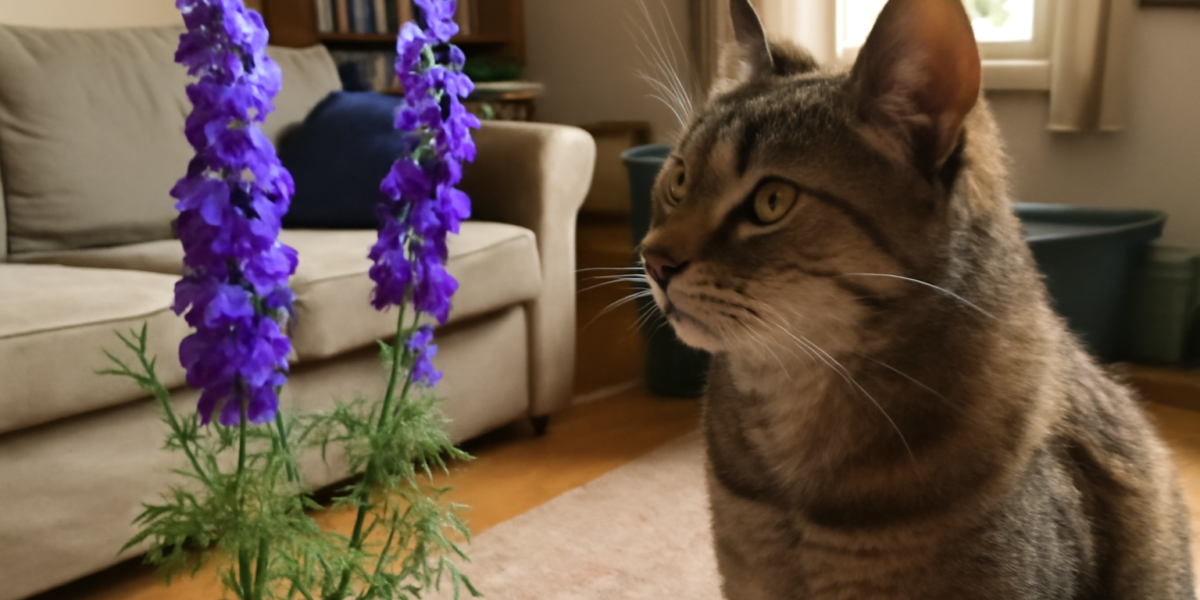
The Short Answer: Larkspur Is Severely Toxic to Cats
Larkspur is toxic to cats. Both annual larkspur (genus Consolida) and perennial larkspur (genus Delphinium) — historically lumped together and still confused at the garden center — are listed as toxic to cats and dogs by the ASPCA. The risk tier is severe: the diterpene alkaloids in this group can cause neuromuscular weakness and cardiac arrhythmia, not just simple GI upset.
In this article
- The Short Answer: Larkspur Is Severely Toxic to Cats
- Larkspur vs Delphinium: Same Family, Same Toxins
- What Makes Larkspur So Dangerous
- Symptoms in Cats: From GI to Cardiac
- What to Do If Your Cat Eats Larkspur
- Veterinary Treatment: What to Expect
- Identifying Larkspur in Your Garden
- Preventing Larkspur Exposure
- How Larkspur Compares to Other Severe Garden Toxins
- Frequently Asked Questions
If your cat has chewed any part of a larkspur plant — leaf, stem, flower, or seed — treat it as an urgent exposure. The larkspur toxic cats picture is most dangerous in the seedling and seed-pod stages, when alkaloid concentrations peak. Call your veterinarian or one of the poison control hotlines below before you do anything else, and do not wait to see whether your cat looks fine an hour later.
Larkspur vs Delphinium: Same Family, Same Toxins
Botanically, “larkspur” and “delphinium” used to be a single genus and are still cross-shelved at most nurseries. Today, perennial garden delphiniums are kept in genus Delphinium, while the annual cottage-garden plants people commonly call “larkspur” have been moved into Consolida. Both groups produce the same family of toxic diterpene alkaloids — methyllycaconitine, delphinine, and a long list of related compounds — and both should be treated identically when it comes to feline safety.
For the closely-related perennial picture, see our delphinium and cats guide; for the dog-side larkspur picture, see larkspur and dogs. The ASPCA does not draw a meaningful distinction between the genera in its toxicity listing, and neither should you in a poisoning emergency.
Common cottage-garden cultivars include ‘Imperial’ series larkspurs, the Pacific Giant delphiniums, and dwarf ‘Magic Fountains’ types. All carry the same alkaloid family. Color (the iconic blue-purple-pink-white spires) does not affect toxicity.
What Makes Larkspur So Dangerous
The active toxins are diterpenoid alkaloids — chemically distant cousins to aconitine in monkshood. Methyllycaconitine binds to nicotinic acetylcholine receptors and produces neuromuscular blockade, meaning muscles, including breathing muscles, can weaken or fail to contract properly. Delphinine and related alkaloids hit cardiac sodium channels and can cause arrhythmias, slowed heart rate, and low blood pressure.
Concentration varies by plant part and growth stage. Seedlings and seed pods are typically the most concentrated; mature stems and old flowers are lower but never zero. Drying does not detoxify the alkaloids, so cut flowers, dried arrangement material, and seed pods saved for next year all retain meaningful toxicity.
Cats are particularly vulnerable to alkaloid-class toxins because of their limited liver detoxification pathways relative to dogs and humans. A small cat ingesting even a moderate bite can show signs that would barely register in a larger animal. Don’t be reassured by “well, the dog ate one once and was fine” — cats are not small dogs.
Symptoms in Cats: From GI to Cardiac
Early signs typically appear within an hour of ingestion. Watch for drooling, lip-smacking, vomiting, diarrhea, and reduced appetite. Cats often hide and look uncomfortable, with hunched posture and reluctance to move.
As the alkaloids absorb, neuromuscular signs may follow: weakness, trembling, wobbly gait, head tremors, stiff or rigid limbs, and difficulty rising. Cardiac signs can include slow or irregular heart rate, pale or muddy gum color, and weak pulses. Breathing may become shallow or labored as respiratory muscles tire.
Severe progression looks like collapse, seizures, or unresponsiveness. This is the part of the picture that makes larkspur ingestion an emergency rather than a wait-and-see — once cardiac or respiratory signs appear, the cat needs supportive care immediately, and the difference between an ICU stay and a tragic outcome is often measured in hours.
What to Do If Your Cat Eats Larkspur
Step one: get the cat away from the plant and remove any visible plant material from the mouth without forcing the jaw. Note the time, the plant part eaten, and an estimate of the amount. A photo of the plant in the garden, with a hand or coin for scale, will help the vet enormously.
Step two: call. Your veterinarian is the right first call. If the practice is closed, call your nearest 24-hour emergency vet. You can simultaneously contact the ASPCA Animal Poison Control Center at (888) 426-4435 or the Pet Poison Helpline at (855) 764-7661; both give you a case number that the vet can use to coordinate care. Both charge a consultation fee.
Do not induce vomiting at home. Do not give milk, hydrogen peroxide, or “natural detox” preparations. Cardiac alkaloids can make home decontamination genuinely dangerous, and cats handle emetics worse than dogs. Decontamination decisions belong to the veterinary team.
Veterinary Treatment: What to Expect
At the clinic, your vet will start with cardiac monitoring (ECG if signs warrant), a focused neuro exam, and IV access. Decontamination — induced vomiting, gastric lavage under sedation, or activated charcoal — is appropriate only if the ingestion was recent, the cat is alert enough to handle it safely, and the team determines benefit outweighs risk.
Supportive care is the core of treatment: IV fluids, anti-nausea drugs, atropine or other heart-rate support if bradycardia develops, oxygen if breathing weakens, and seizure control if needed. Bloodwork to check kidney values, electrolytes, and a baseline hematology panel is standard. Severe cases may need overnight ICU monitoring with continuous ECG.
The prognosis depends almost entirely on speed of treatment and the amount eaten. Cats who arrive promptly, before significant cardiac or respiratory compromise, generally do well. Cats who arrive late or after collapse face a much harder fight. This is the single most important reason not to wait.
Identifying Larkspur in Your Garden
Larkspur produces tall, upright spires of spurred flowers, usually 1–6 feet depending on species and variety. Colors run from deep navy and royal blue through purple, pink, and white. Leaves are deeply lobed and palmate — fingered, almost like a maple leaf. The flower has a distinctive backward-pointing “spur” (the larkspur’s namesake), which distinguishes it from most other spire-flowering garden plants.
Annual larkspur (Consolida) is more widely sown from seed in cottage and cutting gardens, blooms early, and is often direct-seeded. Perennial delphinium has heavier, more architectural flower spikes and tends to be the species in formal English-garden borders. Seed pods on both are slim, upright, and split along the seam to release small dark seeds — those seeds are particularly toxic and worth raking up after deadheading.
If your cat is an outdoor or indoor-outdoor cat, walk your borders and identify any spurred-flower spires. If you have cut larkspur in vases, treat the water as toxic too — alkaloids leach into the vase water and a curious cat drinking from the vase has been exposed.
Preventing Larkspur Exposure
If you have a cat with garden access, the cleanest move is to omit larkspur and delphinium from beds the cat actually walks through. If you love the look, consider planting them in a fenced cutting garden the cat cannot reach, or use them as cut flowers stored on high surfaces away from cat traffic.
Be especially careful at seed-saving time. Dried seed pods and saved-seed envelopes left on a desk or shelf are exactly the kind of crinkly object cats love to bat around. Toxic seeds in a cat’s mouth is not a story worth living through. Store all saved seed in a closed jar or drawer.
For pet-safe substitutes that give you that same vertical, blue-purple cottage spire, look at salvia (most varieties), catmint (cats love it but it is non-toxic), and veronica. Our cat-safe flowers list goes deeper, and our pet-safe garden plants guide covers full beds. If you are still in the new-cat planning phase, the cat adoption hub covers pet-proofing alongside the rest of the prep.
How Larkspur Compares to Other Severe Garden Toxins
Larkspur sits in the same severe tier as monkshood (its close cousin in alkaloid chemistry) and is more dangerous than buttercup-family plants like anemones. The cardiac component pulls it close to foxglove and oleander in clinical severity, even though the chemistry is different. For broader context, see monkshood and cats and foxglove toxicity in cats.
The takeaway: larkspur is one of the genuinely high-stakes plants in the cottage garden, alongside foxglove, monkshood, oleander, and yew. It does not get talked about as often because it does not have the celebrity reputation, but the alkaloid load is real and a small cat can be in genuine trouble after a small meal. Treat it accordingly.
Frequently Asked Questions
Is the whole larkspur plant toxic, or just certain parts?
The entire plant is toxic — leaves, stems, flowers, seed pods, and seeds. Concentration is highest in young plants and seed pods. Drying does not reduce toxicity, so dried arrangements and saved seeds remain dangerous to cats.
My cat drank from a vase with larkspur in it — is that a real exposure?
Yes. Diterpene alkaloids leach into vase water. Treat it as a real ingestion: call your vet or poison control with the cat’s weight, time of exposure, and an estimate of how much water was drunk. Replace the water source immediately and dispose of the contaminated arrangement.
How quickly do larkspur symptoms show up?
Most cats show GI signs within 30–60 minutes. Neuromuscular and cardiac signs typically appear within 1–4 hours but can be delayed in lower-dose ingestions. Do not use “she still looks fine” at 30 minutes as reassurance — call before symptoms appear, not after.
Are ‘safe’ colors of larkspur or delphinium?
No. Flower color does not affect alkaloid content. Blue, purple, white, and pink larkspurs are all equally toxic to cats, as are dwarf and tall varieties.
What flowers can I plant instead of larkspur?
Salvia (most species), catmint (Nepeta), veronica, agastache, snapdragon, and cosmos all give a similar vertical garden look without the larkspur alkaloid load. Our cat-safe flowers list covers more options, and pairs well with non-toxic foliage from our cat-safe houseplants guide.


