
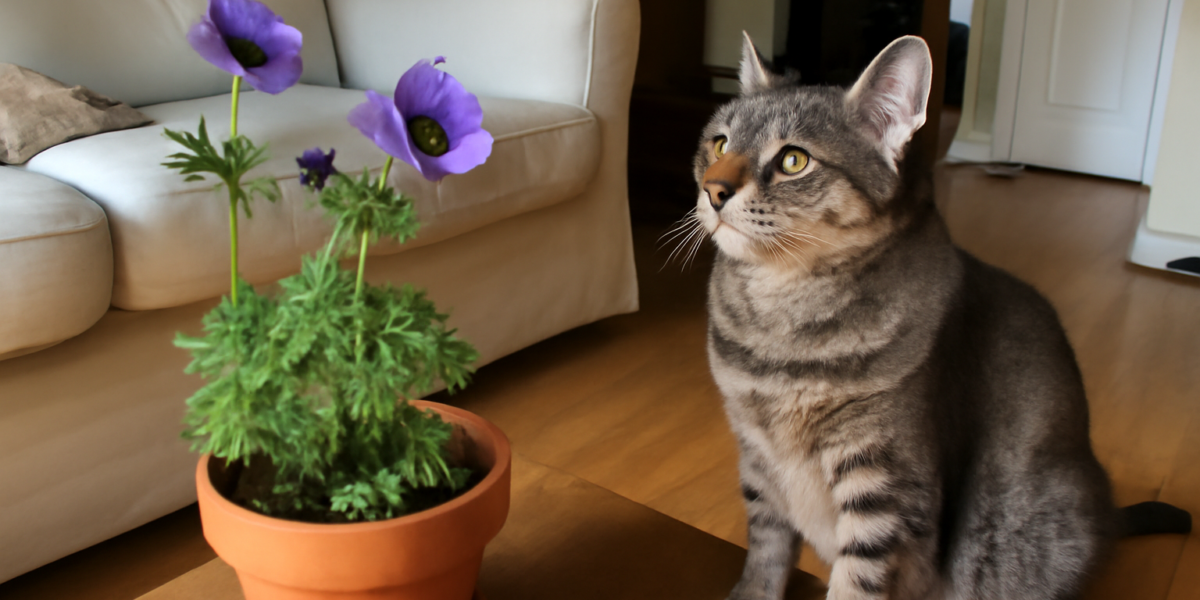
Are Anemones Really Toxic to Cats?
Yes — anemones (genus Anemone, family Ranunculaceae) are listed as toxic to cats by the ASPCA Animal Poison Control Center. The toxic principle is protoanemonin, a chemical released from a precursor called ranunculin when the leaves, stems, or flowers are crushed, chewed, or wilted. Most cats who graze on a windflower in the garden experience oral irritation, drooling, and gastrointestinal upset — a mild-to-moderate toxicity tier. Larger or repeated ingestions can produce more pronounced vomiting, diarrhea, and rarely neurological signs.
In this article
- Are Anemones Really Toxic to Cats?
- Why Anemones Are Considered a Buttercup-Family Hazard
- Which Anemones Are We Talking About?
- Symptoms of Anemone Poisoning in Cats
- Cats Versus Dogs: Why Cats Often Look Worse Sooner
- What to Do in the First Hour
- What Veterinary Treatment Looks Like
- Preventing Anemone Exposure at Home and in the Garden
- Other Ranunculaceae Plants Cat Owners Should Know
- Living Safely With a Curious Cat
- Frequently Asked Questions
If your cat has just chewed on an anemone of any species — the bright spring florist anemone (A. coronaria), the late-summer Japanese anemone (A. hupehensis or A. × hybrida), or the woodland wood anemone (A. nemorosa) — call your veterinarian or the ASPCA Animal Poison Control Center at 888-426-4435 for guidance. Do not induce vomiting at home unless a clinician specifically tells you to. The good news is that uncomplicated cases usually resolve with supportive care once the cat is rinsed, hydrated, and observed.
Why Anemones Are Considered a Buttercup-Family Hazard
Anemones share their family — Ranunculaceae — with buttercups, larkspur, columbine, monkshood, hellebore, clematis, and delphinium. Most members of this family carry some version of the same blistering chemistry, although the specific compound and concentration vary widely. Buttercups and anemones are the family’s most famous protoanemonin producers, and several Anemone species are reported to contain it at higher concentrations than the common meadow buttercup. That is why anemone leaves and sap can feel surprisingly burning to human skin and why a curious cat may foam at the mouth almost immediately.
Ranunculin itself is not toxic. The trouble starts when a cell wall is damaged — a paw stepping on a leaf, a tooth biting a stem, a wilted floral arrangement sitting on the kitchen counter. An enzyme called beta-glucosidase converts ranunculin to protoanemonin, which is the unstable, blistering compound that contacts your cat’s mouth, esophagus, and stomach. Once protoanemonin polymerizes into a stable inert dimer called anemonin, the danger fades — which is why dried, hayed, or fully cured anemone material is generally less risky than fresh.
Which Anemones Are We Talking About?
“Anemone” is a sprawling genus with roughly 200 species, and many show up in pet households without owners realizing they are all the same plant. The varieties most likely to bring a cat into contact with protoanemonin are listed below.
- Florist anemone (Anemone coronaria): the dramatic red, purple, blue, or white spring cut flower with a black eye. Sold in supermarket bouquets and grown from corms in mild gardens.
- Japanese anemone (Anemone hupehensis, A. × hybrida): a tall pink or white late-summer perennial popular in cottage borders.
- Wood anemone (Anemone nemorosa): a delicate white woodland flower native to Europe; common in UK ancient woodland and shade gardens.
- Snowdrop anemone (Anemone sylvestris) and A. blanda: low-growing species often planted under spring bulbs.
All of the above share the protoanemonin pathway. The ASPCA toxic listing for “Anemone” applies to the genus broadly. Note that “sea anemone” is a marine animal and unrelated; that confusion sometimes appears in search results but has nothing to do with garden plant toxicity.
Symptoms of Anemone Poisoning in Cats
The first signs usually appear within minutes to a couple of hours of chewing. They reflect direct chemical irritation of the lips, tongue, and stomach lining — protoanemonin is a contact irritant before it is anything else.
- Heavy drooling, foaming, or pawing at the mouth
- Reluctance to eat, dropping food, or hiding the face
- Vomiting, sometimes with traces of plant material or fresh blood
- Diarrhea, occasionally bloody, beginning a few hours after ingestion
- Reddened gums or visible blisters on the tongue or palate
- Lethargy, hunched posture, mild tremors in larger ingestions
Severe outcomes — collapse, prolonged seizures, or kidney injury — are uncommon with garden anemones in cats, but they cannot be ruled out if a cat consumed a substantial amount of fresh material or a chewed-on bulb-like tuber. Severity depends on the species, the part eaten (leaves and roots tend to carry more ranunculin than petals), how thoroughly the cat chewed, and the cat’s body size. Kittens and small adults are at higher risk for the same dose.
Cats Versus Dogs: Why Cats Often Look Worse Sooner
Both cats and dogs can be poisoned by anemones, but cats often show oral signs more dramatically. Cats are fastidious groomers — sap that lands on the coat is licked off rather than wiped away, so a single contact event can become repeated oral exposure. Cats also have a smaller body mass, less efficient hepatic glucuronidation for many plant secondary metabolites, and a tendency to chew rather than gulp, which gives the protoanemonin more time to blister oral tissue.
If you have both species in the household and only one was caught with the plant, examine the other carefully too. Cats can chew an anemone leaf privately and tell you about it only with quiet drooling under the bed. For the dog-side picture, see our guide to anemones and dogs.
What to Do in the First Hour
Speed matters less than method. The single most useful thing you can do for a cat that has chewed an anemone is to rinse the mouth and call a professional. Here is the order we suggest.
- Move the cat away from the plant. Take the bouquet out of the room or shut the door to the garden. Pick up any chewed petals or leaves so the cat cannot return to them.
- Rinse the mouth gently. Wipe the gums and tongue with a damp soft cloth, or offer fresh water. Do not force water in with a syringe — aspirated water can cause its own problem.
- Identify what was eaten. Take a clear photo of the plant including the flower, leaves, and any label. Note roughly how much is missing.
- Call your veterinarian, the ASPCA APCC (888-426-4435), or the Pet Poison Helpline (855-764-7661). Both poison control lines charge a consultation fee. They can advise whether your cat needs to be seen.
- Do not induce vomiting at home. Hydrogen peroxide is dangerous for cats and the protoanemonin is already irritating the esophagus — a second pass may worsen the damage.
Most uncomplicated cases are managed at home with monitoring and a soft, bland diet for a day or two. Veterinary visits are warranted if the cat ate a large amount, ate the root or tuber, is showing more than mild signs, or is very young, very old, or has pre-existing kidney or liver disease.
What Veterinary Treatment Looks Like
There is no specific antidote for protoanemonin. Treatment is supportive and aimed at protecting the gut, restoring fluid balance, and easing pain. Depending on what the clinician finds, your cat may receive:
- An oral exam under sedation if there are visible blisters or your cat will not let the vet open the mouth
- Anti-nausea medication (maropitant or ondansetron) to stop vomiting
- Subcutaneous or intravenous fluids to correct dehydration from drooling and vomiting
- Gastric protectants such as sucralfate to coat irritated mucous membranes
- A short course of analgesia if oral lesions are painful
- Activated charcoal in selected cases — only useful very early and only if the airway is protected
Most cats are discharged within 24 hours and recover fully within several days. Persistent inappetence beyond 48 hours is a reason to return to the clinic, since cats can develop hepatic lipidosis when they stop eating for longer than that.
Preventing Anemone Exposure at Home and in the Garden
Cats who roam an outdoor garden will, at some point, chew a leaf out of curiosity. The strategies below cut the risk to near zero without requiring you to dig out every Ranunculaceae plant.
- Keep cut anemones out of cat-accessible spaces. Bouquets belong on a high mantel or in a closed room. Florist mixes labelled “spring bouquet” or “Mediterranean mix” frequently contain A. coronaria.
- Choose pet-safer borders for the cat’s main hangout zones. Plant anemones in raised beds the cat does not patrol or behind low fencing. Our pet-safe garden plants guide lists alternatives that fit the same season and color palette.
- Discard wilted blooms immediately. Wilted Ranunculaceae material can still release protoanemonin and cats often find dropped petals more intriguing than fresh ones.
- Wear gloves when handling cut anemones. The same sap that blisters cat lips can cause contact dermatitis on your hands; do not transfer it to a cat by petting them with sappy fingers.
- Provide cat grass or catnip. A pot of safe greens nearby gives an indoor cat something legal to nibble.
Other Ranunculaceae Plants Cat Owners Should Know
If you found anemones in your garden, you probably have neighbours from the same plant family. The chemistry is similar but each plant earns its own warning level. Use these companion guides as you audit your beds.
- Buttercups and cats — same protoanemonin family, often in lawn grass.
- Larkspur and cats — diterpene alkaloids, severe in livestock.
- Delphinium and cats — close cousin to larkspur with the same alkaloid concern.
- Monkshood and cats — aconitine, the most dangerous plant in the family.
- Hellebore and cats — cardiac glycoside-like helleborin in the Christmas rose.
If your household is small and you adore Ranunculaceae plants, consider clematis, which is also in the family and milder, or move your most eye-catching anemones into the cutting garden you do not let cats into.
Living Safely With a Curious Cat
Pets and plants can coexist; it just takes a little auditing once a season. Walk your home and garden with the ASPCA toxic plant list open on your phone. Take photos of anything you cannot identify and send them to your vet or local plant-ID service. If you are still building your household and are choosing between adding plants or a feline companion, our adopt a cat hub can help match you with a cat whose temperament fits the indoor-outdoor lifestyle you can offer. Many shelters keep notes on which adoptees are inveterate plant chewers — useful information when you have a Japanese anemone you are not willing to part with.
The basic rule we keep repeating to adopters: if a flower came home in a supermarket bouquet, assume it is unsafe until you have identified every stem. The five seconds it takes to check beats the 24 hours of vet care it could prevent.
Frequently Asked Questions
Is the florist anemone the same as the windflower in my garden?
Both names refer to plants in the genus Anemone. “Windflower” is a common name applied to several species including the woodland A. nemorosa and the spring A. blanda. Florist anemones are usually A. coronaria. All carry protoanemonin and all should be considered toxic to cats.
My cat licked an anemone leaf and seems fine. Should I still call the vet?
If your cat is bright, eating, and showing no drooling, a phone consult with the vet or poison control is enough. Watch for delayed vomiting or diarrhea over the next 12 hours. If signs appear, escalate to an in-person visit.
Are dried anemones in a craft arrangement still toxic?
Protoanemonin breaks down in dried plant material over time, but freshly dried specimens may still cause mild oral irritation. Treat any cat-chewed dried bouquet as suspicious and call your vet for advice.
Are sea anemones related to the garden plant?
No. Sea anemones are stinging marine animals (cnidarians). They share only the name. Garden anemones are flowering plants in the buttercup family.
What can I plant instead of anemones if I have an outdoor cat?
Roses, snapdragons, petunias, sunflowers, and zinnias all give comparable spring-summer color and are listed as non-toxic by ASPCA. See our cat-safe flowers roundup for a full planting plan.


