
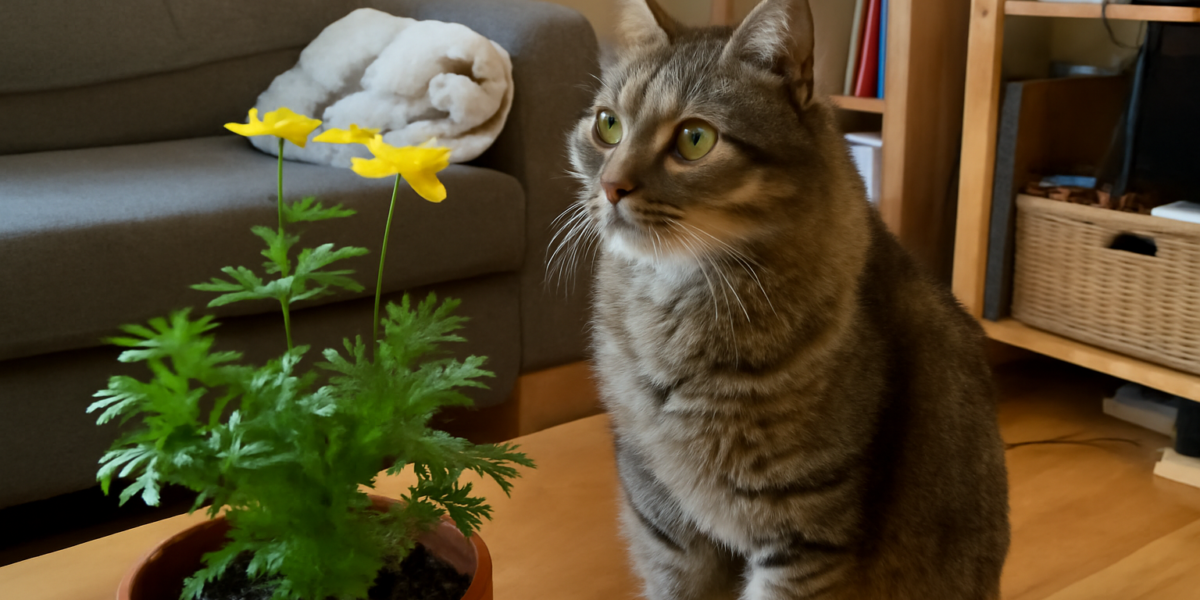
The Short Answer: Buttercups Are Toxic to Cats
Yes, buttercups are toxic to cats. The genus Ranunculus — which includes the common cheerful yellow-flowered buttercup of pastures and lawns, the cultivated florist’s ranunculus with its tightly layered petals, and the creeping buttercup of damp meadows — contains a chemical irritant called protoanemonin in the fresh leaves and stems. When a cat chews on a buttercup, this compound triggers oral irritation, drooling, vomiting, and sometimes mild contact dermatitis where the sap touches the skin. Severity is mild to moderate; severe systemic poisoning is uncommon at typical exposure levels but can occur with large ingestions.
In this article
- The Short Answer: Buttercups Are Toxic to Cats
- The Ranunculus Genus and What “Buttercup” Refers To
- The Toxic Compound: Protoanemonin
- Symptoms of Buttercup Exposure in Cats
- What to Do If Your Cat Ate or Contacted Buttercups
- How Veterinarians Treat Buttercup Ingestion
- Cat Encounter Patterns: Garden vs Bouquet
- Cats vs Dogs: Comparing Buttercup Exposure
- Differentiating Buttercups from Look-Alike Plants
- Other Ranunculaceae Plants Worth Knowing About
- Removing Buttercups from a Cat-Friendly Yard
- For Cut-Flower Households
- Adopting a Cat Into a Garden-Lover’s Home
- Frequently Asked Questions
If your cat nibbled a buttercup flower or grazed on leaves in the yard, this is a “call your vet for guidance” situation rather than a 911 emergency. Buttercups toxic cats searches usually come from owners who saw their indoor-outdoor cat trotting back across a buttercup-rich lawn or noticed chewed yellow petals on the patio. Most cats stop after one bitter mouthful and recover within 24 hours with conservative care. The rest of this guide walks through what to watch for, when to escalate, and how the cat-side picture compares to the dog-side. For the dog perspective, see our companion piece on buttercups and dogs.
The Ranunculus Genus and What “Buttercup” Refers To
The genus Ranunculus contains over 600 species worldwide. Common members that cat owners may encounter include:
- Common / meadow buttercup (Ranunculus acris) — the iconic yellow-flowered weed of pastures and damp meadows.
- Creeping buttercup (Ranunculus repens) — low-growing, runners spread aggressively, common lawn weed.
- Bulbous buttercup (Ranunculus bulbosus) — similar yellow flowers, bulb-like base.
- Persian buttercup (Ranunculus asiaticus) — the cultivated florist flower with tightly layered petals in cream, pink, red, orange, and yellow; common in spring bouquets.
- Lesser celandine (Ficaria verna, formerly Ranunculus ficaria) — early-spring yellow flowers in damp shade; recently moved to a separate genus but shares the protoanemonin chemistry.
All commonly encountered Ranunculus species and the closely related Ficaria are considered toxic to cats with similar mild-to-moderate severity. Cultivated florist’s ranunculus and field buttercups have similar chemistry; severity does not depend strongly on whether the plant came from a flower shop or a meadow.
The Toxic Compound: Protoanemonin
The toxic principle in buttercups is protoanemonin, an unstable lactone compound formed when the plant’s tissues are damaged. The intact plant contains a precursor called ranunculin, which is harmless on its own; when leaves or stems are crushed, chewed, or otherwise injured, an enzyme converts ranunculin into protoanemonin. This is why fresh, crushed buttercup material is irritating but dried hay containing buttercup is much less so — protoanemonin is unstable and degrades quickly into the inactive compound anemonin during drying.
Protoanemonin is a direct chemical irritant. It blisters mucous membranes on contact, causes burning sensation in the mouth and throat, triggers vomiting and salivation as protective responses, and can produce contact dermatitis on skin. Larger absorbed doses can cause GI bleeding, abdominal pain, and in severe cases nervous system effects (tremors, weakness). The same compound is responsible for the toxicity of anemones and pasque flowers, which are in the same family (Ranunculaceae) — see our piece on anemone and cats for the related plant.
The bitter taste and burning sensation usually self-limit ingestion. Most cats stop after one bite, which is why severe buttercup poisoning in cats is uncommon. Severe outcomes happen when a cat ingests a large amount before the irritation registers — for instance, if she bats and chews multiple stems of cut florist ranunculus while playing.
Symptoms of Buttercup Exposure in Cats
Symptoms typically develop within minutes to a couple of hours of ingestion. The most common signs include:
- Drooling, lip-licking, or pawing at the mouth (oral irritation from protoanemonin).
- One or two episodes of vomiting, often with visible plant fragments.
- Loose stool or mild diarrhea over the next 12 to 24 hours.
- Reduced appetite for one or two meals.
- Mild lethargy.
- Occasional mild dermatitis on muzzle, paw pads, or chin where sap touched skin.
- Bloody saliva or vomit in larger ingestions, reflecting GI mucosal injury.
The more concerning escalation pattern (uncommon but possible with larger ingestions) includes:
- Persistent or forceful vomiting that does not stop.
- Bloody diarrhea.
- Significant lethargy or weakness.
- Tremors or twitching.
- Abdominal pain (hunched posture, restless behavior).
- Difficulty walking or apparent disorientation.
If escalation symptoms develop, treat as an emergency and head to the clinic immediately.
What to Do If Your Cat Ate or Contacted Buttercups
Stay calm and walk through a sensible response. Move your cat to a separate room from the plant. Wipe any visible plant juice or pollen off her muzzle, paws, and fur with a damp cloth. Offer fresh water. Watch for symptoms over the next 6 to 12 hours.
Call your veterinarian and describe what happened — species (a photo helps), approximate amount eaten, time of ingestion, and any symptoms you have seen. For most buttercup exposures the vet will recommend home monitoring with a follow-up if symptoms worsen, or an in-clinic visit for fluids and an anti-nausea injection if your cat has vomited multiple times or seems uncomfortable.
If your regular vet is closed, the ASPCA Animal Poison Control Center at (888) 426-4435 and the Pet Poison Helpline at (855) 764-7661 are staffed by veterinary toxicologists 24 hours a day. Both charge consultation fees and provide a case number that streamlines vet-side care.
Do not induce vomiting at home. Hydrogen peroxide is unsafe in cats anyway, and bringing irritant plant material back up the esophagus risks additional injury. Decontamination decisions belong to the vet.
If sap got in your cat’s eye (more common with cut florist ranunculus that was knocked over), flush gently with sterile saline or lukewarm water for at least 10 minutes and call the vet — eye exposure to protoanemonin can cause significant conjunctivitis and warrants prompt evaluation.
How Veterinarians Treat Buttercup Ingestion
Treatment is supportive and conservative for typical cases. The clinic will examine the cat, look for any plant residue around the mouth, palpate the abdomen for tenderness, and assess hydration. Cats showing only mild symptoms often need observation and a take-home plan.
For cats with more significant symptoms, treatment may include:
- Subcutaneous or intravenous fluids for hydration support.
- Anti-nausea injection (maropitant or ondansetron is typical).
- Sucralfate slurry to coat irritated stomach lining.
- Pain control if abdominal discomfort is significant.
- Bland diet plan for 24 to 72 hours.
- For cats with eye exposure: ophthalmic exam, possibly fluorescein staining for corneal injury, topical antibiotic drops.
Activated charcoal is sometimes used for very recent large ingestions. Most cats are fully recovered within one to three days of conservative care. There is no antidote for protoanemonin specifically because the toxicity is direct chemical irritation rather than a circulating molecule that needs binding.
Cat Encounter Patterns: Garden vs Bouquet
Cats encounter buttercups in two main settings, and the typical exposure pattern differs:
Outdoor garden / pasture exposure — indoor-outdoor cats who roam yards or pastures may graze on buttercup leaves while exploring. Most do not eat much because the bitter taste discourages further ingestion. Pasture cats encountering large buttercup-dense areas are more at risk than urban cats with manicured lawns.
Cut-flower / florist’s ranunculus exposure — cultivated Ranunculus asiaticus appears in many spring bouquets, often labeled simply “ranunculus” or “Persian buttercup.” Cats batting at flowers, chewing stems, or drinking vase water containing dissolved sap can develop the same protoanemonin-driven symptoms. The cut-flower exposure is more concerning in some ways because the sap is fresher and the cat’s interaction is sustained (cats often play with cut flowers over many minutes).
For households with cats and cut flowers, place ranunculus arrangements in rooms the cat does not access, ideally with closed doors. Pick up dropped petals — a fallen petal on the rug looks like a cat toy.
Cats vs Dogs: Comparing Buttercup Exposure
Both species can develop the protoanemonin-driven syndrome. Dogs are more likely to ingest large amounts in single events because of less discriminating eating, so dog cases more often involve significant GI symptoms. Cats more often present with small-volume but multi-site exposure because of grooming behavior — sap on a paw becomes sap on the tongue and lips a minute later, sometimes the eye after a face-wash. Pasture exposure is more documented in livestock (horses and cattle) than in either pet species; for grazing animals, large quantities are possible. Household cat exposures are typically much smaller.
Cats also have specific vulnerability factors worth noting. Their grooming behavior multiplies single contact points. Their smaller body size means dehydration from vomiting comes on faster. Their reduced hepatic glucuronyl transferase capacity affects detoxification of some plant compounds (though for protoanemonin specifically, the local irritant action is the main concern, not systemic metabolism).
Differentiating Buttercups from Look-Alike Plants
Several common garden plants share the cheerful yellow-flower aesthetic of buttercups. A few worth knowing:
- Buttercup (Ranunculus) — five-petaled glossy yellow flowers, deeply lobed leaves, smooth or slightly hairy stems.
- Dandelion (Taraxacum officinale) — yellow composite flowers (many small florets clustered together rather than five distinct petals); generally non-toxic to cats.
- Yellow wood sorrel (Oxalis stricta) — yellow flowers with shamrock-like leaves; mildly toxic from oxalic acid (different mechanism from buttercup).
- Marsh marigold (Caltha palustris) — looks similar to large buttercup, also in Ranunculaceae, also contains protoanemonin; same toxicity profile as buttercup.
- Yellow primrose (Primula) — different family entirely (Primulaceae), generally low-toxicity.
If you cannot identify what your cat ate, save a sample or photo for the vet. The five glossy petals of buttercup are distinctive enough that ID is usually straightforward in fresh material.
Other Ranunculaceae Plants Worth Knowing About
Buttercups belong to the Ranunculaceae (buttercup family), which contains several other plants with the same protoanemonin chemistry or related toxic principles. If your cat is a known plant-grazer, the broader family is worth being aware of:
- Anemone — same protoanemonin mechanism, sometimes more concentrated.
- Larkspur — diterpene alkaloids, more severe; in this family.
- Delphinium — same alkaloid chemistry as larkspur, also severe.
- Monkshood (Aconitum) — extremely severe, cardiotoxic alkaloids.
- Columbine — similar protoanemonin-related compounds, generally milder.
- Hellebore — saponins and cardiac glycoside-like compounds, more severe.
The Ranunculaceae as a family covers a wide range from “mild” (buttercup, columbine) to “severely toxic” (monkshood, larkspur). Buttercup sits on the milder end.
Removing Buttercups from a Cat-Friendly Yard
Buttercups are persistent garden weeds — they spread by runners (creeping buttercup) or by seed (most species), and they thrive in damp, undermaintained lawns. For households where the cat grazes the yard, a few practical strategies help:
- Hand-pull when in flower — easier to spot and easier to pull when the yellow flowers give them away.
- Improve lawn drainage — buttercups thrive in damp compacted soil. Better drainage and aeration reduce their advantage.
- Mow regularly — preventing seed-set reduces next year’s population.
- Selective herbicide — broadleaf-selective lawn weedkillers work, but treat the cat as having no yard access for the reentry interval listed on the label (usually 24 to 48 hours after spray dries) plus a generous safety margin.
- Replace with cat-safe groundcover in problem areas — see our roundup of pet-safe garden plants for swap options.
For indoor-outdoor cats who roam beyond your yard, buttercups in neighboring fields and pastures are harder to manage. Most cats self-limit grazing on buttercups because of the bitter taste, so widespread environmental exposure is rarely the problem — the problem is usually a single curious cat sampling a single bouquet or patch of fresh growth.
For Cut-Flower Households
If you love spring ranunculus arrangements, you can still have them in a cat household with a few adjustments. Place arrangements in rooms with a closeable door — guest bedrooms, home offices, formal dining rooms. Keep arrangements out of reach on stable counter-height surfaces where a cat would have to actively jump up; many cats do not bother if the surface is unrewarding. Pick up dropped petals or stem fragments promptly; fallen petals are the most common cause of indoor cat exposure.
For known plant-batters, skip ranunculus arrangements in favor of confirmed cat-safe cut flowers. Roses (with thorns trimmed), gerbera daisies, snapdragons, sunflowers, freesias, and orchids are commonly recommended cat-safe choices. Our roundup of cat-safe flowers walks through swap options that are both visually similar and confirmed safer.
Adopting a Cat Into a Garden-Lover’s Home
Bringing a new cat into a household with active gardens or fresh-flower habits is a great moment for a plant audit. Walk Me Home Rescue’s cat adoption hub can help you find your next family member, and a quick before-and-after sweep of the garden and indoor flower habits is one of the highest-value preparations you can do. Buttercups do not need to disappear — most cats coexist with garden borders fine — but knowing the symptoms to watch for and having the vet’s number handy makes any future incident a manageable phone call rather than a panic.
Frequently Asked Questions
Are dried buttercups in hay still toxic to cats?
Mostly no. Protoanemonin is unstable and degrades into the inactive compound anemonin during drying. This is why livestock generally tolerate buttercup-containing hay even though they avoid eating fresh buttercups in the pasture. Cats encountering dried buttercups (in pet bedding made from pasture hay, for instance) face much lower risk than cats encountering fresh plants.
What if my cat just batted at a buttercup but did not eat any?
Sap can transfer to paws and fur from physical contact. Wipe her paws and any obvious spots with a damp cloth, watch for symptoms over a few hours, and call the vet only if anything develops. Pure batting without ingestion rarely causes symptoms, but cats are groomers and a dab of sap on a paw becomes a dab on the tongue.
Can buttercup sap really cause skin rash in cats?
Yes. Mild contact dermatitis from protoanemonin is documented and shows as red, slightly inflamed patches where the sap touched skin. Most cases resolve on their own within a day or two. Severe blistering is uncommon in pet exposures but is documented in human contact-dermatitis literature.
How much buttercup is too much for a cat?
The exact toxic dose is not well characterized for cats. The bitter taste self-limits most cats to small amounts. Severe poisoning is uncommon at typical exposure levels but can occur with large ingestions. There is no documented “safe amount” for buttercup in cats — any confirmed ingestion warrants at least a phone call to the vet.
My cat ate florist’s ranunculus and seems fine. Should I still call the vet?
Yes, a quick call is worth it. Even if symptoms have not appeared, documenting the exposure with your vet gives you a reference point if anything develops over the next 24 hours. Many vets are happy to advise by phone for mild plant exposures and may recommend home monitoring or a quick visit depending on the amount eaten and your cat’s general health.


