
Last updated: May 16, 2026
In this article
- The Short Answer on Norfolk Pine and Cats
- What Norfolk Pine Actually Is
- Why Norfolk Pine Is Considered Mildly Toxic
- Symptoms to Watch For
- What to Do If Your Cat Chewed Norfolk Pine
- What the Vet Will Likely Do
- Norfolk Pine vs True Pine: The Key Distinction
- Holiday Season Hazards Beyond the Tree
- Cat-Safer Holiday Plant Alternatives
- Living Long-Term With a Norfolk Pine and a Cat
- When to Skip the Wait-and-See
- The Bigger Picture for Cat Households
- Frequently Asked Questions
The Short Answer on Norfolk Pine and Cats
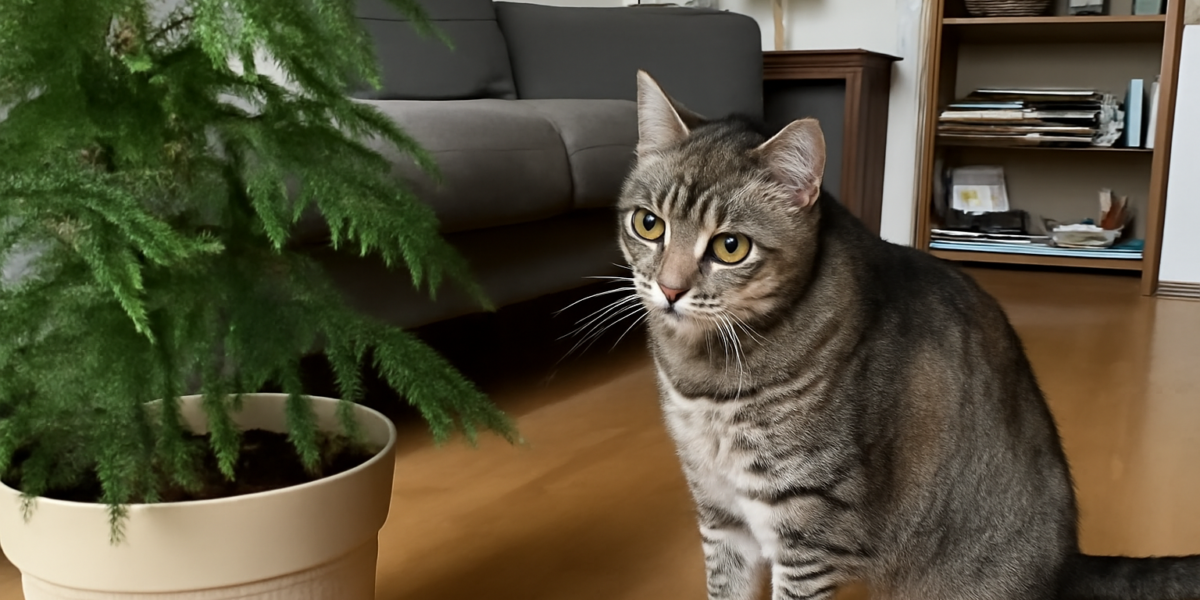
Norfolk pine is mildly toxic to cats. The ASPCA lists Araucaria heterophylla, the species most homes know simply as Norfolk pine or Norfolk Island pine, on its toxic-to-cats register, but the toxicity is on the gentle end of the scale. Most exposures cause mild stomach upset and possibly some depression of energy, with no organ damage and no risk of life-threatening complications. The mechanical hazard from the spiky needles is sometimes a bigger problem than the chemistry itself.
If your cat just chewed a Norfolk pine branch and is vomiting, drooling, or seems quieter than usual, that is the textbook reaction. Move the plant out of reach, offer fresh water, and call your veterinarian or the ASPCA Animal Poison Control Center at 888-426-4435. The Pet Poison Helpline at 855-764-7661 is the second hotline. Most cases resolve within a day with simple supportive care, but a phone call to a professional is the right first move because the constellation of symptoms can sometimes mask a more dangerous exposure.
What Norfolk Pine Actually Is
Araucaria heterophylla is a conifer native to Norfolk Island, a small Australian territory in the South Pacific. Despite the name, it is not a true pine. True pines belong to the genus Pinus in the family Pinaceae, and they look related to Norfolk pine only at a casual glance. Araucaria belongs to a separate, ancient family (Araucariaceae) whose lineage goes back to the dinosaur era. The needles, branch arrangement, and resin chemistry differ from true pine in subtle but real ways.
You will most often meet Norfolk pine as a small Christmas-tree substitute sold in nurseries from October through December. They tolerate indoor light reasonably well, hold their shape for years, and look like a perfect tabletop tree. People then keep them after the holidays as houseplants, sometimes for decades, occasionally reaching ceiling height in a sunny corner. Cats find them because the layered branches are at face level and the needles are deeply chewable.
Why Norfolk Pine Is Considered Mildly Toxic
The toxic principle in Araucaria heterophylla has not been fully characterized, but the resin and sap contain irritant compounds that cause stomach upset when eaten and mild contact dermatitis on sensitive skin. The reactions you see in cats include vomiting, depression of mood and energy, and sometimes diarrhea. The plant does not contain a documented systemic toxin that damages the kidneys, liver, or heart.
That puts Norfolk pine in roughly the same league as rubber plants or other mildly toxic indoor decorative plants. The ASPCA lists it as toxic to cats, dogs, and horses, but flags the severity as mild. There is a meaningful difference between a plant that warrants a phone call to your vet and a plant that warrants an emergency drive at 2 a.m. Norfolk pine is firmly in the first category for the vast majority of exposures.
The other half of the hazard is mechanical. Norfolk pine needles are stiff, sharp, and slightly resinous. A cat who chews and swallows a mouthful of needles can develop irritation along the tongue, gums, and throat from the physical poking, separate from any chemical effect. Smaller cats and kittens with narrower throats are at proportionally higher risk of this mechanical irritation.
Symptoms to Watch For
The signs of Norfolk pine ingestion in a cat usually appear within thirty minutes to a few hours after the bite.
- Vomiting, sometimes with chewed needle fragments
- Drooling or lip-smacking from oral irritation
- Quiet behavior, hiding, or what owners describe as depression
- Reluctance to eat the next meal
- Loose stool or mild diarrhea over the following day
- Pawing at the mouth if a needle is stuck between teeth
- Mild skin redness on the muzzle or around the eyes if sap touched the face
Severe reactions are rare. If you see persistent vomiting that does not stop within a few hours, lethargy that crosses into weakness, or any difficulty breathing, treat the situation as more serious and head to the vet. Those symptoms suggest either a much larger ingestion than typical or that the cat ate something else along with the Norfolk pine that you have not yet identified.
What to Do If Your Cat Chewed Norfolk Pine
Take these steps in this order.
- Move the plant out of reach so the cat cannot continue snacking while you are trying to assess the situation.
- Check the cat’s mouth gently for stuck needle fragments. A soft cloth and good light is enough; do not poke deep.
- Offer fresh water and a small amount of bland food (a teaspoon of plain canned chicken without seasoning is fine for most cats).
- Call your veterinarian or the ASPCA Animal Poison Control Center at 888-426-4435 (consultation fee applies). Pet Poison Helpline at 855-764-7661 is the alternative hotline.
- Watch the cat for the next twelve to twenty-four hours. If vomiting or lethargy progresses rather than improves, the cat needs an in-person vet exam.
Do not induce vomiting at home. Hydrogen peroxide is unsafe for cats and inducing vomiting is the wrong call here anyway because a needle that comes back up can lodge in the esophagus on the return trip. Decontamination decisions belong to your veterinarian.
What the Vet Will Likely Do
Most Norfolk pine cases need nothing more than supportive care. The vet will examine the mouth, listen to the abdomen, check hydration, and assess the cat’s general comfort. Treatment can include anti-nausea medication, fluids under the skin if vomiting was significant, and a recommendation for a soft, bland diet for two or three days. Bloodwork is rarely needed because the toxin does not damage organs.
If the vet finds a needle wedged in the gum or between teeth, removing it under sedation is the standard fix. The vast majority of cats are back to themselves within twenty-four hours of the exam, and the cost is generally limited to the office visit plus a couple of medications.
Norfolk Pine vs True Pine: The Key Distinction
The names are almost identical and the look is similar at a glance, but Norfolk pine and true pine have meaningfully different toxicity profiles for cats. True pines (Pinus species) contain different aromatic resins and essential oils that can cause more dramatic reactions, particularly in cats who lack key liver enzymes for metabolizing certain plant chemicals. Most veterinary toxicology resources lump pine needle exposures with cats into a separate category from Norfolk pine.
If you are unsure which one you have, look at the branches. True pine has needles in clusters of two, three, or five emerging from a single point, called a fascicle. Norfolk pine has individual short needles arranged in two ranks along the twig, giving each branch a flat, scaled appearance like a green feather. If you bought the plant from a nursery as an indoor Christmas plant, it is almost certainly Norfolk pine. Outdoor cut Christmas trees and outdoor pine wreaths are usually true pine.
Holiday Season Hazards Beyond the Tree
Norfolk pine is one of the milder hazards of the December houseplant season. The bigger Christmas-time worries for cats are the lights and ornaments, the chocolate and fruitcake on the table, the lily bouquets in vases (true lilies are catastrophically toxic to cats), the holiday baking with grapes and raisins, and the antifreeze that ends up on garage floors during the cold months. Each one of those deserves more vigilance than the Norfolk pine on the side table.
That said, every household plant is worth knowing. If you set up a Norfolk pine for the holidays and you have a cat, place it in a room you can close, use a heavy base so a tail-strike does not topple it, and stop the cat from drinking the water in the saucer (treated tree-water can include preservatives). A few small changes turn a December surprise into a non-event.
Cat-Safer Holiday Plant Alternatives
If you want a plant that gives the same evergreen, conifer-adjacent look without any toxicity worry, several options exist. The classic Boston fern is non-toxic to cats and offers a soft, layered green. Areca palms are tall, feathery, and ASPCA non-toxic, making them a good Norfolk pine substitute in a corner with reasonable light. Air plants are non-toxic, miniature, and can be displayed on a shelf or in a hanging glass globe out of reach.
For Christmas-specific decor, look at non-toxic flower options like roses, alstroemeria (Peruvian lily, despite the misleading common name, is not a true lily), or our suggestions in the broader cat-safe houseplants guide. The roundup of cat-safe flowers is also worth bookmarking before the holidays.
Living Long-Term With a Norfolk Pine and a Cat
Plenty of households keep a Norfolk pine for years without trouble. The trick is height and accessibility. Once the plant clears about six feet of trunk, the lower branches typically thin out and the leafy crown moves above the cat’s reach. Until then, position the plant in a corner the cat does not patrol, use a tall sturdy pot that the cat cannot tip, and keep the soil covered with rocks to discourage digging.
If your cat is a confirmed plant-chewer, the Norfolk pine should probably go to a friend without cats or move into a room the cat cannot enter. Persistent plant-chewing in cats is often a sign of boredom, dietary deficiency, or stress. Talking with your vet about a gentle fiber-rich snack rotation, more interactive play, and a cat grass tray often resolves the underlying drive.
When to Skip the Wait-and-See
Most Norfolk pine exposures resolve on their own with minor support. Take your cat to a vet right now, not in the morning, if any of the following appear: persistent vomiting that does not stop within four hours, weakness or collapse, difficulty breathing, blood in vomit or stool, or a cat who is hiding and not responding to gentle calling. Those signs are unusual but indicate either a much larger ingestion or a different exposure altogether.
Kittens, senior cats, and cats with chronic conditions like chronic kidney disease deserve a lower threshold for evaluation. Their reserves are smaller and the dehydration that follows even a mild bout of vomiting hits them harder. A telephone consultation costs nothing and can settle whether to bring the cat in.
The Bigger Picture for Cat Households
Plant safety is a layered problem rather than a single decision. Knowing which plants are toxic, where they live in your home, and what to do if a cat samples one is the foundation. Norfolk pine sits comfortably in the mild category and rarely causes serious harm, but it earns a place on the watch list because so many homes acquire one in December and forget about it by February.
If you are bringing home a new cat soon, our cat adoption hub includes a household-prep checklist that walks you through plants, foods, cords, and chemicals to address before the cat arrives. The afternoon you spend on prep buys you years of relaxed, plant-filled evenings.
Frequently Asked Questions
Is Norfolk pine the same as the Christmas tree people put in their living rooms?
Usually not. Most cut Christmas trees in North America and the UK are true pines, firs, or spruces. Norfolk pine is the small live potted plant sold around the holidays as an indoor Christmas-tree substitute. Both can cause problems for cats, but Norfolk pine is on the milder end of the toxicity scale.
My cat just licked some sap from a Norfolk pine. Will she be okay?
Most likely yes. A small lick of sap typically causes mild oral irritation at most. Watch for drooling, vomiting, or hiding over the next few hours. If she eats and drinks normally that evening and seems herself, the exposure was minor. Call your vet if any symptom worsens.
Can the dropped needles on the floor harm my cat?
The bigger risk from dropped needles is mechanical, not chemical. A cat who licks one up may swallow a sharp fragment that irritates the throat or gut. Sweeping fallen needles regularly is the simplest way to manage this.
Is the variegated cultivar of Norfolk pine safer than the green one?
No. Variegation does not change the chemistry. The toxic and irritant compounds are present in all cultivars at similar levels. Treat any Norfolk pine the same regardless of leaf color.
Will my cat learn to avoid the Norfolk pine after a bad experience?
Most cats do learn from a single uncomfortable encounter and will avoid the plant in the future. Some do not, especially bored or under-stimulated cats. The safer plan is physical separation rather than relying on the cat’s memory.


