
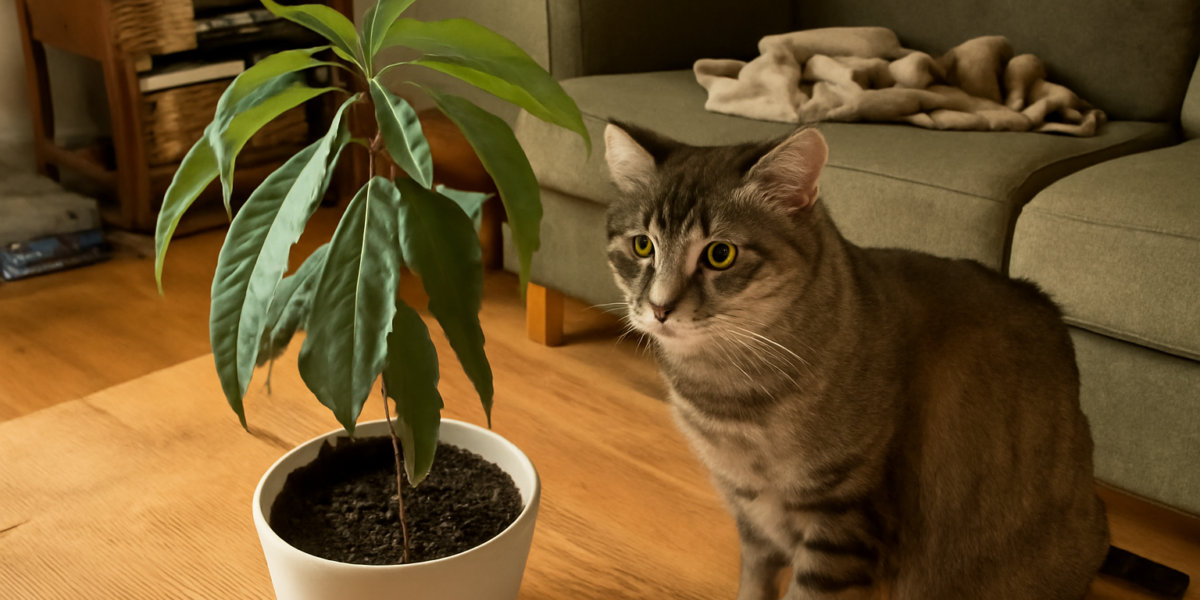
The Short Answer: Peach Pits Are Toxic to Cats
Peach pits are toxic to cats. The kernel inside the pit contains amygdalin, a cyanogenic glycoside that converts to hydrogen cyanide when chewed and digested, and the pit itself is a mechanical hazard — large enough to lodge in a small cat’s throat, esophagus, or intestine. The risk tier is moderate to severe depending on whether the cat actually chewed the kernel and how big the cat is relative to the pit.
In this article
- The Short Answer: Peach Pits Are Toxic to Cats
- Why Cats Are at Lower (But Not Zero) Risk
- The Two Risks: Cyanide and Choking/Obstruction
- Symptoms to Watch For
- What to Do If Your Cat Eats a Peach Pit
- Veterinary Treatment
- Peach Flesh vs Peach Pits for Cats
- The Stone-Fruit Family: Same Chemistry Across the Board
- Preventing Peach Pit Exposure
- When to Call: Vet Routing Recap
- Frequently Asked Questions
Cats are far less likely than dogs to eat a peach pit on purpose, but the peach pits toxic cats concern still matters. Curious kittens, indoor cats who play with what falls on the floor, and cats in mixed households where peaches are common can all wind up with a pit in their mouth. If that has happened, call your vet or a poison control hotline before assuming the cat will be fine.
Why Cats Are at Lower (But Not Zero) Risk
Cats are obligate carnivores and naturally less interested in fruit than dogs are. Most cats who encounter a peach pit will sniff, bat, and walk away. That is the primary reason peach pits are a much bigger story in dogs than in cats — not because the toxin is different, but because the behavior is different.
The cats who do get into trouble fall into a few groups: kittens (who explore everything by mouth), pica-prone cats (who chew non-food objects), cats with access to compost or open kitchen bins, and cats in households where children drop peach pits on the floor. Pet behaviorists often see pica increase with stress and diet changes, so a usually-uninterested cat may suddenly investigate.
One important wrinkle: cats are more vulnerable per pound than dogs to many alkaloid-class and glycoside-class toxins because of their reduced liver detoxification capacity. A small amount of amygdalin in a 9-pound cat is a meaningfully bigger insult than the same amount in a 50-pound dog. The “cats won’t bother with peaches” pattern is true on average; it is not a guarantee.
The Two Risks: Cyanide and Choking/Obstruction
Risk one is chemical. Amygdalin in the kernel converts to hydrogen cyanide (HCN) on chewing and digestion. HCN blocks cells from using oxygen, producing rapid breathing, bright red gums (early), then muddy or bluish gums, weakness, drooling, vomiting, collapse, and seizures in severe cases. A whole pit that passes through without being crushed releases very little HCN; a chewed kernel is a different story.
Risk two is mechanical. Peach pits are roughly 2–3 cm across, hard, and irregular. In a 9–12 pound cat, that is a serious size. The most immediate concern is choking on a pit lodged in the throat. Once the pit gets past the throat, it can still lodge in the esophagus, stomach outflow, or small intestine, causing repeated vomiting, abdominal pain, refusal to eat, and surgical emergencies if it tears the gut wall.
In real-world veterinary practice with cats, mechanical hazard is usually the more pressing concern simply because cats rarely chew pits enough to release significant cyanide. But mixed presentations happen, and any cat with peach-pit exposure deserves a vet call.
Symptoms to Watch For
Choking signs are immediate and dramatic: gagging, retching, pawing at the mouth, drooling, blue or pale gums, distress vocalizations, and inability to breathe normally. This is a “drive to the ER now” picture, not a “call and ask” picture.
Obstruction signs develop over hours to a couple of days: repeated vomiting (often after eating or drinking), drooling, refusal to eat, hunched posture, abdominal tenderness, lethargy, and reduced or absent stool. Some cats hide under furniture and refuse to come out — in cats, hiding is often the loudest symptom.
Cyanide signs (if the cat actually chewed and swallowed kernel material) include rapid panting, bright red mucous membranes early on, vomiting, weakness, wobbly gait, and in severe cases seizures and collapse. Cats hide cardiopulmonary distress remarkably well until late, so do not be reassured by a quiet cat that “just looks tired.”
What to Do If Your Cat Eats a Peach Pit
If the cat is choking right now, treat it as an immediate airway emergency and head to the nearest open clinic without stopping for phone calls. If the cat is breathing normally but you saw or suspect peach-pit ingestion, get the cat into a quiet carrier and call. Do not chase or stress the cat — adrenaline can make airway distress worse.
Call your veterinarian first if business hours. After hours, call your nearest emergency vet. You can simultaneously contact the ASPCA Animal Poison Control Center at (888) 426-4435 or the Pet Poison Helpline at (855) 764-7661. Both charge a consultation fee. Have ready: cat’s weight, time of ingestion, whether the pit was chewed or swallowed whole, and a photo of the pit if you can.
Do not induce vomiting at home. Cats handle emetics worse than dogs, and a whole pit on its way back up can lodge in the throat. With cyanide-class toxins, decontamination decisions belong in the clinic, not the kitchen.
Veterinary Treatment
For mechanical concerns, the vet will start with a focused exam, then radiographs or ultrasound to locate the pit. Treatment depends on location: throat or esophageal lodgement may need urgent endoscopic retrieval under sedation; stomach pits can sometimes be retrieved endoscopically too; small-intestine lodgement that does not move is a surgical case (enterotomy).
For cyanide concerns, supportive care leads: oxygen, IV fluids, and monitoring of breathing, heart rate, and gum color. Specific cyanide antidotes (sodium nitrite plus sodium thiosulfate, or hydroxocobalamin) exist and are used at referral hospitals in severe cases. Activated charcoal can be given to bind unreleased amygdalin if the timing is right.
Outcomes depend almost entirely on speed and severity. A cat presenting promptly with mild signs typically recovers well. Cats who present after collapse or with bowel perforation face a much harder fight. As with most ingestion cases, “call now” beats “wait and see.”
Peach Flesh vs Peach Pits for Cats
Plain peach flesh in tiny amounts is not toxic to cats, but it is also not nutritionally meaningful and the high natural sugar can upset feline digestion. Cats are obligate carnivores; they do not need fruit and most actively dislike sweet flavors. There is no good reason to feed your cat peach flesh, but if she licked a piece off the counter, that alone is not an emergency.
The pit, the kernel, the leaves, and the bark are the real concerns. The flesh is just a bystander. If the cat ate “peach,” the question that matters to the vet is whether the pit was involved. A photo of any leftover material helps.
Canned peaches in syrup add sugar and sometimes preservatives that are not great for cats. Skip them. Peach yogurts often contain xylitol, which is much more dangerous in dogs than in cats but is not something to share with a cat either.
The Stone-Fruit Family: Same Chemistry Across the Board
Peach belongs to genus Prunus, alongside cherry, plum, apricot, almond, and nectarine. All of them carry the same cyanogenic glycosides in pits, leaves (especially wilted), and bark. For broader stone-fruit context, see cherry leaves and cats and almond trees and cats. The dog-side master article is cherry pits and dogs.
Look-alike confusion is real: ornamental flowering plums and cherries drop the same kind of pits as fruiting ones, and “wild peach” or “wild plum” volunteers in fence rows are the same hazard as the orchard tree. If your cat has access to a yard with any Prunus species — fruiting or ornamental — assume the windfall risk applies.
For the dog-side picture (relevant in mixed households), see peach pits and dogs.
Preventing Peach Pit Exposure
The simplest prevention is closed-bin disposal. Pit peaches over the sink, drop pits straight into a closed kitchen bin, and take the trash out daily during peach season. Do not leave a “peach pit pile” on the back patio overnight; cats — even uninterested ones — explore at night.
If you have peach trees in a yard a cat can access, walk the yard daily during fruit drop and pick up windfalls. The cat may never touch them, but rotting peaches attract flies, raccoons, and other things you do not want around either. Use covered compost containers rather than open piles.
For more general indoor cat-proofing, our cat-safe houseplants guide covers houseplant swaps, and the cat adoption hub covers home prep alongside the rest of the new-cat checklist.
When to Call: Vet Routing Recap
Call your veterinarian first. After hours, call your nearest emergency clinic. You can also call the ASPCA Animal Poison Control Center at (888) 426-4435 or the Pet Poison Helpline at (855) 764-7661. Have ready: cat’s weight, time of ingestion, whether the pit was chewed or swallowed whole, any visible flesh remaining, and any current symptoms (breathing changes, drooling, vomiting, hiding).
Do not induce vomiting, do not give milk or oils, and do not wait several hours to see if the cat looks normal. Cats hide distress until late; an apparently calm cat can be in genuine trouble.
Frequently Asked Questions
My cat batted a peach pit around but I don’t think she chewed it. Is that an exposure?
If the cat did not chew or swallow any of the pit, the cyanide risk is essentially zero and the mechanical risk is also zero. Watch for any change in behavior over the next 24 hours, and dispose of the pit in a closed bin so the cat cannot return to it.
How small a piece of peach pit is dangerous?
There is no clean published threshold for cats. A small chip of pit chewed and swallowed is generally a low-grade concern; a fully chewed kernel is a real cyanide concern. Either deserves a vet call. Cats are smaller than dogs, so the same fragment matters more per pound.
Can my cat eat fresh peach flesh as a treat?
Plain, ripe peach flesh in tiny amounts is not toxic, but cats do not benefit nutritionally from fruit. Most cats dislike the texture and sweetness anyway. Skip the experiment unless your vet has a specific reason to recommend it.
Are nectarine pits the same as peach pits for cats?
Yes. Nectarine is the same species as peach (Prunus persica), just a fuzz-free cultivar. Pits, kernels, leaves, and bark all share the same cyanogenic chemistry and the same mechanical-hazard profile.
What plants should I avoid if I am redesigning a fruit garden for a cat household?
Skip all Prunus species (cherry, peach, plum, apricot, almond, nectarine — fruiting and ornamental) in beds your cat actually walks through. For confirmed-safe substitutes, see our pet-safe garden plants guide.


