
Last updated: May 16, 2026
In this article
- The Short Answer on String of Turtles and Pets
- What String of Turtles Actually Is
- Why Peperomias Are Considered Pet-Safe
- The Critical Senecio Versus Peperomia Distinction
- How to Tell Your Plant Apart
- What to Do If Your Pet Ate String of Turtles
- When a Vet Visit Is Worth It
- Why “Non-Toxic” Still Comes With Caveats
- Other Pet-Safe Houseplant Pairings
- Living with String of Turtles and a Pet
- The Reassurance for Owners Who Found the Wrong “String”
- Frequently Asked Questions
The Short Answer on String of Turtles and Pets
String of turtles is safe for cats and dogs. The plant, sold under the botanical name Peperomia prostrata, is part of the broader Peperomia genus, which the ASPCA lists as non-toxic to both cats and dogs. If your cat batted a strand off the shelf or your dog grabbed a fallen cutting, the worst case for most pets is mild stomach upset from eating something that is not normal pet food. There is no cyanide, no calcium oxalate raphide chemistry, no cardiac glycoside, and no alkaloid concern.
The bigger problem with string of turtles is not the plant itself but the names on neighboring shelves at the garden center. The “string of” naming convention is shared by several toxic Senecio plants, and the marine-animal common names sit side by side in the houseplant section. This article will reassure you that your turtles are safe and walk you through how to be certain you have the right plant.
What String of Turtles Actually Is
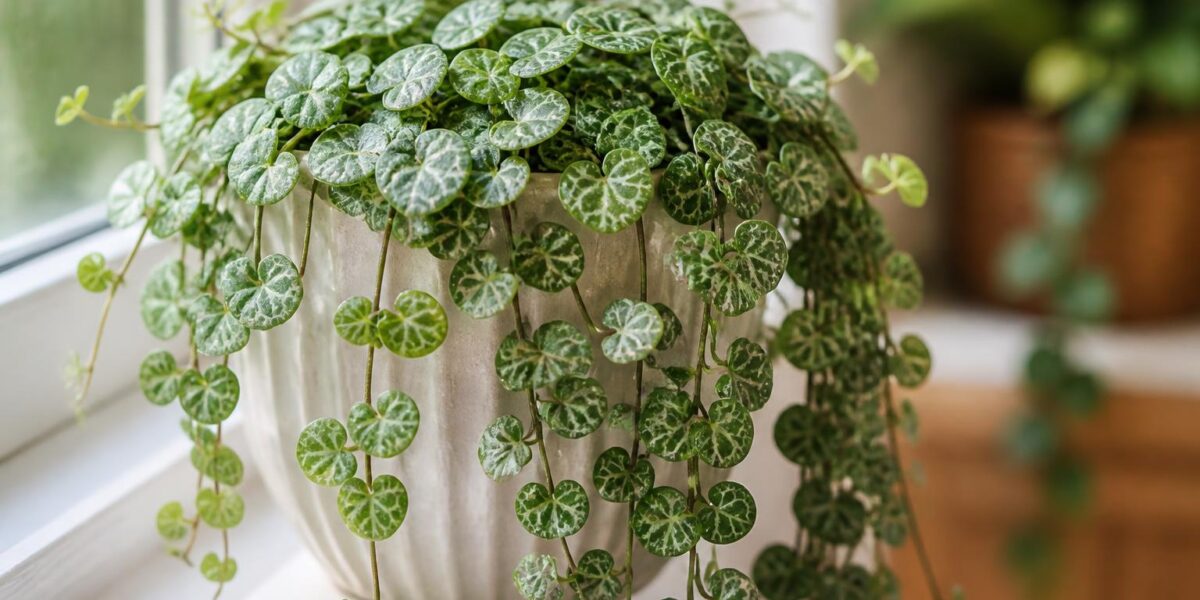
String of turtles is a small trailing houseplant with rounded, slightly fleshy dark-green leaves marked with pale silver-green veining that resembles the geometric plates on a turtle shell. The stems are thin, often red-tinted, and the leaves grow flat against the stem in a tidy row, giving the plant a beaded-bracelet look when it trails over the edge of a pot.
The species belongs to the genus Peperomia, which sits in the family Piperaceae, the same plant family as black pepper. The genus contains more than fifteen hundred species and is a popular houseplant group for the easy-going temperament and the lack of significant toxicity in the species sold for indoor use. Peperomia prostrata is one of the smaller, slower-growing members of the group, often sold as a potted “turtle plant” or “turtle vine” for terrariums and hanging glass orbs.
It is a tropical understory plant native to the rainforests of South America, where it grows on damp tree branches and the surfaces of moss-covered rocks. That epiphytic habit translates to easy houseplant care: bright indirect light, a chunky well-drained mix, and water only when the top of the soil dries out.
Why Peperomias Are Considered Pet-Safe
Peperomias are listed as non-toxic to cats and dogs by the ASPCA Animal Poison Control Center. The genus has been studied informally for years through pet-poison-helpline call records, and Peperomia ingestions consistently come back as low-tier exposures. There is no documented major toxic compound in the leaves or stems that produces systemic illness in companion animals.
That said, “non-toxic” in the ASPCA sense does not mean “free meal.” Any plant matter eaten in volume can cause mechanical GI upset simply because the digestive tract of a cat or small dog is not designed to process leafy greens. A pet that eats a large amount of any plant, toxic or not, may vomit or pass loose stools while the body clears the unfamiliar fiber. Reassurance is the right framing here, but reassurance with a couple of caveats.
The other caveat is pesticide and fertilizer residue on shop-bought plants. Commercial growers sometimes treat plants with systemic insecticides, and those residues can transfer to a chewed leaf for several weeks after purchase. If you bring a string of turtles home and the cat samples it on day one, the issue may be the residue rather than the plant. We say more about this in the management section below.
The Critical Senecio Versus Peperomia Distinction
The single most common confusion at the houseplant shelf is between the toxic Senecio “string of” plants and the non-toxic Peperomia “string of” plants. They are in completely different plant families, with completely different chemistry, and pet owners regularly search for them interchangeably because the common names sound similar.
The toxic Senecios include string of pearls (Senecio rowleyanus), string of bananas (Senecio radicans), and string of dolphins (Senecio peregrinus). All three are in the daisy family (Asteraceae) and contain pyrrolizidine alkaloids and irritant milky sap. String of hearts (Ceropegia) is in yet another family but also has a milky sap that is mildly irritant.
String of turtles (Peperomia prostrata) is in the pepper family (Piperaceae), is unrelated to all of the above, and is non-toxic. If you see the word “Senecio” on the plant tag, treat the plant as toxic. If you see “Peperomia,” treat it as safe. The marine-animal common names are not reliable on their own; the botanical name on the grower’s tag is.
How to Tell Your Plant Apart
Here is the visual cheat sheet for the four most-confused trailing succulents and vines.
- String of turtles (Peperomia prostrata, safe): small, almost-flat dark-green leaves with pale veining like a tortoise shell, on thin red stems. Leaves are not juicy succulents; they are slightly fleshy but more like a thick paper.
- String of pearls (Senecio rowleyanus, toxic): spherical, pea-shaped green beads on a thin stem. Leaves are full water-storing succulents.
- String of bananas (Senecio radicans, toxic): curved, banana-shaped fleshy leaves, glossy and brighter green than the pearl version.
- String of dolphins (Senecio peregrinus, toxic): plump leaves shaped like leaping dolphins, often with a paler “belly” stripe.
If the leaves look like glossy fleshy beads or curved bananas or dolphins, you are looking at a Senecio and the plant is toxic. If the leaves look like flat little turtle shells with pale veining, you are looking at a Peperomia and the plant is safe.
What to Do If Your Pet Ate String of Turtles
If your cat or dog chewed a strand of string of turtles, the most likely outcome is no symptoms at all. Some pets will pass a few flecks of green plant material in the next bowel movement and that is the entire story. Others may vomit once or have a single softer stool, especially if they ate a large amount. Both presentations are typical low-tier plant ingestion responses and usually resolve within twelve to twenty-four hours.
Watch your pet for the first few hours after the chew. Offer fresh water and a small bland meal. If the pet eats normally, drinks water, and acts like itself, you do not need a vet visit. If you see persistent vomiting, repeated diarrhea, lethargy that lasts more than a few hours, or any sign that the pet is uncomfortable, call your veterinarian. Even non-toxic plant ingestions warrant a phone consultation if the pet seems unwell.
The ASPCA Animal Poison Control Center at 888-426-4435 and the Pet Poison Helpline at 855-764-7661 will both take a call about a non-toxic plant if you want to be sure. There is a consultation fee, and they will document the ingestion in their records, which can be useful if you have a dog that grazes plants regularly.
When a Vet Visit Is Worth It
Most string of turtles ingestions do not require a vet exam, but a few situations are worth the call.
Very young kittens or puppies have small body mass and less reserve, so even a non-toxic plant ingestion that produces vomiting can dehydrate them faster than an adult pet. If a kitten under twelve weeks chews a plant and starts vomiting, call the vet that day rather than waiting through the night. Older pets with chronic kidney disease, inflammatory bowel disease, or any condition that makes vomiting risky also deserve a lower threshold for evaluation.
The other scenario worth a call is if you suspect your pet ate something else along with the string of turtles. Cats that chew the trailing vines often also walk through the soil, which may carry pesticide or systemic insecticide residue. Dogs that knock a pot off a shelf may ingest soil, perlite, or even chunks of fertilizer. The plant is safe; the surrounding material may not be.
Why “Non-Toxic” Still Comes With Caveats
Even with reassuring ASPCA listings, three things can turn a non-toxic plant ingestion into a vet trip.
The first is volume. Any pet that eats a very large quantity of fibrous plant matter can develop vomiting or a partial GI obstruction, especially smaller cats and toy-breed dogs. A cat that grazes a single leaf is fine; a cat that consumes most of a hanging basket in an evening is not. This is unusual with the small leaves of string of turtles, but worth keeping in mind for households where the plant is unsupervised for long stretches.
The second is pesticide residue. Garden centers spray commercial plants with insecticides and fungicides, and the residue can sit on leaves for weeks. If you bring a new plant home, rinse the foliage gently under cool water and let it dry before placing it where the pet can reach. After two or three weeks of normal indoor conditions, residue is typically minimal, but the first month is the riskier window.
The third is the soil itself. Indoor potting mixes sometimes contain slow-release fertilizer pellets, perlite, or vermiculite. A cat that digs in the pot may ingest these as a side effect of the chew. The plant is non-toxic but the soil chemistry is not designed for pet ingestion.
Other Pet-Safe Houseplant Pairings
If you have decided string of turtles is your starter pet-safe trailing plant, the natural follow-ups in the same Peperomia family are also non-toxic. Baby rubber plant (Peperomia obtusifolia) and watermelon peperomia (Peperomia argyreia) share the genus and the safety profile, with completely different leaf shapes and patterns for visual variety.
For other safe trailing or shelf-friendly houseplants, look at haworthia rosettes, prayer plants, calatheas, and spider plants. Our cat-safe houseplants guide goes through the full list with light requirements and care notes. Building a pet-safe houseplant collection is much easier than it used to be, and the visual range is wide enough that nobody has to feel limited.
Living with String of Turtles and a Pet
String of turtles is genuinely one of the easier houseplants to share with a pet. The leaves are small enough that even a determined chewer cannot strip much volume in a sitting, the plant is non-toxic so an occasional chew is not a poisoning risk, and the slow growth habit means a single plant can sit on a shelf for a year or two without sprawling out of control.
The standard placement advice still applies. Hanging from a low hook, a small pot on a low shelf, or a glass terrarium on a coffee table are all fine for households with cats or dogs, because the chewing risk is cosmetic to the plant rather than dangerous to the pet. The most common complaint we hear from owners is that the cat keeps stealing strands as toys; the plant becomes less photogenic but the cat is fine.
The Reassurance for Owners Who Found the Wrong “String”
If you found this article because your pet just chewed a “string of” plant and you cannot remember which one you bought, take a breath. Look at the leaves. If they are flat and turtle-shell-patterned, you are reading the right article and your pet is almost certainly fine. If they are juicy beads, curved bananas, or dolphin shapes, you have a Senecio and you should switch to the appropriate toxic-string article and call a vet.
For households setting up a new home for an adopted pet, the Peperomia genus is one of the easiest plant groups to feel confident about. Our cat adoption and dog adoption hubs include household-prep guides that go further into pet-safe plant selection, with a starter list of plants you can buy without checking the toxicity database every time.
Frequently Asked Questions
Is string of turtles toxic to cats?
No. String of turtles (Peperomia prostrata) is in the Peperomia genus, which the ASPCA lists as non-toxic to cats. A cat that nibbles a leaf or two should not develop poisoning symptoms. Heavy chewing volume can still cause mild stomach upset, but that is true of any non-food plant.
Is string of turtles the same as string of pearls?
No, and the difference matters. String of turtles is a Peperomia and is non-toxic. String of pearls is a Senecio and is toxic to cats and dogs. They are in completely different plant families. Always check the botanical name on the plant tag if you are unsure which one you have.
My dog ate a strand of string of turtles. Should I induce vomiting?
No. Do not induce vomiting at home for any plant ingestion, toxic or not. If your dog ate a small amount of string of turtles, monitor for vomiting or diarrhea over the next twelve hours. If your dog ate a very large amount or shows persistent symptoms, call your veterinarian for guidance.
Are all Peperomia plants safe for cats and dogs?
The major species sold as houseplants (P. obtusifolia, P. argyreia, P. caperata, P. prostrata) are listed as non-toxic by the ASPCA. The genus contains more than fifteen hundred species and not all have been individually evaluated, but the common houseplant Peperomias are considered pet-safe.
Should I rinse a new string of turtles before letting my cat near it?
It is a sensible precaution. Commercial growers sometimes treat plants with systemic insecticides whose residue can sit on leaves for weeks. Rinse the foliage gently under cool water, let it dry, and consider giving the plant two or three weeks before placing it where pets can reach.


