
Last updated: May 16, 2026
In this article
- The Short Answer on Watermelon Peperomia and Pets
- What Watermelon Peperomia Actually Is
- Why Peperomias Are Considered Pet-Safe
- Symptoms After a Chew
- What to Do If Your Pet Ate Watermelon Peperomia
- When a Vet Visit Is Worth It
- Why “Non-Toxic” Still Has Practical Limits
- Look-Alike Confusion to Watch For
- Other Pet-Safe Peperomia Pairings
- Living with Watermelon Peperomia and a Pet
- The Bigger Picture for Pet-Safe Plant Households
- Frequently Asked Questions
The Short Answer on Watermelon Peperomia and Pets
Watermelon peperomia is safe for cats and dogs. The plant, sold under the botanical name Peperomia argyreia, sits in the Peperomia genus, which the ASPCA lists as non-toxic to both cats and dogs. If your cat batted a striped leaf to the floor or your dog grabbed a fallen cutting and crunched it, the realistic worst case for most pets is mild stomach upset from eating something that is not normal pet food. There is no calcium oxalate raphide chemistry, no cyanide, no cardiac glycoside, and no pyrrolizidine alkaloid concern.
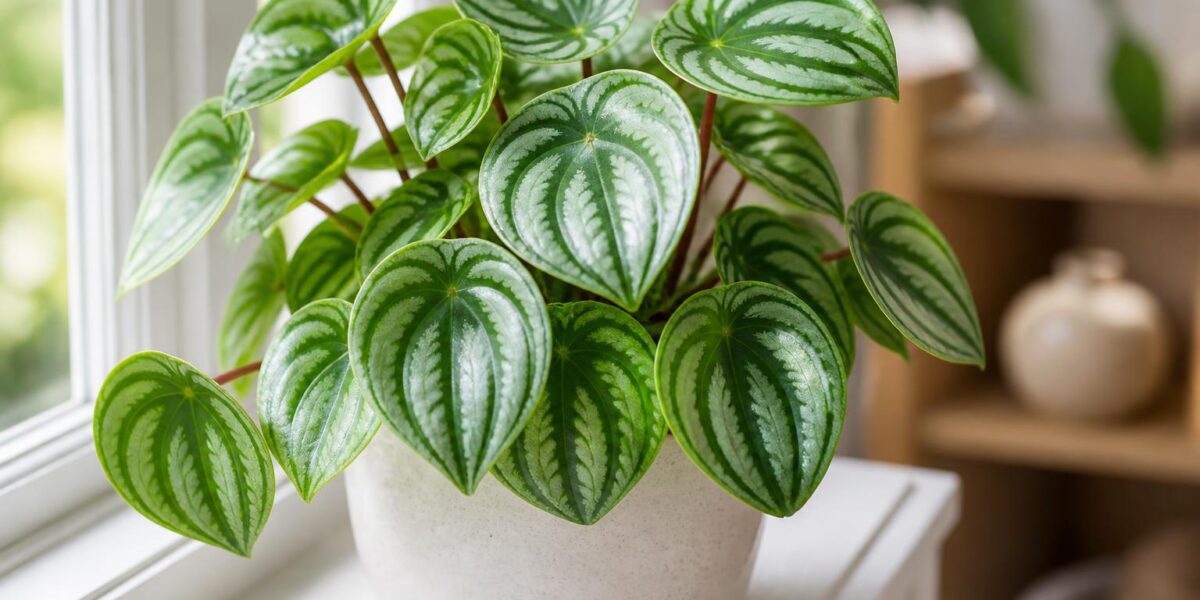
The plant gets its common name from the dramatic silver-and-green leaf pattern that genuinely does look like the rind of a watermelon, which makes it one of the more photogenic non-toxic houseplants on the market. This article covers the safety profile, the few caveats that still apply to “non-toxic” plants, and the close cousins in the Peperomia genus that share the safety profile.
What Watermelon Peperomia Actually Is
Watermelon peperomia is a compact tropical houseplant native to the rainforests of South America, particularly Brazil and Bolivia. It grows as an understory plant in the wild, where filtered light through the forest canopy and consistent humidity match its preferred indoor conditions. The leaves are oval, slightly fleshy, and held on tall red-tinted petioles that give the plant a striking architectural look.
The defining feature is the leaf pattern. Each leaf has a deep green base with broad silvery stripes radiating from the central vein, mimicking the rind of a watermelon. The stripes are not paint or variegation; they are a structural feature of the leaf surface that catches light differently from the green tissue. The effect is most pronounced in young leaves and softens slightly as the leaf ages.
The botanical name Peperomia argyreia translates roughly to “silver-leaved peperomia,” which captures the appearance well. Some older houseplant references call it Peperomia sandersii, an obsolete synonym. You may also see it sold as watermelon begonia, though it is not actually a begonia and the begonia common name should be ignored.
Why Peperomias Are Considered Pet-Safe
The Peperomia genus is listed as non-toxic to cats and dogs by the ASPCA Animal Poison Control Center. The listing covers the species commonly sold as houseplants, including P. argyreia, P. obtusifolia (baby rubber plant), P. caperata (ripple peperomia), and P. prostrata (string of turtles). The genus has been informally tracked through pet-poison-helpline records for years and consistently presents as a low-tier ingestion category with no documented major toxic compound in the foliage or stems.
The Piperaceae family that contains Peperomia is the same family as black pepper. The peppery edge that pet owners sometimes report when they bruise a leaf comes from mild aromatic compounds shared with the broader pepper family, but those compounds do not produce systemic toxicity in cats and dogs at any reasonable ingestion volume. The taste tends to discourage repeat chewing more than anything else.
Caveats apply to “non-toxic” the same way they apply to all safe-for-pets houseplants. Any plant matter eaten in volume can cause mechanical GI upset because pet digestive tracts are not designed for fibrous greens. Pesticide residue on shop-bought plants can transfer to a chewed leaf for several weeks after purchase. And the soil itself can carry slow-release fertilizer pellets or systemic insecticide treatments that are not pet-safe even when the plant is. We come back to all three in the management section.
Symptoms After a Chew
Most pets show no symptoms after chewing watermelon peperomia. The leaf is fleshy enough that an inquisitive cat may take a single bite, react to the mild peppery taste, and walk away. A few pets will pass small flecks of green plant material in the next bowel movement, which is the entire story. A smaller subset will vomit once or develop a single softer stool, especially if they ate a meaningful amount of foliage.
The signs to watch for, in the rare cases where a pet does react, include the following.
- One or two episodes of vomiting in the first few hours, often containing visible plant fragments
- A single softer stool or one episode of mild diarrhea
- Mild loss of appetite for a meal, especially if the pet ate a large volume of leaf
- Drooling or lip-licking from a mild sense of an unpleasant taste
These signs typically resolve within twelve to twenty-four hours with simple home support: fresh water, a small bland meal when the pet is ready, and rest. Persistent vomiting, repeated diarrhea, or lethargy beyond a day are unusual for a Peperomia ingestion and warrant a vet call to rule out something else.
What to Do If Your Pet Ate Watermelon Peperomia
Stay calm. The plant is non-toxic and the most likely outcome is no symptoms at all. Take the practical steps below in order.
- Move the plant out of reach so the pet does not return for a second helping while you are observing the first.
- Wipe any visible plant material out of the mouth with a soft, damp cloth if your pet tolerates it.
- Offer fresh water and a small bland meal when your pet is interested.
- Watch for vomiting, diarrhea, or signs of discomfort across the next twelve to twenty-four hours.
- If symptoms appear and persist, or if the pet seems unwell, call your veterinarian or a poison control hotline.
The ASPCA Animal Poison Control Center at 888-426-4435 and the Pet Poison Helpline at 855-764-7661 will both take a call about a non-toxic plant if you want to be sure. There is a consultation fee on both lines. Do not induce vomiting at home, even though the plant is non-toxic; home vomiting techniques are unsafe for cats and uncertain for dogs, and there is no benefit to triggering vomiting after a non-toxic exposure.
When a Vet Visit Is Worth It
Most watermelon peperomia ingestions do not need a vet exam. A few situations are worth the call regardless of the non-toxic listing.
Very young kittens or puppies have small body mass and less reserve, so a non-toxic plant ingestion that produces vomiting can dehydrate them faster than an adult animal. If a kitten under twelve weeks chews any plant and starts vomiting, call the vet that day rather than waiting overnight. Older pets with chronic kidney disease, inflammatory bowel disease, diabetes, or any condition that complicates vomiting also deserve a lower threshold for evaluation.
The other situation worth a call is uncertainty about the species. If a friend gave you a cutting and you are not sure it is a Peperomia, or if the plant tag is missing and the leaves look ambiguous, treat the ingestion as unknown and ask the vet or a poison hotline to help you identify the plant from photos. Small uncertainty resolves quickly with a phone call and is worth the cost.
Why “Non-Toxic” Still Has Practical Limits
Three ordinary scenarios can turn a safe-for-pets plant ingestion into a vet trip.
The first is volume. A pet that eats a very large amount of fibrous plant matter in a short time can develop vomiting, diarrhea, or a partial GI obstruction, especially smaller cats and toy-breed dogs. A cat grazing one striped leaf is fine; a cat that strips most of the plant in an afternoon is at risk for mechanical GI upset that has nothing to do with the chemistry.
The second is pesticide residue. Garden centers spray commercial plants with insecticides and fungicides, and the residue can sit on leaves for weeks after purchase. If a pet samples a new plant within the first month and shows mild symptoms, the chemistry of concern may be on the surface of the leaf rather than in the leaf itself. Rinsing new foliage gently under cool water and letting the plant rest for two to three weeks before placing it within pet reach is a sensible precaution.
The third is the soil. Indoor potting mixes can contain slow-release fertilizer pellets, perlite, vermiculite, or systemic insecticide drench. A pet that digs in the pot may ingest these alongside any plant chewing. The plant is non-toxic; the soil chemistry sometimes is not.
Look-Alike Confusion to Watch For
Watermelon peperomia is often confused with watermelon begonia (Pellionia repens), an unrelated plant in the nettle family with similar silvery markings on smaller leaves. Watermelon begonia is also generally considered safe for pets, but it is genuinely a different plant and the care needs differ. The botanical name on the tag is the only reliable way to know which one you have.
The “Peperomia” name is sometimes confused with “peppermint,” “pepper plant,” and the genuine pepper crop (Capsicum annuum). None of these are related to Peperomia despite the shared “pepper” stem in the name. Capsicum peppers contain capsaicin and can cause significant GI upset in pets, while peppermint (Mentha) is a separate herb with mild GI implications for cats and dogs in volume. If a friend offers you a cutting from “their pepper plant,” ask the species before you take it home.
The wider Peperomia genus has many sibling species sold as houseplants. Some peperomia content frames the genus from the toxicity-question angle, and the practical answer is the same: the major houseplant Peperomias are listed as non-toxic to dogs, but volume and residue concerns apply to any plant ingestion regardless of label.
Other Pet-Safe Peperomia Pairings
If watermelon peperomia is one piece of your pet-safe houseplant collection, the natural pairings are the other safe Peperomias. String of turtles (Peperomia prostrata) gives you a trailing form. Baby rubber plant (Peperomia obtusifolia) gives you a tidy upright form with paddle leaves. Peperomia varieties in general are a reliable safe pick across cats and dogs.
Beyond the Peperomia genus, the other reliable pet-safe plant groups are spider plants, prayer plants (Maranta and Ctenanthe), calatheas, parlor palms, areca palms, haworthia, and most ferns sold as houseplants. Our cat-safe houseplants guide goes through the full list with light requirements and care notes. The visual range of safe-for-pets plants is wide enough that nobody has to feel limited.
Living with Watermelon Peperomia and a Pet
Watermelon peperomia is a low-drama coexistence with cats and dogs. The leaves are visually striking enough that an attentive cat may bat at them, and a determined chewer will sample a leaf at least once, but the non-toxic profile means a chew is not a poisoning event. The plant prefers bright indirect light and consistent humidity, which often steers it toward bathrooms or kitchen counters in real homes; both rooms are easy to keep cat-friendly with sensible placement.
Standard placement advice still applies. Higher shelves keep the plant cosmetically intact and reduce the volume any one chew can take. Ground-level pots are fine for safety but expect the plant to acquire some chew marks if you have a curious pet. The plant grows slowly enough that occasional grazing can be tolerated, but heavy grazing eventually leaves you with bare stems and a slow recovery.
The Bigger Picture for Pet-Safe Plant Households
Building a pet-safe houseplant collection is much easier than it used to be, and watermelon peperomia is a strong starter pick. The Peperomia genus, the prayer plant family, and the calathea group together cover most of the visual range that pet owners want, with safety listings backed by ASPCA records and decades of pet-poison-helpline call data.
If you are setting up a home for a newly adopted pet, our cat adoption and dog adoption hubs include household-prep guides that walk you through plant audits, food storage, and chemical safety. A short afternoon of plant review is a fair trade for years of relaxed evenings on the sofa with a cat draped over the cushion and a watermelon peperomia on the shelf above.
Frequently Asked Questions
Is watermelon peperomia toxic to cats?
No. Watermelon peperomia (Peperomia argyreia) is in the Peperomia genus, which the ASPCA lists as non-toxic to cats. A cat that nibbles one of the striped leaves should not develop poisoning symptoms. Heavy chewing volume can still cause mild stomach upset, but that is true of any non-food plant.
Is watermelon peperomia the same as watermelon begonia?
No, but they are often confused. Watermelon peperomia is Peperomia argyreia in the pepper family. Watermelon begonia is Pellionia repens in the nettle family. Both are generally considered safe for pets, but they are different plants with different care needs. Check the botanical name on the tag.
My dog ate a watermelon peperomia leaf. Do I need to do anything?
Probably not. Watch for vomiting or diarrhea over the next twelve hours. Most dogs will pass plant fragments without symptoms. If your dog acts uncomfortable, eats poorly, or develops persistent GI signs, call your veterinarian. Do not induce vomiting at home.
Do the silver stripes on watermelon peperomia mean anything for toxicity?
No. The stripes are a structural feature of the leaf surface, not a chemical marker. The plant is non-toxic regardless of how dramatic the variegation looks. Cultivars and selections all share the same safety profile.
Should I rinse a new watermelon peperomia before letting my pet near it?
It is a sensible precaution. Commercial growers sometimes treat plants with systemic insecticides whose residue can sit on leaves for weeks. Rinse the foliage gently under cool water, let it dry, and consider giving the plant two or three weeks before placing it where pets can reach.


