
Last updated: May 16, 2026
In this article
- The Short Answer on Baby Rubber Plant and Pets
- What Baby Rubber Plant Actually Is
- Why Peperomias Are Considered Pet-Safe
- The Critical Rubber Plant Versus Rubber Tree Confusion
- How to Tell Your Plant Apart
- What to Do If Your Pet Ate Baby Rubber Plant
- When a Vet Visit Is Worth It
- Why “Non-Toxic” Still Has Limits
- Other Pet-Safe Houseplant Pairings
- Living with Baby Rubber Plant and a Pet
- The Reassurance for Owners Who Found the Wrong “Rubber”
- Frequently Asked Questions
The Short Answer on Baby Rubber Plant and Pets
Baby rubber plant is safe for cats and dogs. The plant, sold under the botanical name Peperomia obtusifolia, sits in the Peperomia genus, which the ASPCA lists as non-toxic to both cats and dogs. If your cat snipped off a glossy leaf or your dog grabbed a fallen cutting, the realistic worst case is mild stomach upset from eating something that is not normal pet food. There is no calcium oxalate raphide, no cyanogenic glycoside, no cardiac glycoside, and no alkaloid concern.
The bigger problem with this plant is the name. The pet-care world has at least three different houseplants commonly called “rubber plant” or “rubber tree,” and only one of them is the harmless Peperomia. The other two are genuinely toxic. This article will reassure you that baby rubber plant is fine and walk you through the naming chaos so you can be sure of which plant is in your home.
What Baby Rubber Plant Actually Is
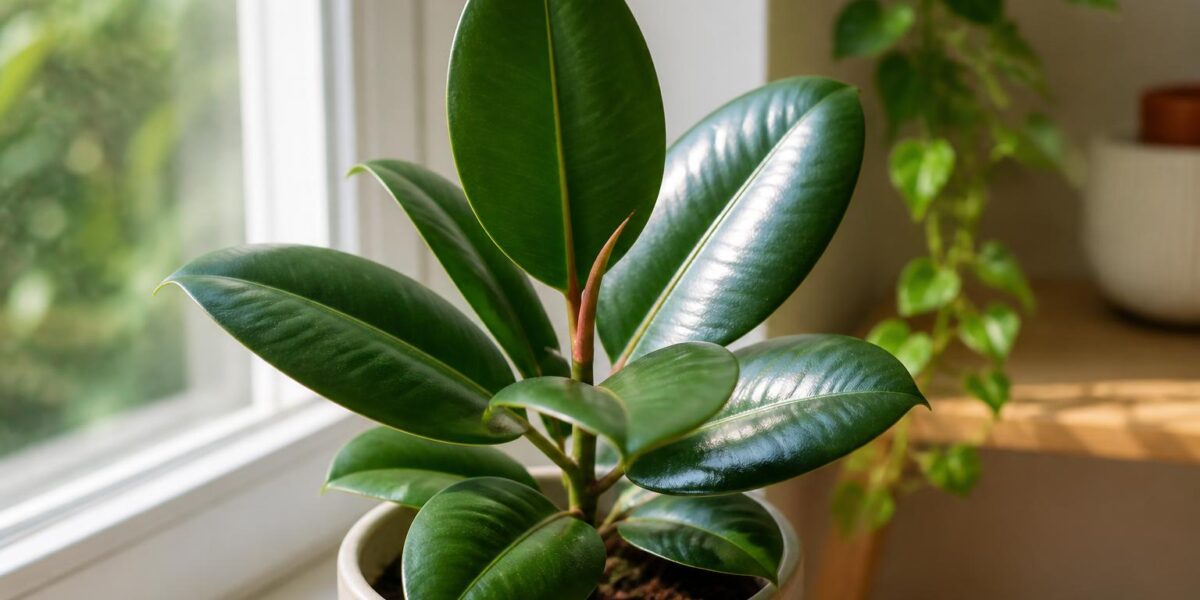
Baby rubber plant is a small, upright Peperomia with thick, glossy, paddle-shaped leaves that look like tiny patent-leather spoons. The leaves are deep green in the standard form, with variegated cultivars that show cream, yellow, or silver markings around the leaf edges. The plant rarely exceeds about a foot in height in indoor conditions and typically grows in a tidy, compact rosette habit.
The botanical name Peperomia obtusifolia translates to “blunt-leaved peperomia,” which describes the rounded leaf tip well. The plant is native to Mexico, the Caribbean, and parts of South America, where it grows as a low-growing understory plant in the rainforest. Like other Peperomias, it is semi-succulent: the leaves store some water, and the plant is drought tolerant within reason.
It is sold under several common names, which is part of where the confusion starts. Baby rubber plant, American rubber plant, pepper face, and shining bush are all the same species. Each name reflects either the appearance of the leaves (rubbery, glossy) or the family name (pepper, since it is in Piperaceae alongside black pepper).
Why Peperomias Are Considered Pet-Safe
The Peperomia genus is listed as non-toxic to cats and dogs by the ASPCA Animal Poison Control Center. The listing covers the species commonly sold as houseplants, including P. obtusifolia, P. argyreia (watermelon peperomia), P. caperata (ripple peperomia), and P. prostrata (string of turtles). The genus has been informally tracked through pet-poison-helpline call records for years and consistently presents as a low-tier ingestion category with no documented major toxic compound in the foliage.
“Non-toxic” in this sense does not mean “edible,” and there are still ordinary caveats to keep in mind. Any plant matter eaten in significant volume can cause mechanical GI upset because cats and small dogs have digestive tracts that are not designed for fibrous greens. A pet that grazes a few leaves is fine; a pet that strips an entire plant in an afternoon may vomit or pass loose stools as the unfamiliar fiber clears.
Pesticide residue on shop-bought plants is the other ordinary caveat. Commercial growers sometimes use systemic insecticides whose residue persists on leaves for several weeks after purchase. If a cat or dog samples a plant within the first month of bringing it home and shows mild symptoms, the chemistry of concern may be on the plant rather than in it. We come back to this in the management section.
The Critical Rubber Plant Versus Rubber Tree Confusion
This is the single most important distinction for baby rubber plant owners, because the casual word “rubber” is shared with several toxic plants. Pet owners frequently search interchangeably for plants that have nothing in common other than rubbery-looking leaves.
The rubber tree (Ficus elastica) is a tall, woody houseplant with large oval glossy leaves and a milky white sap. It is in the fig family (Moraceae) and the sap is irritating to the mouth, eyes, and skin of cats and dogs. The ASPCA lists it as toxic to both species. Rubber tree exposure in dogs and rubber tree exposure in cats typically produces drooling, vomiting, and skin irritation around the muzzle.
The Indian rubber plant or simply “rubber plant” is sometimes used for the same Ficus elastica and sometimes for related Ficus species. Either way, it is the toxic Ficus group. Rubber plants and cats and rubber plants and dogs articles cover that genus in detail.
Baby rubber plant (Peperomia obtusifolia) is not a Ficus, has no milky white sap, is in the pepper family rather than the fig family, and is non-toxic. The “rubber” in the common name refers only to the rubbery feel of the leaves. If you see “Ficus” anywhere on a plant tag, treat the plant as toxic. If you see “Peperomia,” treat it as safe.
How to Tell Your Plant Apart
The visual clues are reliable once you know what to look for.
- Baby rubber plant (Peperomia obtusifolia, safe): small upright plant up to about a foot tall, with thick paddle-shaped leaves on short red-tinted stems. No milky sap if a leaf is broken.
- Rubber tree (Ficus elastica, toxic): woody upright tree often three to ten feet tall indoors, with large oval glossy leaves on a thick trunk. Milky white sap oozes immediately if a leaf or stem is broken.
- Variegated rubber tree cultivars (toxic): “Tineke,” “Ruby,” “Belize,” and similar Ficus elastica cultivars show pink, cream, or red variegation on the same toxic Ficus body plan. Still toxic.
- Indian rubber tree (Ficus elastica again, toxic): usually a synonym for the same plant; some old houseplant books list it as a separate species, but the modern reading is that it is the same.
The single fastest field test is to break a small leaf or stem. If white milky sap appears, the plant is a Ficus and is toxic. If the break is dry, the plant is most likely a Peperomia and is safe.
What to Do If Your Pet Ate Baby Rubber Plant
If your cat or dog chewed a baby rubber plant leaf, the most likely outcome is no symptoms at all. Some pets will pass a few flecks of green plant material in the next bowel movement and that is the entire story. Others may vomit once or have a softer stool, especially if they ate a meaningful amount of foliage. Both presentations are typical low-tier plant ingestion responses and usually resolve within twelve to twenty-four hours.
Watch your pet for the first few hours. Offer fresh water and a small bland meal. If the pet eats normally and acts like itself, no vet visit is needed. If you see persistent vomiting, repeated diarrhea, lethargy beyond a few hours, or any sign that the pet is uncomfortable, call your veterinarian.
Even non-toxic plant ingestions deserve a phone consult if the pet seems unwell. The ASPCA Animal Poison Control Center at 888-426-4435 and the Pet Poison Helpline at 855-764-7661 will both take a call, and they can help you decide whether home monitoring or a vet exam is the right next step. There is a consultation fee on both lines.
When a Vet Visit Is Worth It
Most baby rubber plant ingestions do not require a vet exam, but a few situations are worth the call.
Very young kittens or puppies have small body mass and less reserve, so a non-toxic plant ingestion that produces vomiting can dehydrate them faster than an adult animal. If a kitten under twelve weeks chews any plant and starts vomiting, call the vet that day rather than waiting through the night. Older pets with chronic kidney disease, inflammatory bowel disease, or any condition that complicates vomiting also deserve a lower threshold for evaluation.
The other situation worth a call is if you are not certain you actually have a baby rubber plant. The “rubber” naming overlap means that a friend who gave you a cutting might have given you a Ficus elastica without realizing it, or you might have bought a plant whose tag was wrong. If your pet chewed a glossy-leafed plant and you cannot confirm the species, treat it as a potential Ficus exposure and call the vet.
Why “Non-Toxic” Still Has Limits
Three ordinary scenarios can turn a non-toxic plant ingestion into a vet trip.
The first is volume. A pet that eats a very large quantity of fibrous plant matter in a short time can develop vomiting, diarrhea, or a partial GI obstruction, especially smaller cats and toy-breed dogs. A cat that grazes one leaf is fine; a cat that strips most of the plant in an afternoon is at risk for mechanical GI upset.
The second is pesticide residue. Garden centers spray commercial plants with insecticides and fungicides, and the residue can sit on leaves for weeks. If you bring home a new plant and the cat samples it on day one, the issue may be the residue rather than the plant. Rinsing the foliage gently under cool water and letting the plant settle for two or three weeks before placing it within pet reach is a sensible precaution.
The third is the soil itself. Indoor potting mixes can contain slow-release fertilizer pellets, perlite, or vermiculite that are not designed to be eaten. A cat that digs in the pot may ingest these alongside any plant chewing. The plant is safe; the soil chemistry is not.
Other Pet-Safe Houseplant Pairings
If baby rubber plant is your starter pet-safe houseplant, the natural follow-ups in the same Peperomia genus are also non-toxic and offer different leaf shapes for visual variety. String of turtles (Peperomia prostrata) gives you a trailing-vine look. Watermelon peperomia (Peperomia argyreia) gives you the dramatic striped foliage. Peperomia varieties in general are a reliable safe pick.
For other safe shelf-friendly plants, look at spider plants, prayer plants, calatheas, and parlor palms. Our cat-safe houseplants guide covers the full list with light needs and care notes. Building a pet-safe plant collection is genuinely easy now that ASPCA listings are widely available, and the visual range is wide enough that nobody has to feel constrained.
Living with Baby Rubber Plant and a Pet
Baby rubber plant is one of the easier houseplants to share with a cat or dog. The compact growth habit means a single plant sits on a shelf without sprawling, the leaves are thick enough to survive an occasional cat batting without instant damage, and the non-toxic profile takes the panic out of finding chew marks on a leaf. Most owners we hear from describe the plant as a low-drama coexistence with their pets.
The standard placement advice still applies. Higher shelves keep the plant cosmetically intact, but ground-level placement is fine for the safety profile of the plant. The most common complaint is that a curious cat will discover the leaves are pleasingly chewy and become an occasional grazer. The plant grows slowly enough that this can be tolerated for a while, although heavy grazing will eventually leave you with bare stems.
The Reassurance for Owners Who Found the Wrong “Rubber”
If you arrived here because your pet chewed a “rubber plant” and you are not sure which one, look at the plant. If it is a small upright potted plant under a foot tall with paddle leaves on red stems and no milky sap, you have a baby rubber plant and your pet is almost certainly fine. If it is a tall woody tree with thick oval leaves and milky white sap when you break a leaf, you have a Ficus rubber tree and the pet may need a vet call.
For households setting up for a newly adopted pet, the Peperomia genus is among the easiest plant groups to feel confident about. Our cat adoption hub and dog adoption hub include household-prep guides that go deeper into pet-safe plant selection.
Frequently Asked Questions
Is baby rubber plant toxic to cats?
No. Baby rubber plant (Peperomia obtusifolia) is in the Peperomia genus, which the ASPCA lists as non-toxic to cats. A cat that nibbles a leaf or two should not develop poisoning symptoms. Heavy chewing volume can still cause mild stomach upset, but that is true of any non-food plant.
Is baby rubber plant the same as rubber tree?
No, and the difference matters. Baby rubber plant is a Peperomia and is non-toxic. Rubber tree is a Ficus elastica and is toxic to cats and dogs because of the irritating milky sap. They are in completely different plant families. The “rubber” common name is shared by both, which causes real confusion.
My dog ate a baby rubber plant leaf. Do I need to do anything?
Probably not, but watch for vomiting or diarrhea over the next twelve hours. Most dogs will pass plant fragments without symptoms. If your dog acts uncomfortable, eats poorly, or develops persistent GI signs, call your veterinarian. Do not induce vomiting at home.
How do I tell baby rubber plant apart from rubber tree?
Break a small leaf. Rubber tree (Ficus) immediately oozes milky white sap; baby rubber plant (Peperomia) does not. Rubber tree also grows much taller (three to ten feet indoors), is woody, and has thicker, larger leaves. Baby rubber plant stays compact at under a foot.
Are variegated baby rubber plants safe for pets too?
Yes. The variegated cultivars of Peperomia obtusifolia (often sold as “variegata” or with cream-edged leaves) share the same non-toxic profile as the standard green form. Variegation is cosmetic and does not change the chemistry of the plant.


