
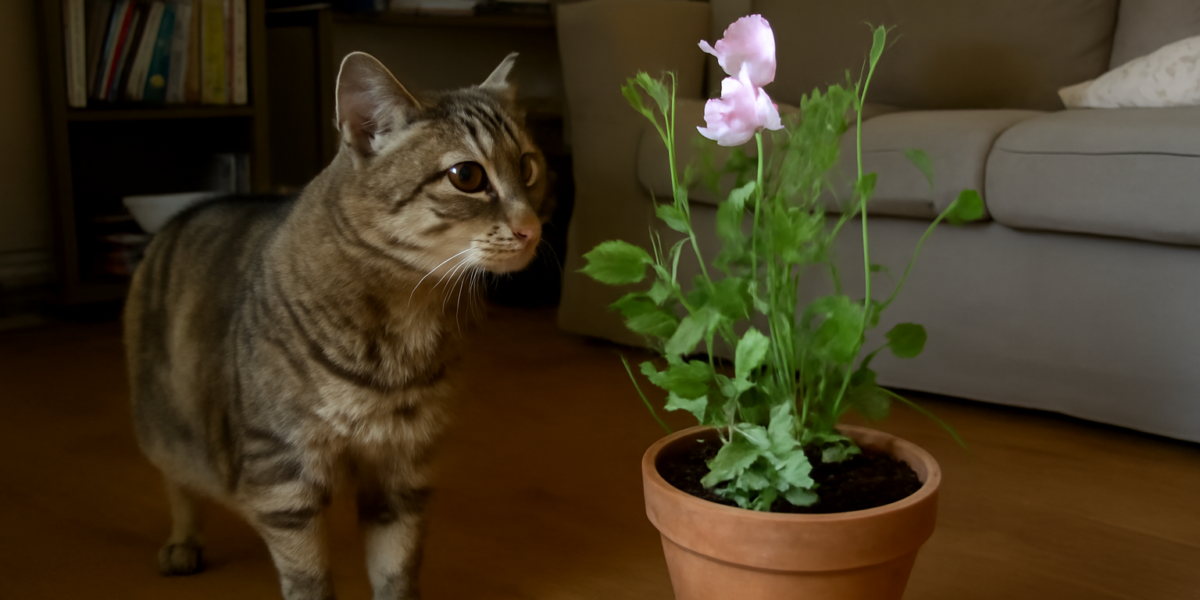
Are Sweet Peas Toxic to Cats? The Short Answer
Yes — ornamental sweet peas (Lathyrus odoratus, family Fabaceae) are toxic to cats. The plant contains lectins and a group of compounds collectively called lathyrogens, including aminopropionitrile, that can damage connective tissue and the nervous system in chronic exposures and produce gastrointestinal upset and weakness in acute ingestions. The seeds and pods carry the highest concentration of toxin, which matters because they look like edible garden peas and cats sometimes investigate them when they roll out of seed packets or fall on the ground.
In this article
- Are Sweet Peas Toxic to Cats? The Short Answer
- Crucial First Clarification: Sweet Peas Are Not Edible Peas
- What Are Lathyrogens?
- Which Parts of the Sweet Pea Plant Are Toxic?
- Symptoms of Sweet Pea Poisoning in Cats
- What to Do in the First Hour
- What Veterinary Treatment Looks Like
- Why Cats End Up Eating Sweet Peas
- Prevention and the Pet-Safe Garden
- Other Garden Vines and Climbers Cat Owners Should Know
- For Households With Both Cats and Dogs
- Choosing a Cat With a Trellis Garden in Mind
- Frequently Asked Questions
If your cat has chewed any part of a sweet pea plant — flower, vine, leaf, pod, or seed — call your veterinarian, the ASPCA Animal Poison Control Center at 888-426-4435, or the Pet Poison Helpline at 855-764-7661. Both poison lines charge a consultation fee. Most acute cat exposures produce mild-to-moderate signs that resolve with supportive care, but ingestion of seeds or pods raises the concern level and warrants a clinical assessment.
Crucial First Clarification: Sweet Peas Are Not Edible Peas
This is the single most important point on the page, because the wrong assumption sends owners to the wrong conclusion. Two completely different plants share the word “pea” in their common name.
- Sweet pea (Lathyrus odoratus): the ornamental flowering vine grown for fragrant cut flowers. Toxic. Not for eating. Pods and seeds look like small edible peas but contain lathyrogens.
- Edible garden pea (Pisum sativum): the culinary pea — green peas, snap peas, snow peas, split peas. Safe in moderation for cats and dogs. A different genus entirely.
The two plants are in the same family (Fabaceae, the legumes) but in different genera, and their pods and seeds carry very different chemistry. If you searched for “can my cat eat peas” expecting to know whether to share dinner pea pods, you are looking for a different answer — culinary Pisum sativum peas are safe for cats in small amounts as an occasional treat. This article is specifically about the ornamental flowering Lathyrus odoratus, which is not safe.
What Are Lathyrogens?
The Lathyrus genus produces a small family of toxic amino acid analogues collectively called lathyrogens. The best-studied is beta-aminopropionitrile (BAPN), a lysyl oxidase inhibitor that interferes with collagen and elastin cross-linking — the proteins that hold connective tissue together. The seeds of grass pea (L. sativus), a cousin of sweet pea grown as a famine crop, are the historical source of “lathyrism” — a chronic neurological and skeletal condition documented in human populations during food shortages.
For pets, the chronic-poisoning picture relevant to humans is rare because cats and dogs almost never eat Lathyrus seeds in quantity over weeks. The acute-poisoning picture is more familiar to vets — vomiting, weakness, and occasional neurological signs after a one-off ingestion. Sweet pea (L. odoratus) also contains lectins, the same protein class found in raw red kidney beans, which add to the gastrointestinal irritation a cat experiences after chewing seeds or pods.
Which Parts of the Sweet Pea Plant Are Toxic?
All parts contain some level of toxin, but concentrations are not equal. Knowing what your cat ate helps the vet assess severity.
- Seeds and pods: highest concentration of lathyrogens and lectins. The most concerning ingestion type. Seeds in particular look like green peas and roll out of opened packets where curious cats find them.
- Flowers: lower concentration but still toxic. Cut bouquets are a common exposure route because owners do not realize the cut flower is toxic.
- Leaves and vines: lower concentration than seeds but still capable of causing oral irritation and vomiting in larger ingestions.
- Roots: not commonly eaten by cats; concentration data limited.
If the chewed part was a sealed seed packet from a garden center, save the packet for the vet — the variety name tells the clinician roughly what concentration to expect.
Symptoms of Sweet Pea Poisoning in Cats
Acute signs typically appear within a few hours of ingestion and reflect a combination of GI irritation from the lectins and systemic effects from the lathyrogens.
- Vomiting, sometimes containing chewed plant material or whole seeds
- Diarrhea, occasionally with mucus or fresh blood
- Drooling, foaming, or pawing at the mouth
- Reduced appetite and reluctance to eat for 24 to 48 hours
- Lethargy, hunched posture, or hiding
- Weakness in the back legs in larger ingestions
- Tremors, wobbly gait, or other neurological signs in severe cases — uncommon but possible
Chronic neurological signs documented in humans (lathyrism) are not a typical clinical picture in cats and would only emerge after weeks of ingestion that almost never occurs in a household setting. Acute sign severity depends on the dose, the body weight of the cat, and which part of the plant was eaten. Kittens and small adults are at higher risk for the same exposure.
What to Do in the First Hour
The decontamination workflow is the same as for any toxic plant: contain, identify, call.
- Move the cat away from the plant. Pick up any chewed seeds, pods, or vine pieces so the cat cannot return to them.
- Rinse the mouth gently. Wipe the gums and tongue with a damp soft cloth. Offer fresh water.
- Identify what was eaten. Take a clear photo of the plant or the seed packet. Note how much is missing.
- Call your veterinarian or poison control. ASPCA APCC: 888-426-4435. Pet Poison Helpline: 855-764-7661. Both charge a fee.
- Do not induce vomiting at home. Hydrogen peroxide is dangerous for cats and is not always appropriate for sweet pea exposure; let the clinician decide.
Most uncomplicated cases are managed at home with monitoring and a bland diet. Veterinary visits are warranted if the cat ate seeds or pods, ate a substantial amount of foliage, is showing more than mild signs, or is very young, very old, or has pre-existing kidney or liver disease.
What Veterinary Treatment Looks Like
There is no specific antidote for lathyrogens or sweet pea lectins. Treatment is supportive and aimed at protecting the gut, restoring fluid balance, and managing any neurological signs that appear. Depending on the severity, your cat may receive:
- Anti-emetic medication (maropitant or ondansetron) to control vomiting
- Subcutaneous or intravenous fluids to correct dehydration
- Gastric protectants such as sucralfate to coat irritated mucous membranes
- Activated charcoal in selected early cases — only useful within roughly the first hour and only with a protected airway
- Blood work to assess liver and kidney function in larger ingestions
- Hospitalization for IV fluids and monitoring if neurological signs develop
Most cats are discharged within 24 hours and recover fully within several days. Persistent vomiting, refusal to eat for more than 36 hours, or any neurological signs are reasons to escalate care.
Why Cats End Up Eating Sweet Peas
Cats are not natural pea-pod chewers, so most cases follow a predictable pattern. Knowing the pattern helps you put the right barrier in place.
- Spilled seed packets. Sweet pea seeds rolled out of an open packet and found by a curious cat. Common in spring when gardeners are sowing.
- Cut flower bouquets. Sweet peas are a popular cottage-garden cut flower. A vase on a low table is fair game for a counter-surfing cat.
- Outdoor cats grazing. A free-roaming cat sampling a vine on the trellis. Less common because the leaves are not especially appealing, but it happens.
- Mistaken identity. Owners growing edible peas and ornamental sweet peas in the same kitchen-garden bed sometimes confuse them; cats follow.
Storage and placement fix most of these. Seal seed packets in a closed jar. Put bouquets on a high mantel. Plant ornamental sweet peas in a dedicated cutting bed away from the main pet zone.
Prevention and the Pet-Safe Garden
You can keep sweet peas in your life without putting your cat at risk. The strategies below cover the household and garden cases.
- Store seeds in a cat-proof container. A glass jar with a lid in a closed cupboard is more reliable than a paper packet on the kitchen counter.
- Place cut bouquets on high surfaces. Cats jump, but most will not target a bouquet that is genuinely out of reach.
- Plant ornamentals in a dedicated cutting bed. Fence the bed or grow the vines on a tall trellis that the cat does not patrol.
- Replace risky borders with safer flowers. Our pet-safe garden plants guide and cat-safe flowers roundup list comparable cottage-garden flowers that are non-toxic.
- Provide cat grass indoors. A pot of safe greens gives a chewing cat something legal to nibble.
Other Garden Vines and Climbers Cat Owners Should Know
If you grow sweet peas, you probably grow other climbers. Several of them carry their own toxicity. The companion guides below help you audit the trellis bed.
- Honeysuckle and cats — saponins and cardiac glycoside-like compounds in some species.
- Bleeding heart and cats — isoquinoline alkaloids; same Fumariaceae family hazard.
- Larkspur and cats — diterpene alkaloids in a related cottage-garden flower.
- Foxglove and cats — cardiac glycosides; the most dangerous cottage flower.
The pattern is consistent: cottage-garden style favors species with active chemistry. A good rule of thumb is to identify every plant on your trellis and bed, then look up each on the ASPCA database before declaring the bed pet-safe.
For Households With Both Cats and Dogs
Sweet peas are toxic to dogs as well as cats. If your dog was caught eating the seeds or vines, see our companion guide on sweet peas and dogs. The clinical pictures are similar; dogs are more likely to consume larger volumes in a single event because they swallow rather than chew, which can shift severity. In multi-species households, treat any sweet pea exposure for either pet as a reason to audit storage and planting locations for both.
Choosing a Cat With a Trellis Garden in Mind
Cottage gardens and curious cats can coexist when you plant defensively. If you are still adopting and trying to think through the household match, our adopt a cat hub helps you weigh the indoor-outdoor lifestyle question. Many shelter cats come with notes on whether they are confirmed plant chewers — useful information when you have a sweet pea trellis and want to plan around it.
Frequently Asked Questions
Can my cat eat regular green peas?
Edible garden peas (Pisum sativum) are safe for cats in small amounts as an occasional treat. They are a different plant from ornamental sweet peas (Lathyrus odoratus) and do not contain the same lathyrogens. A few thawed peas mixed into a meal are fine.
How much sweet pea is dangerous for a cat?
There is no published toxic dose. Severity depends on which part of the plant was eaten — seeds and pods are the most concerning — and on the cat’s body weight. Treat any deliberate ingestion as a reason to call your veterinarian.
My cat sniffed a sweet pea bouquet but did not eat it. Should I worry?
Sniffing is not ingestion. If the cat is bright and eating, monitor for delayed signs over the next 12 hours. Move the bouquet out of reach and check that no petals fell on the floor.
Are dried sweet peas in a craft arrangement still toxic?
Lathyrogens persist in dried plant material. A dried craft arrangement should be treated with the same caution as fresh material if a cat chews on it.
What can I plant instead of sweet peas if I have an outdoor cat?
Climbing roses, clematis (lower-toxicity than many think but still a Ranunculaceae — verify with vet), morning glory (not pet-safe), or non-vining alternatives like snapdragons and cosmos give cottage-garden style without the Lathyrus risk. See our cat-safe flowers roundup.


