
Last updated: May 16, 2026
In this article
Can Dogs Eat Cranberry Sauce? The Short Answer
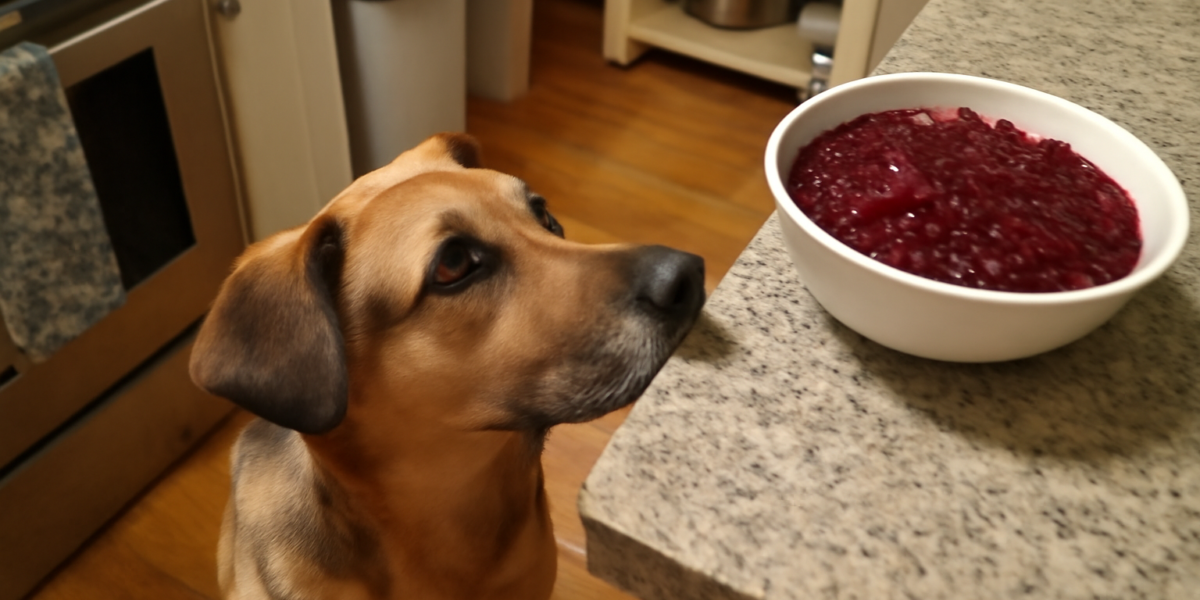
Cranberry sauce sits in an awkward middle ground for dogs. Plain cooked cranberries — the actual berry — are not toxic and have a long history of veterinary use for urinary tract support. The trouble is that almost no one serves plain cooked cranberries. The sauce on a Thanksgiving table is usually heavily sweetened, often combined with orange zest or orange juice, sometimes spiked with port or grand marnier, and in some recipes thickened with raisins or other dried fruit. Each of those additions changes the safety calculation.
If you want a clean answer for the holiday: a teaspoon or two of homemade plain cranberry sauce, made without raisins, citrus, or alcohol, is generally tolerated by a healthy adult dog. Commercial canned cranberry sauce is too sugary to recommend, and any sauce containing raisins should be considered off-limits. Diabetic dogs and dogs on weight-management plans should skip cranberry sauce entirely. If your dog stole a spoonful from the table, you do not have a poison emergency on your hands — but you do need to read the recipe.
What Cranberries Themselves Bring to the Table
Whole cranberries are surprisingly nutrient-dense. They are high in vitamin C, manganese, and a class of compounds called proanthocyanidins, which interfere with the ability of certain bacteria to stick to bladder walls. That is why cranberry supplements are sometimes used as adjuncts in canine urinary tract health, although the evidence in dogs is more mixed than the marketing suggests. Our fresh cranberries for dogs guide covers the supplement-versus-food question in more detail.
The berries are also fairly high in fiber and quite low in sugar in their natural form — about four grams of sugar per cup of fresh cranberries, compared with around twenty-four grams in a quarter cup of canned sauce. That difference is the entire reason cranberry sauce is risky and plain cranberries are mostly fine. The cooking process itself is not a problem; the sugar that gets stirred in is.
For dogs who already eat a balanced diet, cranberries are not a nutritional necessity. They are a “nice extra” rather than a fix for any particular problem. Most veterinarians recommend going to plain unsweetened cranberry powder if you specifically want the urinary support benefit, rather than feeding sauce or juice.
Why Commercial Canned Cranberry Sauce Is a Problem
Canned cranberry sauce — both the jellied “log” variety and the whole-berry style — is built on a roughly one-to-one ratio of sugar to fruit by weight. A standard quarter-cup serving carries about twenty-four grams of sugar, which is a meaningful share of the daily sugar tolerance for a small or medium dog. Persistent or repeated high-sugar exposures contribute to dental disease, weight gain, and over time can stress glucose regulation in predisposed dogs.
The bigger acute risk for diabetic dogs is hyperglycemia. A single spoon of canned sauce can spike blood glucose enough to disrupt insulin balance and produce GI upset, increased thirst, and increased urination. For dogs on prescription weight-loss diets, the calorie load is similarly disproportionate. If your dog has diabetes, do not feed cranberry sauce in any form.
Most canned sauces also use high-fructose corn syrup or sucrose, sometimes both. Some “premium” or “organic” brands swap in honey or maple syrup, which are lower glycemic but still sugar. Cranberry “relish” varieties may also include cinnamon, allspice, or clove — small amounts are not toxic, but they add nothing useful for dogs.
The Citrus Question
A huge share of homemade cranberry sauce recipes call for orange zest, orange juice, or both. Citrus is not in the same toxicity tier as onions or chocolate, but it is not a dog-friendly ingredient either. The peel and zest contain essential oils — limonene and linalool — that can cause GI upset, drooling, and in larger amounts central nervous system effects. The juice is acidic and high in sugar.
A small accidental serving of orange-zested cranberry sauce is unlikely to cause serious harm. A dog that gets into the whole bowl, however, may show vomiting, diarrhea, and in some cases a brief wobbly or sedated appearance from the citrus oils. If you are making cranberry sauce for a household with a dog, swap the orange zest for a strip of lemon thyme or a splash of unsweetened apple juice — both add brightness without the citrus oil load.
Lemon and lime appear in some cranberry recipes too. The same logic applies — the peel oils are the bigger concern, the juice is mostly an acid and sugar issue. None of these are emergency-level exposures from a small taste, but none of them belong in a dog’s bowl as a deliberate treat.
Raisins and Dried Fruit: The Hidden Hazard
Some cranberry sauce recipes — especially “old-fashioned,” “harvest,” or “Waldorf-style” versions — include raisins, currants, or sultanas. Some include chopped dates, dried apricots soaked in port, or a tablespoon of dried cherries. The raisin and currant additions are the dangerous ones. Raisins and grapes can cause acute kidney injury in dogs, and there is no known safe threshold; some dogs tolerate handfuls and others have serious reactions to a single piece. Our full guide on grapes for dogs walks through what we currently understand about the toxicity mechanism.
Because the susceptibility is unpredictable, every cranberry sauce that contains raisins should be treated as off-limits. If your dog ate a sauce containing raisins, do not assume “it was only a small amount” — call Pet Poison Helpline at 855-764-7661 or ASPCA Animal Poison Control at 888-426-4435 and follow their triage advice. Early decontamination and IV fluids dramatically improve outcomes if kidney injury starts to develop.
The same principle applies to prunes, dried cherries soaked in alcohol, and dried fruit clusters from gift baskets that often end up in holiday dishes. Read every recipe before sharing.
If Your Dog Ate Cranberry Sauce
The first move is to identify the recipe. A teaspoon of plain homemade sauce — cranberries, sugar, water, no orange, no raisins, no alcohol — is rarely a serious concern in a healthy adult dog. A spoon or two of canned sauce is unlikely to cause more than mild GI upset. A meaningful serving of citrus-spiked, raisin-containing, or alcohol-spiked sauce is a different conversation and warrants a call to your vet.
Watch the dog over the next twenty-four hours for vomiting, diarrhea, lethargy, or refusal to eat. Increased thirst and urination are normal short-term responses to a sugar load. If you see decreased urination, persistent vomiting, or unusual lethargy in the first one to three days after eating raisin-containing sauce, treat that as a kidney injury concern and head to the vet.
Diabetic dogs should have their blood glucose checked sooner rather than later if they accidentally eat sweet cranberry sauce, even in small amounts. Communicate the exposure to your vet so they can adjust the next insulin dose or recommend a recheck.
Better Cranberry Choices for Dogs
If your goal is to share the holiday with the dog, you have a few clean options. The simplest is a few plain fresh or frozen cranberries straight from the bag — most dogs find them sour and only eat one or two, which is a perfect “tasting portion” without much risk of overconsumption. A second option is a homemade dog-safe sauce: a quarter cup of fresh cranberries simmered in two tablespoons of water until they pop, with no sweetener at all. The result is tart and dogs either love it or ignore it.
You can also use a tiny amount of unsweetened cranberry juice as a flavor topper on plain food. Look for “100% cranberry juice” with no added sugar — the cocktail and “juice drink” varieties are mostly sweetener and apple juice. For the urinary support angle, your veterinarian can recommend a dog-formulated cranberry supplement that gives you a known dose without the sugar load and without the citrus or raisin contamination risks of homemade sauce.
Frozen cranberries also make a nice “ice cube” treat in summer — drop two or three into the dog’s water bowl and let them bob around. Most dogs find this curious and refreshing. Some owners blend a small handful of fresh cranberries with plain unsweetened pumpkin puree, freeze the mixture in silicone molds, and offer the resulting cubes as a holiday treat. Both deliver the cranberry flavor with no added sugar, no citrus, and no risk of accidentally including a raisin.
For the rest of the holiday plate, our Thanksgiving stuffing warning, Easter ham guide, and fruitcake warning cover the main dishes that need to stay off the dog plate. The safe staples — plain turkey breast, plain blueberries, and a spoon of plain pumpkin puree — make a generous holiday treat plate without any of the risk. For pancreatitis-prone dogs, our pancreatitis guide covers what to keep out of the bowl entirely during family gatherings.
Frequently Asked Questions
Can my dog eat the canned jellied cranberry sauce?
Technically a tiny amount will not poison most healthy dogs, but the sugar content is high enough that we do not recommend it. If your dog stole a piece, watch for GI upset for the next twenty-four hours and skip a meal if needed. Diabetic dogs should not eat canned sauce in any amount.
Is sugar-free cranberry sauce safer?
It depends entirely on the sweetener. If “sugar-free” means stevia or monk fruit, the sauce is generally tolerable in small amounts. If it contains xylitol — sometimes labeled as “birch sugar” — it is dangerous. Xylitol causes rapid hypoglycemia and liver damage in dogs, and the threshold is low. Read the label carefully.
What about cranberry sauce with apples or pears?
Apples and pears themselves are dog-safe in moderation, so a sauce that uses them as a partial sweetener is a slight improvement over straight sugar. Make sure no seeds or cores are included — apple seeds contain trace cyanide and are best avoided in volume.
My dog ate raisin-containing cranberry sauce — what do I do?
Call Pet Poison Helpline at 855-764-7661 or your veterinarian right away. Do not wait for symptoms. Early intervention with IV fluids is the most effective way to prevent kidney injury after raisin ingestion.
Can I make a dog-friendly cranberry sauce?
Yes — simmer fresh or frozen cranberries in plain water until they pop, with no sweetener, citrus, or alcohol. A teaspoon or two on top of regular food is a fine occasional treat. Skip cinnamon and allspice for routine feeding, and never add raisins.


