
Last updated: May 16, 2026
In this article
- Hedera Helix at a Glance
- What the Latin Name Tells You
- The Toxic Compounds in Hedera Helix
- Symptoms After a Cat or Dog Chews the Plant
- Hedera Helix Versus Devil’s Ivy: Why the Distinction Matters
- First-Aid Steps After an Ingestion or Sap Contact
- When to Call the Vet versus Monitor at Home
- Living With Hedera Helix in a Pet Household
- How Hedera Helix Compares to Other Common Vining Plants
- Frequently Asked Questions
Hedera Helix at a Glance
Hedera helix is the botanical name for the climbing evergreen vine commonly called English ivy, common ivy, or just “ivy” when no qualifier is given. If you searched the Latin name, you may be checking a tag on a hanging basket, identifying a vine that has crept up an outdoor wall, or trying to confirm what your landscaper planted along a fence line. The American Society for the Prevention of Cruelty to Animals (ASPCA) lists Hedera helix as toxic to cats and dogs because of saponins called hederagenin glycosides combined with a polyacetylene compound called falcarinol.
Before going further, an important distinction. The plant frequently sold under the name “devil’s ivy” is not Hedera helix — it is Epipremnum aureum, sometimes also called golden pothos. Both are toxic, but they are different plants with different chemistry, different appearances, and different families. If your tag says Hedera helix, this article applies. If the tag says Epipremnum, devil’s ivy, or pothos, the chemistry described here is the wrong reference. We will distinguish them in detail below.
This Latin-name guide is the technical companion to our common-name pillars. The English ivy toxic to cats, English ivy toxic to dogs, is English ivy toxic to dogs, and is ivy toxic to cats articles cover the same chemistry from the common-name angle. Save your veterinarian’s number, the ASPCA Animal Poison Control Center hotline at 888-426-4435 (per-call fee applies), and the Pet Poison Helpline at 855-764-7661 in your contacts.
What the Latin Name Tells You
Hedera helix is in the family Araliaceae, the same family that includes ginseng, schefflera (umbrella tree), and aralia. The genus Hedera has about 15 species of woody climbing evergreen vines native to Europe, North Africa, and southwestern Asia. Hedera helix is the most widely cultivated and the most commonly seen as both a houseplant and an outdoor groundcover or wall vine.
The plant is famous for its growth habit. Young plants produce the recognizable lobed leaves and trailing vines that are sold as hanging-basket houseplants and used as outdoor groundcover. As plants mature and reach climbing surfaces, they transform — producing aerial rootlets that cement the plant to walls and trees, then shifting to a different leaf form (oval, unlobed) and producing flowers and small black berries in late autumn. The mature climbing form is what you see covering old buildings in postcard images of European architecture.
Both growth forms — juvenile trailing and mature climbing — contain the same toxic compounds. The berries that mature plants produce are particularly worth flagging because they are small, dark, and fall on the ground in autumn, where curious dogs may treat them as food. Berry ingestion can deliver a higher concentrated dose of toxin than leaf chewing.
The Toxic Compounds in Hedera Helix
The two main toxic components of Hedera helix are hederagenin saponins and falcarinol. The saponins are triterpene glycosides — sugar-bound molecules with a soap-like surfactant action — and they cause irritation to mucous membranes and the gastrointestinal tract. They also have hemolytic potential at high doses, meaning they can damage red blood cells in the bloodstream, although this is rarely seen at the doses pets typically ingest.
Falcarinol is a polyacetylene compound that contributes the contact dermatitis and skin irritation aspect of the plant’s toxicity. Falcarinol is also found in carrots, parsnips, and ginseng, where it is present at much lower concentrations and causes occasional contact dermatitis in agricultural workers. In Hedera helix it is concentrated enough to produce reliable skin irritation in pets that contact the cut sap.
The combined effect produces both gastrointestinal upset (from the saponins) and skin/contact reactions (from the falcarinol). The clinical course is typically mild-to-moderate rather than severe, but the dual mechanism means a single chew can produce more diverse symptoms than you might expect from a saponin-only plant.
Symptoms After a Cat or Dog Chews the Plant
Oral exposure typically produces drooling, head-shaking, and pawing at the mouth within minutes of chewing. Vomiting follows within 30 minutes to a few hours, often with leaf fragments visible. Diarrhea can develop over the next 12 hours, sometimes with mucus or small amounts of blood from intestinal mucosal irritation. Loss of appetite is common because the GI tract is uncomfortable.
Skin contact — usually from a pet brushing against fresh-cut vines or having ivy sap transferred onto fur — produces redness, itching, and occasionally raised welts. The face, paws, and belly are common contact zones. In severe cases, blistering can occur, particularly on thin-furred areas of skin like the inner ears or belly. Pets sometimes develop the skin reaction over 12 to 48 hours after the contact rather than immediately.
More severe systemic signs are uncommon but worth knowing about: ataxia (unsteady gait), excessive salivation that does not subside, dilated pupils, and in rare cases muscle tremors or seizures. These are reasons for an emergency vet visit, not home monitoring. Hederagenin saponins at high doses have been associated with hemolytic anemia, which would present as pale gums, weakness, and discolored urine — uncommon, but a vet visit is essential if any of those signs appear.
Hedera Helix Versus Devil’s Ivy: Why the Distinction Matters
The naming overlap between Hedera helix and “devil’s ivy” causes regular confusion and occasional misidentification at nurseries. Devil’s ivy is Epipremnum aureum (sometimes also called golden pothos or pothos), a tropical aroid in the family Araceae. It contains calcium oxalate raphides — the same painful needle-shaped crystals found in dieffenbachia and philodendron — not the saponins and falcarinol found in Hedera helix.
The clinical differences matter for first-aid response. Devil’s ivy ingestion causes immediate severe oral pain, drooling, and sometimes airway swelling — a calcium oxalate raphide picture. Hedera helix ingestion causes more delayed GI upset with vomiting and diarrhea, plus possible skin reactions — a saponin and falcarinol picture. The vet routing is similar (call your vet, ASPCA APCC, or Pet Poison Helpline), but knowing which plant is involved helps the veterinary team triage and prepare.
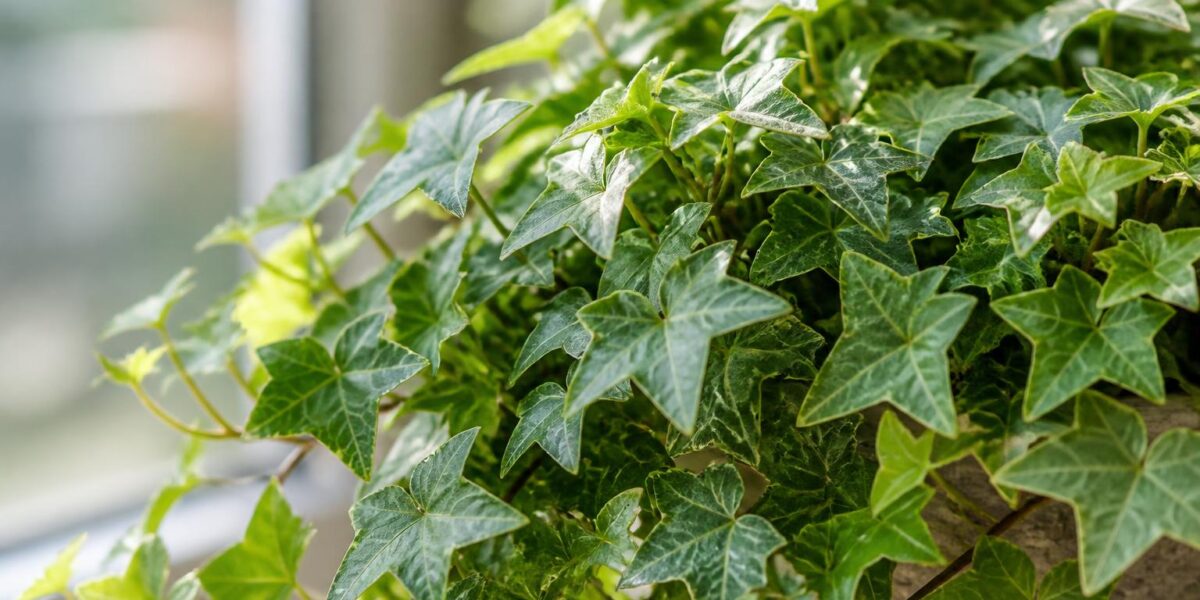
Visually: Hedera helix has lobed evergreen leaves on woody vines, often with white-cream variegation in some cultivars, and grows as a climbing or trailing plant outdoors year-round in temperate climates. Devil’s ivy (Epipremnum aureum) has unlobed heart-shaped leaves, often with yellow-cream variegation, and is a tropical houseplant that does not survive outdoors in cold climates. If you are not sure which plant your pet chewed, photograph the leaf and bring it to the vet — both are toxic and both warrant care, but the chemistry differs.
First-Aid Steps After an Ingestion or Sap Contact
For an oral ingestion, take the plant material away gently and wipe the mouth with a soft damp cloth. Offer small amounts of fresh water. Do not give milk or vegetable oil; neither binds the toxic compounds and both add gut workload. Do not induce vomiting on your own — the saponins can be more irritating in repeat passage through the esophagus, and home induction with hydrogen peroxide is unreliable in cats. Call your vet, the ASPCA APCC at 888-426-4435, or the Pet Poison Helpline at 855-764-7661 first.
For sap contact on skin or fur, wash the area with mild dish soap and lukewarm water. Dish soap breaks up the plant resin more effectively than pet shampoo. Rinse thoroughly to avoid soap residue irritation. Focus on the most contaminated areas first (typically face and paws). Wear gloves while you wash; falcarinol affects human skin too.
For a pet that has eaten ivy berries (the small black fruits on mature plants), this is more concerning than a leaf chew because berries can deliver a concentrated dose. Bring photos of the plant and berries, an estimate of the number of berries eaten, and call ahead so your vet can prepare for decontamination if appropriate.
When to Call the Vet versus Monitor at Home
For a small leaf chew in a healthy adult cat or dog with no underlying conditions, the typical course is GI upset that resolves in 12 to 24 hours with rest, plain water, and a bland diet. Boiled chicken and white rice for dogs, plain unseasoned chicken or a prescription GI diet for cats, in small frequent portions over the next day, gives the irritated gut a break.
Call the vet promptly if any of the following are present: your pet is a kitten, puppy, senior, pregnant, or has known kidney, liver, heart, or GI disease; vomiting is repeated and dehydrating; you see blood in vomit or stool; your pet has not drunk water in 6 to 8 hours; berries were eaten rather than just leaves; skin reaction is spreading or developing welts; or any neurological signs are present (unsteadiness, dilated pupils, tremors, weakness). These are situations where IV fluids, anti-emetics, ophthalmic exam, or topical care will outperform home management.
For broader plant safety browsing, see the cat-safe houseplants roundup, the cat-safe houseplants guide, and the dog-safe houseplants guide. The non-toxic vining alternatives include spider plants and certain Hoya species — verify each against the ASPCA list.
Living With Hedera Helix in a Pet Household
Indoor Hedera helix as a hanging basket or trailing pot plant can coexist with pets if it is positioned where they cannot reach it. Cats are good jumpers and skilled at accessing hanging baskets that look unreachable, so consider the pathways: is there nearby furniture that creates a launch point? A bookshelf? A window sill that becomes a stepping stone? If yes, the plant is functionally accessible.
Outdoor Hedera helix on house walls or as groundcover is harder to manage in a pet household because of the area involved. Dogs that have access to the yard will encounter the plant, and the autumn berry drop is the highest-risk moment. If you have an established ivy wall and a curious dog, supervised yard time during berry season is the practical mitigation. Removing the plant entirely is a substantial landscape project but is worth considering for households with persistent chewers or for outdoor cats that share the yard with a chewing dog.
If you decide to remove the plant, be aware that Hedera helix is invasive in many parts of North America and dispose of cuttings carefully. Bag and trash, do not compost — pieces can root in compost piles and reestablish. Wear gloves and long sleeves while removing. The cut sap will affect your skin too.
How Hedera Helix Compares to Other Common Vining Plants
Within the indoor vining houseplant category, Hedera helix sits in the moderate toxicity range — more clinically meaningful than a non-toxic option like a Hoya or Chlorophytum, comparable to or slightly worse than philodendron and pothos in symptom severity. The skin-contact dimension makes it less manageable than purely-GI toxic plants because pets can be exposed without ever putting the leaves in their mouths.
Other common vining plants in pet households: pothos and philodendron contain calcium oxalate raphides; the chemistry is different but the vet response similar. Hoya species (wax plant) are non-toxic per ASPCA. Spider plants in their trailing form are non-toxic. Strings-of-hearts (Ceropegia woodii) is generally considered non-toxic but has thinner data. Always verify a specific plant against the ASPCA list before bringing it into a pet household.
For pet-safe vining alternatives to Hedera helix, look at Hoya carnosa (wax plant), Hoya kerrii (sweetheart hoya), spider plant trained as a trailer, and the air plant (Tillandsia) collection if you want hanging interest without potted vines. All four options give you trailing or hanging visual interest without the saponin risk.
Frequently Asked Questions
Are variegated Hedera helix cultivars (Glacier, Goldchild) more or less toxic?
The toxicity is the same. The named cultivars are visual variants of Hedera helix with different leaf colors and patterns. All produce the same hederagenin saponins and falcarinol. Treat any plant labeled Hedera helix — under any cultivar name — as toxic to cats and dogs.
Is the risk worse from leaves or from the berries?
Berries deliver a concentrated dose because the saponins are more concentrated in fruiting parts. A pet that eats several ivy berries is at higher risk of significant GI upset than a pet that chews one leaf. Berry ingestions also raise the risk of more pronounced systemic effects because of the higher dose. Treat berry exposures with prompt vet contact regardless of how your pet seems.
Can my pet develop a long-term reaction from skin exposure to ivy sap?
The skin reaction is acute and resolves with the irritant removed. There is no documented chronic dermatitis pattern from intermittent exposures the way there is with poison ivy in humans, although a pet that contacts the plant repeatedly may develop more sensitivity over time. Consistent skin contact with cut sap can cause cumulative irritation, so manage the source rather than treating recurring symptoms.
Are Boston ivy and Virginia creeper the same as Hedera helix?
No. Boston ivy is Parthenocissus tricuspidata, and Virginia creeper is Parthenocissus quinquefolia — both in a different family (Vitaceae) from Hedera helix (Araliaceae). They contain calcium oxalate raphides similar to dieffenbachia rather than saponins. They are also toxic to pets but through a different mechanism. The walls covered with red autumn leaves at universities are usually Parthenocissus, not Hedera, though in a yard setting both genera are common.
What pet-safe vining plants give me a similar look?
For indoor trailing or hanging interest, Hoya carnosa (wax plant), spider plant in trailing form, and Boston fern in a hanging basket are non-toxic per ASPCA and provide similar visual roles. For outdoor groundcover, certain ground-cover sedums, creeping thyme, and creeping Jenny are pet-friendlier — verify each against the ASPCA list before planting at scale. None of them have the climbing-wall behavior of Hedera helix, so for that specific use case, the answer is mostly to choose a different aesthetic rather than a substitute plant.


