
Last updated: May 16, 2026
In this article
- Arugula Plants and Your Pets: The Short Answer
- What Arugula Actually Is — A Brassica Cousin
- Why Arugula Lands in the Safe Bucket
- What “Non-Toxic” Does Not Mean
- Cats and Arugula
- Dogs and Arugula
- Sibling Brassica Plants in the Same Bed
- Designing a Pet-Friendly Salad Garden
- If Your Pet Just Ate Arugula
- Frequently Asked Questions
Arugula Plants and Your Pets: The Short Answer
If your dog or cat just nibbled a peppery leaf out of your salad bed, you can take a deep breath. Arugula plants (Eruca sativa, sometimes still listed under the older name Eruca vesicaria) are not on the ASPCA toxic-plants list. The leaves, stems, flowers, and seedlings are considered non-toxic to dogs, cats, and horses, and small foraging mouthfuls from your kitchen garden almost never cause anything more dramatic than a momentary funny face at the spicy taste.
This article covers the arugula PLANT — what happens if your pet nibbles the leaves, stems, or seedlings in your vegetable garden bed. For whether arugula as a salad green is appropriate to feed your pet on purpose, search our food-safety side for the matching can-dogs-eat or can-cats-eat guide. The plant-side answer is the calm one: arugula belongs to the safe, leafy section of the kitchen garden, and you do not need to fence it off from a curious cat or a salad-thieving terrier.
What Arugula Actually Is — A Brassica Cousin
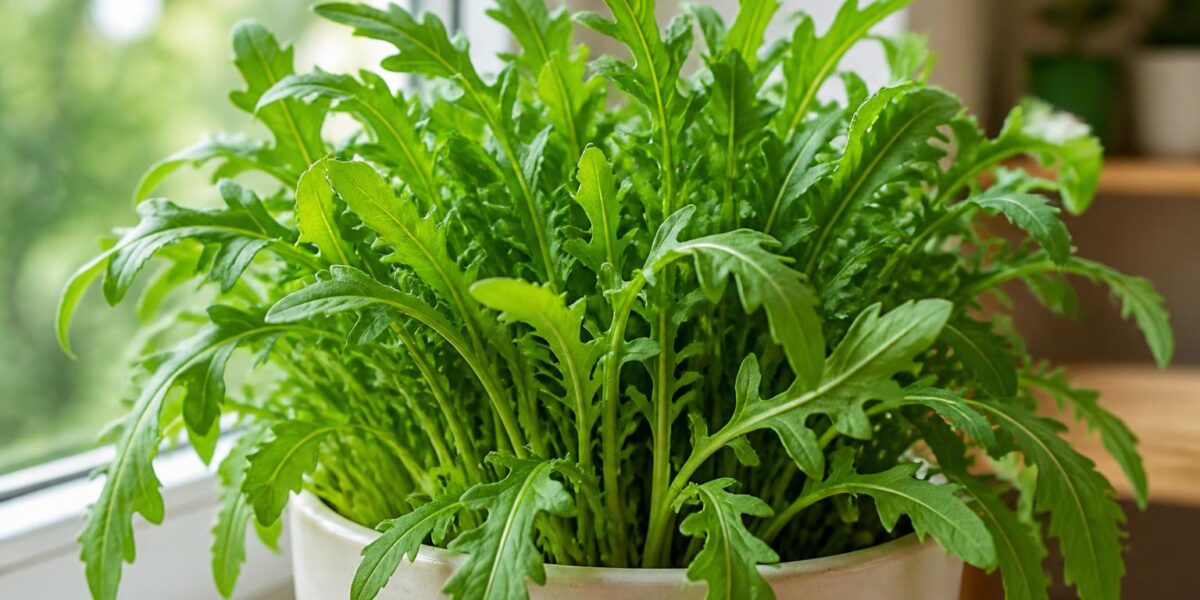
Arugula is a fast-growing leafy annual in the Brassicaceae family, the same broad plant family that gives us kale, cabbage, broccoli, bok choy, mustard greens, and radishes. You may also see it sold as rocket, rucola, salad rocket, or roquette depending on which corner of the world the seed packet came from. The peppery, slightly mustardy flavor that makes it interesting on a salad plate comes from glucosinolates — sulfur-containing compounds shared across the whole Brassica clan.
In a typical home garden, arugula germinates within days and is ready to harvest as baby greens in three to four weeks. It bolts quickly in heat, sending up a slender flowering stalk topped with small cream-colored, four-petaled flowers — a giveaway of its Brassica family lineage. Wild arugula (Diplotaxis tenuifolia) is a related species sometimes grown alongside the cultivated kind. From a pet-safety standpoint, both are treated the same: non-toxic and not a worry for the foraging garden visitor.
Why Arugula Lands in the Safe Bucket
The ASPCA’s Toxic and Non-Toxic Plants database does not flag Eruca sativa as a problem plant for dogs, cats, or horses. There are no documented toxic glycosides, alkaloids, oxalate clusters, or volatile oils that would push arugula into the moderate or severe categories. The glucosinolates that give arugula its bite are present in much smaller concentrations than what you find in true mustard plants, and they don’t cause the kind of clinical poisoning seen with ornamentals like lilies, sago palms, or oleander.
For the same reason, you’ll find arugula on most vet-prepared lists of safe leafy greens that pet parents can grow alongside dogs and cats. It belongs with the other reassuring kitchen-garden leaves rather than with the suspicious ornamentals. If you’ve ever caught your dog grazing a row of baby greens, arugula is one of the calmer surprises you can pull out of their mouth.
What “Non-Toxic” Does Not Mean
Non-toxic is not the same as “infinite quantities are fine.” Any plant material, even a perfectly safe one, can cause GI upset if a pet eats far more than their stomach is built to handle. A small dog who tunnels through your raised bed and inhales an entire flat of baby arugula can absolutely come back into the house with loose stools, mild vomiting, or a refusal of dinner. The cause there isn’t toxicity — it’s volume. The same thing happens with grass, lettuce, or any leafy salad green.
Three other practical caveats worth keeping in mind:
- Pesticide and fertilizer residues. If you’ve sprayed insecticidal soap, neem, slug bait, or systemic fertilizer recently, the leaves themselves are no longer just leaves — they’re carrying whatever you applied. Wait the recommended interval before letting pets nose around the bed.
- Compost-bin curiosity. Bolted, slimy, or rotting arugula in a compost pile can grow molds that produce mycotoxins. The fresh plant is safe; the moldy aftermath is not.
- Allium cross-contamination. Arugula is often planted next to chives, garlic, or onions, which ARE toxic to dogs and cats. A pet who grazes a salad bed indiscriminately may end up eating something less benign sitting one row over.
Cats and Arugula
Cats are obligate carnivores and don’t gain much nutritionally from leafy greens, but plenty of cats nibble plants for fiber, hairball management, or sheer curiosity. Arugula is one of the more boring leaves to a typical cat — the peppery flavor often turns them off after one investigative bite. If your cat does eat a few leaves, expect it to pass uneventfully. Vomiting a small amount of plant material once is not unusual after any leafy snack and doesn’t, on its own, mean the plant was harmful.
Cats with chronic kidney disease or known oxalate sensitivities are sometimes told to avoid certain greens. Arugula is not in the high-oxalate group (unlike spinach, Swiss chard, or beet greens), so it doesn’t carry that specific concern. Still, if your cat has any dietary restriction, run greens past your vet before turning the salad garden into a free buffet.
Dogs and Arugula
Dogs are the more common arugula offenders in a home garden. Many dogs graze leafy greens with apparent enjoyment, especially during heat or when their stomach is unsettled. Arugula’s pepperiness puts off some dogs and intrigues others. A casual mouthful from a garden bed isn’t a vet visit; a dog who cleared half the row is more likely to give you a few hours of mild GI upset than anything serious.
Watch for the volume-related signs rather than poisoning signs: soft stool, gas, a reluctance to eat the next meal, or a single episode of vomiting. These typically settle within twelve to twenty-four hours with bland food. Persistent vomiting, lethargy, or anything that looks unusual should always trigger a call to your veterinarian — even with a safe plant, because a dog ploughing through a garden bed may have eaten something else you didn’t see.
Sibling Brassica Plants in the Same Bed
Arugula rarely grows alone. Most kitchen gardeners plant it as part of a leafy green rotation alongside other Brassica family members. The same “non-toxic but eat in moderation” framing applies to its closest neighbours. If you want to walk through them one by one, see our companion guides on kale plants and pet safety, collard greens and pets, broccoli plants and pets, and cabbage plants and pets.
One important exception in the Brassica family is mustard. Cultivated and wild mustard plants accumulate higher concentrations of glucosinolates than salad greens like arugula and can cause moderate GI upset if a pet eats a large amount. We cover the difference in detail in are mustard plants toxic to pets. The takeaway is that “Brassica family” is mostly a green-light family for pet-friendly gardens, but mustard is the asterisk.
Designing a Pet-Friendly Salad Garden
If you want a vegetable patch you don’t have to fence off from a foraging dog or an outdoor cat, leafy Brassica greens make a sensible backbone. Pair arugula with lettuces, spinach (in moderation — higher oxalates), bok choy, and radish leaves for a low-risk early-season bed. Avoid placing chives, garlic, onions, or leeks near anywhere a pet grazes; the entire allium family is toxic to both dogs and cats and is one of the more common kitchen-garden poisonings. Tomato and pepper foliage are another category to keep separate — the ripe fruits are mostly fine, but the leaves and stems are a different story.
For a wider menu of pet-safe planting ideas, our pet-safe garden plants roundup walks through ornamentals and edibles that earn the same green light as arugula. If you’re shifting from “ornamental garden” to “edible garden” partly so your pet can browse safely, arugula is one of the easiest first crops to put in.
If Your Pet Just Ate Arugula
For a small to moderate amount of arugula leaves or seedlings, the right move is usually to watch and wait. Offer fresh water, hold off on the next meal for an hour or two if your pet seems off, and observe stools and energy through the next day. Most pets need no further intervention.
If the amount eaten was unusually large, if the bed had been recently sprayed, or if you’re not sure whether your pet was actually grazing arugula or grabbed something else, contact your veterinarian. You can also call the ASPCA Animal Poison Control Center at (888) 426-4435 or the Pet Poison Helpline at (855) 764-7661. Both lines are available around the clock and will help you decide whether to come in for evaluation. Do not induce vomiting at home unless a veterinarian instructs you to — the wrong agent or wrong timing can cause more harm than the original ingestion.
Frequently Asked Questions
Are arugula leaves and flowers both safe for pets?
Yes. The leaves, stems, flowers, and even the small seed pods are all considered non-toxic to dogs and cats. Bolted arugula that has gone to flower is no more dangerous than the salad-stage leaves; it’s just less appetizing.
Can my dog eat arugula on purpose as a snack?
Plain, washed arugula in small amounts is a safe occasional nibble for most dogs. Skip dressings, garlic, onions, and oils, all of which are far more likely than the leaf itself to cause trouble. As with any new food, introduce slowly and watch for individual sensitivities.
My cat threw up after eating arugula — is that an emergency?
One isolated vomit after eating a leafy plant is usually a mechanical reaction rather than poisoning, and arugula isn’t on the toxic list. Continued vomiting, lethargy, refusal to eat, or any behavior that worries you should always be checked with your vet, regardless of the plant.
Is wild rocket the same as arugula for pet safety?
Wild rocket (Diplotaxis tenuifolia) and cultivated arugula (Eruca sativa) are different species but are both in the Brassicaceae family and both treated as non-toxic in standard pet-poisoning references. The peppery taste is sharper in wild rocket, but the safety picture is essentially the same.
Where do I learn more about safe pets and safe gardens?
Start with our adopt a dog hub or adopt a cat hub if you’re thinking about bringing a new family member home, and bookmark the radish plants and pets guide as another easy salad-bed companion.


