
Last updated: May 16, 2026
In this article
- Radish Plants and Your Pets: The Short Answer
- What Radish Plants Actually Are
- Why Radish Lands in the Safe Bucket
- Radish Leaves vs Radish Roots
- What “Non-Toxic” Doesn’t Mean
- Cats and Radish Plants
- Dogs and Radish Plants
- Radish’s Brassicaceae Cousins in the Same Bed
- Designing a Pet-Friendly Radish Bed
- If Your Pet Just Ate Radish
- Frequently Asked Questions
Radish Plants and Your Pets: The Short Answer
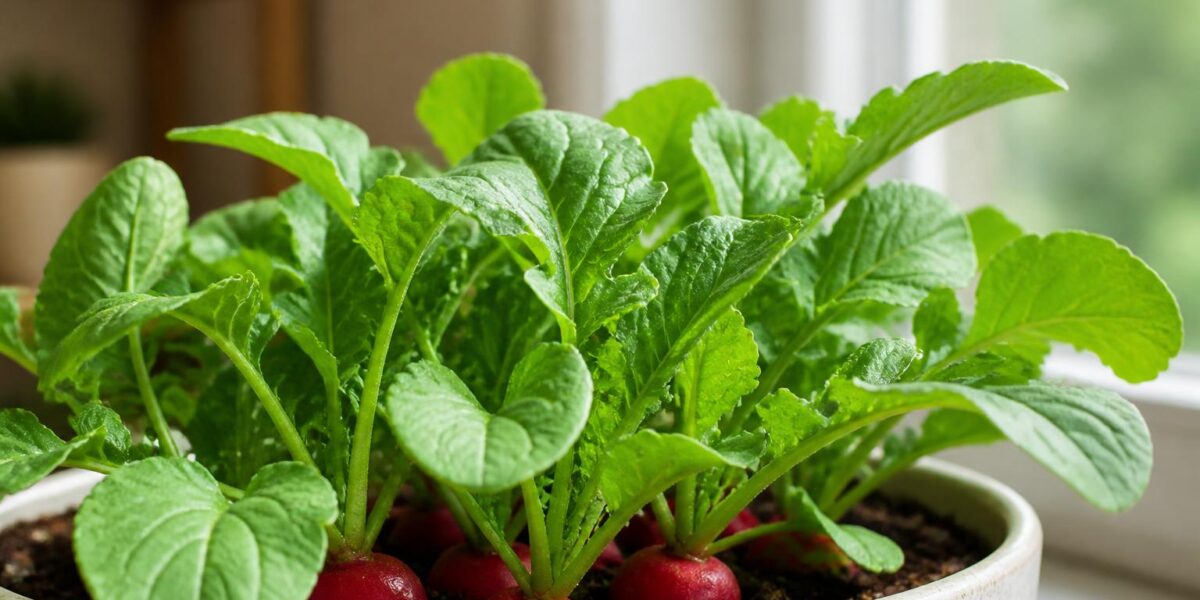
Radish plants (Raphanus sativus, including the small round salad radishes, daikon Raphanus sativus var. longipinnatus, French breakfast types, watermelon radishes, and Spanish black radishes) are not on the ASPCA’s toxic-plants list. Whether your dog roots up a row of seedlings or your cat sniffs at a tray of shoots, radish plants are considered non-toxic to dogs, cats, and horses. The leaves AND the swollen taproot are both in the safe column. The typical garden encounter — a leaf grabbed, a small root nipped — almost never causes anything worse than mild GI upset.
This article covers the radish PLANT — what happens if your dog or cat nibbles the leaves, stems, roots, seed pods, or seedlings in your vegetable garden. For whether radish as a salad ingredient is appropriate to feed your pet on purpose, search our food-safety side for the matching can-dogs-eat or can-cats-eat guide. The plant-side answer is reassuring: radishes belong in the safe column with sensible caveats around volume and the spicy-bite phenomenon that some pets find off-putting.
What Radish Plants Actually Are
Radish is a Brassicaceae family root vegetable in the genus Raphanus — close cousins of arugula, mustard, and the wider Brassica family but in a separate genus. The plant grows quickly: seeds germinate within days, leaves form a low rosette, the taproot swells into the round, oblong, or long root we eat, and if left unharvested the plant bolts to flower with white or pale pink four-petaled blooms followed by edible seed pods. Every stage is in the safe-for-pets bucket.
You’ll see several radish varieties in gardens:
- Salad radish — the small round red, white, or purple roots harvested in three to four weeks.
- Daikon radish — the long white Asian radish, sometimes a foot or more in length.
- Watermelon radish — green outside, pink inside, mild and slightly sweet.
- Black Spanish radish — pungent, dense, often used as a winter storage radish.
- Wild radish (Raphanus raphanistrum) — the weedy roadside cousin; generally considered non-toxic but with sharper flavor.
From a pet-safety standpoint, all of these are treated the same: non-toxic and not a worry for the foraging garden visitor.
Why Radish Lands in the Safe Bucket
The ASPCA classifies Raphanus sativus as non-toxic to dogs and cats. There are no acutely poisonous compounds in radish leaves or roots at the levels found in the cultivated plant. The chemistry is the standard Brassicaceae family lineup — glucosinolates, isothiocyanates, sulforaphane precursors — at concentrations that don’t cause clinical poisoning when a pet grazes a leaf or nibbles a root. The familiar “peppery” or “spicy” taste of radish flesh comes from those compounds, but at lower active concentrations than mustard plants in the same family.
For practical pet-safety purposes, radish sits with kale, broccoli, cabbage, arugula, and bok choy in the “your dog can graze a leaf without an emergency” group. It’s not in the same category as truly toxic ornamentals like lilies, sago palms, or oleander. Knowing the difference is what lets you stay calm when you see your dog wandering away from a torn-up radish row.
Radish Leaves vs Radish Roots
Both leaves and roots are non-toxic. Radish leaves (the green tops above ground) are coarser and a bit fuzzy compared to lettuce, with a peppery flavor similar to arugula. They’re edible for humans too, often used in stir-fries, soups, or as braising greens. A dog or cat who grazes the tops is in a low-concern situation; the leaves are firmly in the leafy-greens safe bucket.
The taproot is also non-toxic. Sharp-flavored radishes like daikon or black Spanish can carry enough bite to discourage further chewing — a dog who takes one bite of a strong daikon often reconsiders. Larger amounts can produce gas and unsettled stool, mostly because of fermentable fibers and the same sulfur compounds that make Brassicas a bit gassy in any digestive system. Mechanical issues are rare but possible: a small dog gulping a chunk of dense daikon root could theoretically gag. Cut roots in pieces if you’re feeding them deliberately.
What “Non-Toxic” Doesn’t Mean
Non-toxic is not synonymous with “infinite quantities are fine.” A medium dog who clears half a row of radishes can absolutely come back with vomiting, soft stool, gas, or a passed dinner. The cause is volume and fermentation, not poisoning. Some practical caveats:
- Pesticide and fertilizer residues. Recently sprayed leaves carry whatever you applied. Wait the full re-entry interval before letting pets graze.
- Allium cross-contamination. Radishes are often interplanted with garlic and onions, which ARE toxic to dogs and cats. A grazer may end up with the wrong mouthful.
- Compost rot. Slimy or moldy radishes in a compost pile carry mycotoxins. Fresh plant safe, rotted plant not.
- Strong-bite varieties (black Spanish, mature daikon) can be irritating to a small mouth and cause more dramatic mouth-pawing than a milder cultivar.
Cats and Radish Plants
Cats don’t gain meaningful nutrition from radish, but plenty of cats nibble plant material out of curiosity, fiber craving, or hairball-clearing instinct. Most cats find radish’s peppery edge off-putting and stop after a sniff or tentative bite. If your cat does eat a few leaves or a small piece of root, expect them to pass uneventfully. A single vomit afterward is common with any plant matter and isn’t, on its own, a sign of poisoning.
Cats with chronic kidney disease should have any new plant exposure cleared with their vet, but radish doesn’t carry a special oxalate or thyroid footnote. For a cat with no chronic conditions, a casual radish nibble is among the lower-concern things they could be eating in your garden.
Dogs and Radish Plants
Dogs are the more common radish-bed offenders. The leafy tops are accessible, and a digging dog can absolutely turn up the root. Many dogs find raw radish more interesting than they expected — the slight crunch and sweet-spicy flavor is novel. A casual mouthful is not a vet emergency. The volume that matters more is “my dog tunneled into the bed and ate several roots” — that’s the scenario likely to produce gas, soft stool, and an unsettled day.
Watch for the volume-related signs rather than poisoning signs: soft stool, gas, vomiting once or twice, refused dinner. These usually settle within twelve to twenty-four hours with bland food and free water. Persistent vomiting, lethargy, blood in stool, or anything that looks unusual should always trigger a vet call — and remember that a foraging dog may have eaten more than just radish.
Radish’s Brassicaceae Cousins in the Same Bed
Radish often gets planted as a fast-cycle “filler” between slower vegetables, so a curious pet is likely to encounter several Brassicaceae plants in the same trip. The family is mostly in the same non-toxic bucket — see our companion guides on arugula plants and pets, kale plants and pets, broccoli plants and pets, and bok choy and pets. Cabbage and collards are also in the same family — cross-link with cabbage plants and pets.
The exception within the family is mustard. Mustard plants accumulate higher glucosinolate concentrations than radish leaves and roots, and a moderate ingestion can produce more obvious GI signs. See are mustard plants toxic to pets for the contrast. Radish is on the safer end; mustard is the asterisk.
Designing a Pet-Friendly Radish Bed
Radishes are one of the most pet-friendly vegetable crops you can grow. They’re fast (so a destroyed row is replaceable in a month), they’re non-toxic at every life stage, and the bites are mild enough to be uneventful for most pets. Pair radish with arugula, lettuce, kale, and broccoli for a low-risk salad bed. Skip alliums (garlic, onion, shallot, chive, leek) from anywhere a pet grazes — those are toxic to both species.
For broader planting ideas, see our pet-safe garden plants roundup. If you’re new to a foraging-tolerant kitchen garden, radishes are one of the easier first crops to put in.
If Your Pet Just Ate Radish
For a small to moderate amount of radish leaves or roots, the right move is usually to watch and wait. Offer fresh water, hold the next meal for an hour or two if your pet seems off, and observe stools and energy through the next day. Most pets need no further intervention.
If the amount eaten was unusually large, if a sharp-bite variety (mature daikon, black Spanish) seems to be irritating your pet’s mouth, if the bed had been recently sprayed, or if you’re not certain radish was the only thing eaten, contact your veterinarian. You can also call the ASPCA Animal Poison Control Center at (888) 426-4435 or the Pet Poison Helpline at (855) 764-7661 for around-the-clock guidance. Do not induce vomiting at home unless a veterinarian instructs you to — the wrong agent or wrong timing can do more harm than the original ingestion.
Frequently Asked Questions
Are radish leaves safe for pets too?
Yes. Radish tops, stems, flowers, and the immature green seed pods are all considered non-toxic to dogs and cats. The leaves are peppery, similar to arugula in flavor, and most pets aren’t tempted to eat much of them.
Is daikon any different from regular salad radish?
Botanically the same species (Raphanus sativus var. longipinnatus). Daikon is generally milder in flavor than small red radishes, and the long thick root is bigger so a determined dog could eat a meal-sized portion in one go. Volume caveats apply more to daikon than to small salad radishes.
Can I feed my dog raw radish slices?
In small amounts, plain raw radish slices (no salt, no garlic, no onion) are fine for most dogs. Cut into small pieces to reduce choking risk, especially with crunchy salad radishes that small dogs might gulp. Talk to your vet if your dog has any GI condition.
What about wild radish growing in my yard?
Wild radish (Raphanus raphanistrum) is generally treated as non-toxic to pets, though it has sharper flavor than cultivated radishes. A casual nibble is low-concern; large amounts could produce more obvious GI upset because of higher glucosinolate concentration in wild plants.
Where can I learn more about pet-safe gardening?
Start with our adopt a dog hub or adopt a cat hub, and bookmark collard greens and pets as another easy salad-bed companion to radish.


