
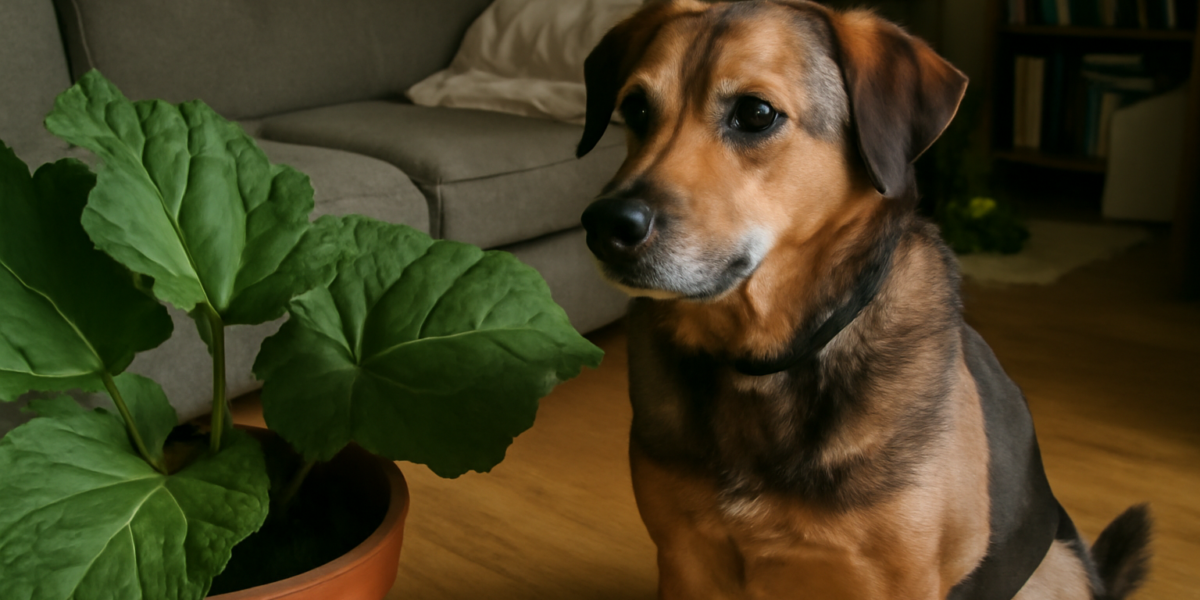
The Short Answer: Rhubarb Leaves Are Severely Toxic to Dogs
Yes, rhubarb leaves are toxic to dogs — and significantly more so than the mild “drooling and vomiting” tier that defines most plant toxicities. Rhubarb leaves (Rheum rhabarbarum, also known as Rheum rhaponticum) contain high concentrations of soluble oxalates that can cause acute kidney injury, low blood calcium, and severe metabolic disturbance in dogs. The stalks — the part used in pies, jams, and crumbles — are safe in normal culinary amounts, but the broad green leaves at the top of every rhubarb plant are not. The leaves are explicitly NOT food, and dogs that get into compost piles, raw garden plants, or kitchen scraps containing rhubarb leaves can become seriously ill.
In this article
- The Short Answer: Rhubarb Leaves Are Severely Toxic to Dogs
- What Makes Rhubarb Leaves So Dangerous
- Why the Stalks Are Safe but the Leaves Are Not
- How Dogs Actually Encounter Rhubarb Leaves
- Symptoms of Rhubarb Leaf Poisoning in Dogs
- What to Do If Your Dog Ate Rhubarb Leaves
- How Veterinarians Treat Rhubarb Leaf Poisoning
- Rhubarb Look-Alikes and Identification
- Comparing Rhubarb Leaf Toxicity to Other Garden Hazards
- Preventing Future Rhubarb Encounters
- Cooked Rhubarb, Pies, and Trash Risk
- Building a Dog-Safe Garden Without Sacrificing Rhubarb
- Frequently Asked Questions
If you suspect your dog ate any quantity of rhubarb leaves, treat this as a true urgent veterinary call rather than a “monitor at home” situation. Rhubarb leaves toxic dogs sits in the moderate-to-severe tier of plant poisoning, and prompt treatment dramatically improves the outcome. Call your veterinarian immediately, or contact the ASPCA Animal Poison Control Center at (888) 426-4435 or the Pet Poison Helpline at (855) 764-7661 — both lines are staffed by veterinary toxicologists 24 hours a day. The same chemistry hits cats; for that picture, see our companion piece on rhubarb leaves and cats.
What Makes Rhubarb Leaves So Dangerous
The toxic principle in rhubarb leaves is soluble oxalates — primarily potassium oxalate and oxalic acid. These compounds dissolve in water (unlike the calcium oxalate raphides that cause acute oral pain in plants like dieffenbachia and philodendron), and they exert their toxicity systemically rather than locally.
The mechanism unfolds in two harmful ways. First, soluble oxalates absorbed from the gut bind tightly with calcium in the bloodstream, forming insoluble calcium oxalate complexes. These complexes precipitate in the small blood vessels and tubules of the kidneys, blocking filtration and triggering acute renal failure. The same precipitation drops free calcium concentration in the blood (hypocalcemia), which can cause muscle tremors, weakness, abnormal heart rhythm, and seizures.
Second, oxalic acid itself is corrosive to the gastrointestinal tract. Dogs that eat rhubarb leaves often vomit hard, develop diarrhea, and experience abdominal pain from direct mucosal injury — independent of the kidney effects.
The leaves contain enough oxalate that small ingestions can produce real symptoms. The exact dose-response curve is not as well characterized in companion-animal medicine as it is in human toxicology, but the general principle — oxalates accumulate, the dose matters, and any meaningful ingestion warrants veterinary evaluation — applies firmly.
Why the Stalks Are Safe but the Leaves Are Not
Rhubarb stalks (the pink-to-red fleshy stems used in cooking) contain much lower oxalate concentrations than the leaves. They are not zero-oxalate, but they are far below the threshold for acute toxicity in normal culinary servings. The leaves, by contrast, can contain several times the oxalate concentration by weight. This difference is the reason rhubarb pie is a beloved dessert and rhubarb leaves are explicitly never used in cooking.
Practically, this means that rhubarb stalks fed in small pieces to a dog as an occasional treat are unlikely to cause toxicity, though the sour taste discourages most dogs from eating them anyway. The leaves are the entire problem — and the leaves are easily encountered by dogs who roam the garden, dig through compost, or counter-surf when the cook trims a fresh rhubarb stalk.
Cooked rhubarb (in pies, jams, sauces) follows the same logic — the cooked stalks are still relatively low oxalate; the leaves should never have been included. Sugar and other ingredients in baked goods do not change the oxalate chemistry meaningfully.
How Dogs Actually Encounter Rhubarb Leaves
The typical exposure scenarios for dogs are predictable and avoidable:
- Garden grazing — dogs with yard access who pass a rhubarb patch may sample the broad accessible leaves. This is the most common route and is the reason rhubarb is on most “garden plants to keep away from dogs” lists.
- Compost pile — kitchen scraps including rhubarb leaf trimmings get tossed into the compost. Dogs that dig in compost (almost all dogs) can find and eat them. Compost piles are a recurring source of plant-toxicity emergencies generally.
- Kitchen counter-surfing — when someone is preparing rhubarb, leaves and stalk trimmings often end up on counters or in trash bags. Dogs that counter-surf or trash-pick may grab a handful.
- Allotment or shared-garden access — dogs walked through garden plots can graze on neighbors’ rhubarb if leashes are slack and the gardener has not screened in the patch.
Knowing the common routes helps with prevention. The single highest-value step in most dog households is to fence off the rhubarb patch and keep compost behind a closed bin or fence. If you grow rhubarb and your dog has yard access, treat the garden bed like a chemical-storage area — physical barriers, not just behavioral training.
Symptoms of Rhubarb Leaf Poisoning in Dogs
Symptoms typically develop within a few hours of ingestion, though kidney effects may take 12 to 24 hours to become clinically obvious. The early picture includes:
- Drooling and lip-licking (oral irritation from oxalic acid).
- Vomiting — often forceful and repeated, possibly with visible plant fragments.
- Diarrhea, sometimes with blood.
- Abdominal pain — hunched posture, refusal to lie down comfortably.
- Reduced appetite, sometimes complete refusal to eat.
- Lethargy and weakness.
The more concerning later picture (typically 6 to 48 hours after ingestion) reflects systemic oxalate effects:
- Increased thirst and urination, then decreasing urination.
- Tremors or muscle twitches (low blood calcium).
- Weakness, ataxia (wobbly walking), or collapse.
- Irregular heart rhythm or rapid heart rate.
- Severe lethargy or unresponsiveness.
- Seizures in advanced cases.
- Reduced or absent urine output (kidney failure).
Even mild early symptoms warrant immediate veterinary attention because the kidney injury can progress while the dog superficially appears stable. Do not wait for late-stage signs.
What to Do If Your Dog Ate Rhubarb Leaves
This is one of the plant exposures where speed matters. Take these steps in order:
Call your veterinarian or an emergency vet clinic immediately. Describe what happened — species (rhubarb leaves), approximate amount, time of ingestion, your dog’s weight, and any symptoms you are seeing. Do this before doing anything else.
If you cannot reach your regular vet, call the ASPCA APCC at (888) 426-4435 or the Pet Poison Helpline at (855) 764-7661. Both lines are 24/7. Both will help triage and give your treating vet a case number that streamlines care.
Do not induce vomiting at home unless explicitly told to. Hydrogen peroxide instructions you may have seen online for emergencies are not universally appropriate, and inducing vomiting can be harmful with corrosive plant material. Decontamination decisions belong to the veterinary professional.
Bring the plant or a clear photo when you head to the clinic. Rhubarb leaves are distinctive (large, broad, slightly crinkled, with reddish veins and a thick fleshy stalk), but a sample helps with confirmation.
Document the exposure — time eaten, estimated amount, what symptoms have started and when. This information directly informs treatment urgency and dosing.
Do not delay even if your dog seems fine. The most dangerous window with rhubarb is the apparent-recovery phase before kidney effects become clinically obvious. Treating early is dramatically more effective than treating after kidney damage has begun.
How Veterinarians Treat Rhubarb Leaf Poisoning
Treatment is aggressive and multi-pronged. There is no specific antidote for soluble-oxalate toxicity; the goal is to limit absorption, support the kidneys, and correct the metabolic disturbances.
If the ingestion was very recent (under one to two hours), the vet may induce vomiting in a clinical setting using apomorphine. Activated charcoal may be given to bind any remaining oxalate in the gut. Calcium-containing solutions (calcium gluconate or calcium-rich oral suspensions) are sometimes given to bind oxalate in the gut and form less-absorbable calcium oxalate before it reaches the bloodstream.
Once absorbed oxalates are circulating, the cornerstone of therapy is intravenous fluid therapy — usually run continuously for at least 48 to 72 hours — to maintain renal perfusion, dilute oxalate concentrations in the kidney tubules, and flush precipitated crystals through the system. Blood work to monitor BUN, creatinine, calcium, potassium, and electrolytes is typically repeated every 8 to 24 hours during inpatient care.
For dogs with hypocalcemia symptoms (tremors, weakness), IV calcium gluconate is given carefully under cardiac monitoring. For dogs with severe kidney injury, referral to a specialty hospital for hemodialysis may be considered, though dialysis is not available everywhere and is expensive.
Outcomes are highly variable. Dogs treated early and with mild ingestion often recover fully. Dogs with delayed treatment or large ingestions can develop persistent kidney damage and require long-term renal management. The pillar guide on acute kidney injury in dogs covers the broader picture of recovery and follow-up monitoring.
Rhubarb Look-Alikes and Identification
Rhubarb is fairly distinctive but a few garden plants share a similar profile. Worth knowing:
- Rhubarb (Rheum rhabarbarum) — large heart-shaped or broad-triangular green leaves, thick reddish-pink to deep-red stalks, clumping perennial. The leaves are often a foot or more across.
- Burdock (Arctium) — large heart-shaped leaves, similar size to rhubarb but with a different stem and flower spikes; mostly mild GI concerns.
- Swiss chard (Beta vulgaris) — sometimes confused with rhubarb because of the bright red stems; chard leaves are generally fine for dogs in small amounts. The stems are different — chard is grooved and ribbed, rhubarb is smooth and fleshy.
- Garden sorrel (Rumex) — also contains oxalates; safer in small amounts but warrants caution in large ingestions.
If you cannot identify what your dog ate, save a photo and a sample for the vet. Do not waste time trying to identify the plant when in doubt — call the vet first and triage from there.
Comparing Rhubarb Leaf Toxicity to Other Garden Hazards
Rhubarb leaves are among the more dangerous garden plants for dogs because of the kidney-injury risk. For perspective on the broader garden-plant-toxicity landscape:
- Grapes and raisins (different category, but similar acute-kidney-injury risk in dogs).
- Lilies (true lilies) — primarily a cat concern; dogs tolerate them reasonably.
- Azaleas / rhododendrons — cardiac and GI toxicity, severe.
- Foxglove — cardiac glycosides, severe.
- Yew — cardiac glycosides, severe.
- Sago palms — severe hepatotoxicity, potentially lethal.
Rhubarb belongs in the “treat as a true emergency” category alongside these — different mechanism, similar urgency.
Preventing Future Rhubarb Encounters
For households that grow rhubarb or have neighbors who do, prevention is straightforward:
- Fence off the rhubarb patch — physical exclusion is the single most reliable approach. A simple chicken-wire surround works.
- Secure compost piles — closed bins or fenced piles keep dogs from digging through trimmings. Compost piles are a recurring source of plant-toxicity emergencies generally.
- Bag and seal kitchen scraps — rhubarb leaf trimmings should go into a sealed bag in a closed trash can rather than an open kitchen bin.
- Train “leave it” reliably for any garden grazer.
- Walk on leash through any unfamiliar gardens — allotments and shared community gardens are a common exposure path.
If you have just adopted a new dog who has not yet been “garden-proofed,” walk-throughs of the yard with the dog on leash for the first few weeks identify which plants are interesting before any unsupervised access. Walk Me Home Rescue’s dog adoption hub has more on integrating a new dog into a household.
Cooked Rhubarb, Pies, and Trash Risk
Cooked rhubarb stalks (in pies, crumbles, jams) are far less concerning because the cook should have removed the leaves before cooking. A dog that grabs a slice of rhubarb pie off the counter is not facing an oxalate emergency.
However: pies often contain other ingredients that ARE concerning for dogs — high sugar, high butter (potential pancreatitis trigger), and sometimes raisins or grapes mixed in (acute kidney injury risk). The pie itself may be a problem for reasons unrelated to rhubarb specifically. If your dog ate a slice of pie, mention all the ingredients to the vet.
Trash bins are a higher concern. Discarded rhubarb leaves in a kitchen bin are the same dangerous leaves they were in the garden. Bag and seal leaf trimmings, do not just toss them in an open bin where a dog can dig them out.
Building a Dog-Safe Garden Without Sacrificing Rhubarb
Many gardeners want to keep growing rhubarb — it is a productive, hardy, perennial vegetable that is genuinely valuable in the kitchen. The path to coexistence is physical separation, not removal. A simple fenced rhubarb bed in a corner of the garden, with a gate the dog cannot open, is fully compatible with a dog-friendly yard.
For broader garden planning, our roundup of pet-safe garden plants covers swap options for the borders and foundation plantings where dogs DO have access. Reserve the toxic-but-valuable plants (rhubarb, certain ornamentals) for fenced beds, and fill the rest of the garden with confirmed safe choices.
Frequently Asked Questions
How much rhubarb leaf does it take to poison a dog?
The exact toxic dose is not as well characterized in companion-animal medicine as it is in human toxicology, but the general principle is that oxalate exposure is dose-dependent and any meaningful ingestion warrants veterinary evaluation. Small dogs are at risk from smaller absolute amounts than large dogs, but no dog should be assumed to have eaten “too little to matter.” Call the vet for any confirmed ingestion.
What about rhubarb stalks — are those safe for dogs?
Rhubarb stalks contain much lower oxalate concentrations and are generally not severely toxic in normal culinary amounts. That said, they are sour and not part of a normal canine diet; most dogs do not eat them voluntarily. There is no real reason to feed rhubarb stalks to dogs as a treat — better dog-safe vegetables are available.
Is cooked rhubarb leaves toxic, or does cooking destroy the oxalates?
Cooking does not destroy the oxalates. Cooked rhubarb leaves are just as dangerous as raw. The leaves should never have been cooked or eaten in the first place — there is no safe preparation method that makes them edible.
My dog ate a rhubarb leaf yesterday and seems totally fine. Do I still need to call?
Yes, call. Some dogs eat small amounts and recover without overt symptoms, but kidney injury can develop silently. Bloodwork may show changes that an owner cannot detect. A 24-hour-post-ingestion check at minimum is the responsible move.
Can a dog die from eating rhubarb leaves?
Yes, severe rhubarb leaf poisoning can be fatal if untreated, particularly from acute kidney failure. With prompt veterinary care, prognosis is much better but still depends on amount ingested, time to treatment, and the dog’s underlying health. Treat any rhubarb leaf ingestion as a real emergency.


