
Last updated: May 16, 2026
In this article
- Is Russian Sage Toxic to Cats and Dogs?
- Meet Russian Sage
- Russian Sage vs. Common Sage
- The Essential Oil Mechanism
- Symptoms to Watch For
- What to Do If Your Pet Eats Russian Sage
- Cat-Specific Cautions
- Designing a Pet-Friendly Garden With Russian Sage
- How Russian Sage Compares to Other Lamiaceae Plants
- Disposal and Pruning Notes
- Why the Recent Botanical Reclassification Matters
- Frequently Asked Questions
Is Russian Sage Toxic to Cats and Dogs?
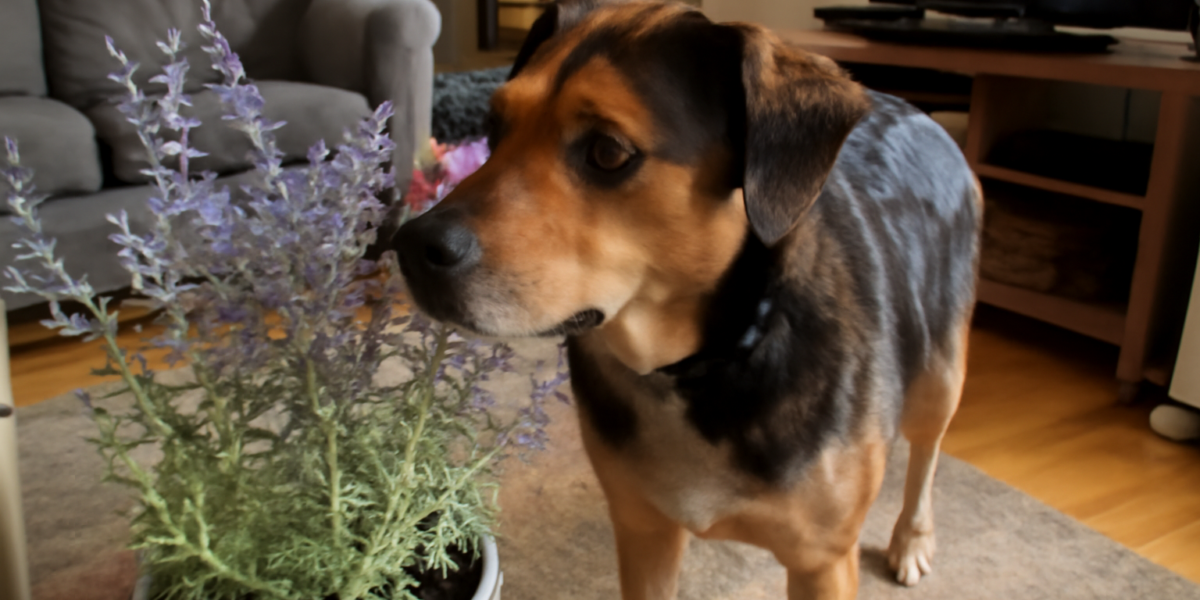
Russian sage toxic pets is a question with a more cautious answer than most of our garden plant guides. Perovskia atriplicifolia — recently reclassified as Salvia yangii after botanical revision placed it firmly in the true sage genus — is considered mildly toxic to pets, with the strongest cautions applying to cats. ASPCA-specific listings are limited for Perovskia / Salvia yangii directly, but its close relationship to common sage (Salvia officinalis) — which we cover for both sage in cats and sage in dogs as mildly toxic — is the most reliable guide. Casual exposure is rarely an emergency, but bulk ingestion of leaves or stems, especially in cats, deserves attention.
The reason this article leans cautious despite Russian sage being a common landscape plant: the genus Salvia contains essential oils (camphor, thujone, cineole, linalool) that cats are particularly poor at metabolizing because of limited liver enzyme activity. Dogs handle these compounds better but can still develop GI upset from significant ingestion. We’ll walk through what Russian sage is, what the chemistry suggests, and how to garden safely.
Meet Russian Sage
Russian sage isn’t from Russia, isn’t culinary sage, and isn’t even technically Perovskia anymore — every part of the common name is a botanical near-miss. The plant is native to Central Asia (Afghanistan, Pakistan, Tibet) and was named for a Russian general, V. A. Perovsky. Recent DNA work moved it from the now-defunct genus Perovskia into Salvia as Salvia yangii, though garden centers still mostly sell it as Perovskia. Key characteristics:
- Tall airy growth reaching 3 to 5 feet, with silver-gray finely-divided leaves on whitish stems.
- Lavender-blue panicles of small two-lipped flowers from midsummer through fall.
- Strong sage-like aromatic foliage — crushing a leaf releases a sharp resinous fragrance.
- Drought-tolerant and xeriscape-friendly — beloved for hot dry sites.
- Common cultivars include ‘Blue Spire’ (most popular), ‘Little Spire’ (compact), ‘Filigran’ (finely cut foliage), and ‘Denim ‘n Lace’ (compact upright).
The plant is in the family Lamiaceae — the mint family — alongside sage, rosemary, lavender, thyme, oregano, mint, and lemon balm. Most Lamiaceae plants share aromatic essential oils with similar pet-safety profiles.
Russian Sage vs. Common Sage
This is one of the most useful clarifications for pet owners. Several aromatic plants share the word “sage”:
- Common sage / culinary sage (Salvia officinalis) — the kitchen herb. Mildly toxic to pets.
- Russian sage (Perovskia atriplicifolia / Salvia yangii) — the ornamental landscape plant. Subject of this article. Mildly toxic by genus relationship.
- Pineapple sage (Salvia elegans) — fragrant ornamental and culinary. Mild concern.
- Salvia divinorum — psychoactive plant, severely concerning.
- Sagebrush (Artemisia tridentata) — North American native, totally different plant family despite the “sage” name.
For pet-safety purposes, anything in the Salvia genus shares similar essential-oil chemistry and similar mild-toxicity status. Russian sage’s recent reclassification into Salvia confirms what experienced gardeners already knew: the plants behave similarly.
The Essential Oil Mechanism
Russian sage’s foliage contains volatile essential oils dominated by camphor, eucalyptol (1,8-cineole), borneol, and other monoterpenes. These compounds are mildly irritating to the GI tract and have known effects on the nervous system at concentrated doses. Two pet-specific issues:
- Cats and essential oils. Cats lack adequate liver enzymes (specifically glucuronyl transferase) to efficiently metabolize many essential-oil compounds. Topical application of concentrated essential oils, ingestion of essential-oil-rich plants, and even diffuser exposure can cause toxicity in sensitive cats. Common signs are drooling, vomiting, lethargy, ataxia (wobbly gait), and tremors.
- Dogs and Lamiaceae herbs. Dogs handle these compounds better than cats, but bulk leaf ingestion can produce vomiting, diarrhea, and GI irritation. Chewing on the woody stems can also splinter.
Russian sage’s leaves contain essential oils at lower concentrations than concentrated commercial oils, but the underlying chemistry is the same. For ordinary garden exposure — a flower investigated, a leaf brushed against — there’s no real risk. For sustained chewing or large ingestion, especially in cats, monitoring is appropriate.
Symptoms to Watch For
After Russian sage ingestion, watch for:
- Drooling or lip-smacking
- Vomiting or repeated retching
- Diarrhea
- Lethargy or decreased activity
- Wobbly gait, especially in cats (essential-oil neurological signs)
- Tremors (rare, in cats with significant exposure)
- Decreased appetite for more than 24 hours
- Pawing at the face or mouth (oral irritation)
The cat-specific neurological signs (wobbliness, tremors) are unusual but warrant immediate veterinary attention if they appear. GI signs alone are typically self-limiting in dogs.
What to Do If Your Pet Eats Russian Sage
For routine garden encounters:
- Remove leftover plant material from your pet’s mouth and from reach.
- Rinse the mouth gently with cool water.
- Note the species, plant part eaten, and approximate amount.
- Offer fresh water and a small bland meal if your pet is hungry.
- Monitor for the symptoms above for 12 to 24 hours.
For cats with substantial ingestion, any neurological signs, or any unclear symptoms, contact your veterinarian. The ASPCA Animal Poison Control Center (888-426-4435) and the Pet Poison Helpline (855-764-7661) are both 24/7 services that can give species-specific guidance. Never induce vomiting at home without veterinary direction. For more on cat-specific essential oil sensitivity, see our essential oils and cats reference.
Cat-Specific Cautions
If you live with cats, Russian sage deserves a slightly elevated level of caution compared to truly non-toxic plants. Practical tips:
- Don’t bring cuttings indoors as cut flowers. Concentrated drying foliage can release more volatile oils into a small space than the live outdoor plant.
- Avoid Russian-sage-scented sachets in cat-accessible areas. Same essential-oil concentration logic.
- Don’t use lavender or sage essential oils diffused or topically on cats or in cat-only spaces — see our cross-reference guides on lavender and cats and lavender plant safety for cats for the full picture.
- Outdoor garden Russian sage is unlikely to cause problems for an outdoor cat that walks past it. The risk is concentrated exposure, not casual brush-by.
- Provide safe alternatives. Cat grass and catnip let cats satisfy nibbling instincts on something genuinely safe.
For dog-only households, Russian sage is closer to a “low-concern with caveats” plant than a serious risk. Dogs can metabolize the relevant compounds reasonably well; the main practical issue is GI upset from large ingestions.
Designing a Pet-Friendly Garden With Russian Sage
Russian sage can fit pet-friendly gardens with a few adjustments:
- Plant at the back of borders where pets are less likely to brush against or chew the foliage.
- Skip Russian sage in tight cat-accessible patios where a cat would have prolonged contact opportunity.
- Pair with safer pollinator alternatives. Lavender carries similar concerns; our lavender-for-dogs guide covers that family. For cleaner safety, consider bee balm, lemon balm, or zinnias.
- Front of border with sibling B118 plants. Pair with lambs ear for a contrasting silver foliage combination — same Lamiaceae family but lambs ear is in the safer half.
- Browse the broader list. Our pet-safe garden plants resource covers cleaner alternatives.
You don’t have to abandon Russian sage if you love its airy lavender clouds — just give pets fewer chances for sustained contact.
How Russian Sage Compares to Other Lamiaceae Plants
The mint family is broad and varies in pet safety. Compare:
- Common sage (Salvia officinalis) — mildly toxic; closely related to Russian sage.
- Lavender (Lavandula) — mildly toxic with cat caution.
- Lambs ear (Stachys byzantina) — non-toxic, low essential oil content.
- Lemon balm (Melissa officinalis) — non-toxic per ASPCA.
- Catnip (Nepeta cataria) — actively beneficial for cats; mild for dogs.
The take-home lesson: not every mint-family plant is the same. Russian sage carries similar mild concerns to common sage and lavender, while lambs ear, lemon balm, and catnip are reliably safe. Plan combinations around the safer end if you have a cat that likes to nibble. For more support, browse our adopt a cat and adopt a dog resources to support a healthy household.
Disposal and Pruning Notes
Russian sage benefits from a hard cutback in late winter or early spring. A few practical considerations:
- Compost the cuttings in an enclosed bin away from pet access — drying aromatic foliage can release stronger-smelling oils that attract curious dogs.
- Don’t burn dried Russian sage in pet-occupied spaces — smoke from aromatic Lamiaceae can be irritating.
- Wash hands after pruning if you’ll be petting cats or feeding sensitive pets soon after — concentrated leaf oils on hands can transfer.
- Bag dropped foliage during cleanup rather than letting it drift around the yard.
None of this is high-stakes for most households, but the small habits add up to fewer accidental concentrated exposures.
Why the Recent Botanical Reclassification Matters
For decades, gardeners knew this plant as Perovskia atriplicifolia, a separate genus from Salvia. In 2017, molecular phylogenetic work demonstrated that Perovskia is nested within the Salvia genus, leading to the reclassification of all Perovskia species into Salvia. The plant we still call Russian sage is now formally Salvia yangii, named for Chinese botanist Yang Tian. Why does this matter for pet owners?
- It validates what gardeners suspected. The strong herbal scent, similar growth habit, and similar pollinator behavior to common sage all hinted at the close relationship — now confirmed genetically.
- It supports the cautious safety framing. If the plant is genuinely a Salvia, then the toxicity data we have for common sage applies more directly to Russian sage than it would for an unrelated genus.
- Garden centers will catch up slowly. Most plant labels still say “Perovskia.” Both names refer to the same plant.
- Other Salvia ornamentals share similar profiles. Mexican bush sage, autumn sage, scarlet sage, and pineapple sage are all in the same genus and likely share similar mild-toxicity considerations, though species-specific data varies.
If you’re shopping or browsing labels, treating “Perovskia” and “Salvia yangii” as the same plant is correct. The pet-safety considerations don’t change with the new name; they just become more clearly grounded in the broader Salvia genus pattern.
Frequently Asked Questions
Is Russian sage poisonous to dogs?
Russian sage is mildly toxic to dogs by extension of its Salvia genus relationship. Casual exposure is not an emergency, but bulk ingestion of leaves or stems can cause vomiting, diarrhea, and GI upset. Most dogs recover with rest and bland food.
Can my cat be around Russian sage?
Outdoor garden Russian sage is generally not a problem for cats walking past it. The concern is concentrated exposure — chewing leaves repeatedly, contact with cut foliage in the home, or essential oil applications. Cats are uniquely sensitive to the essential oils in this plant family.
Is Russian sage the same as cooking sage?
They are close relatives. Russian sage was recently reclassified into the Salvia genus alongside common cooking sage (Salvia officinalis), and the two share similar essential oil chemistry and similar mild-toxicity profiles for pets. Russian sage is grown ornamentally; cooking sage is grown for the kitchen.
My dog ate a stem of Russian sage. What should I do?
For mild ingestion with no symptoms, monitor at home. Watch for vomiting, diarrhea, drooling, or lethargy over the next 24 hours. Call your vet if symptoms develop or persist, particularly if your dog ate a substantial amount of foliage.
Are Russian sage flowers safe for pets?
The flowers contain less essential oil than the leaves but are still part of the same plant. Casual flower investigation is not a concern; sustained chewing should be discouraged. Watch for pollinator-related risks (bee or wasp stings) when pets are near blooming Russian sage.


