
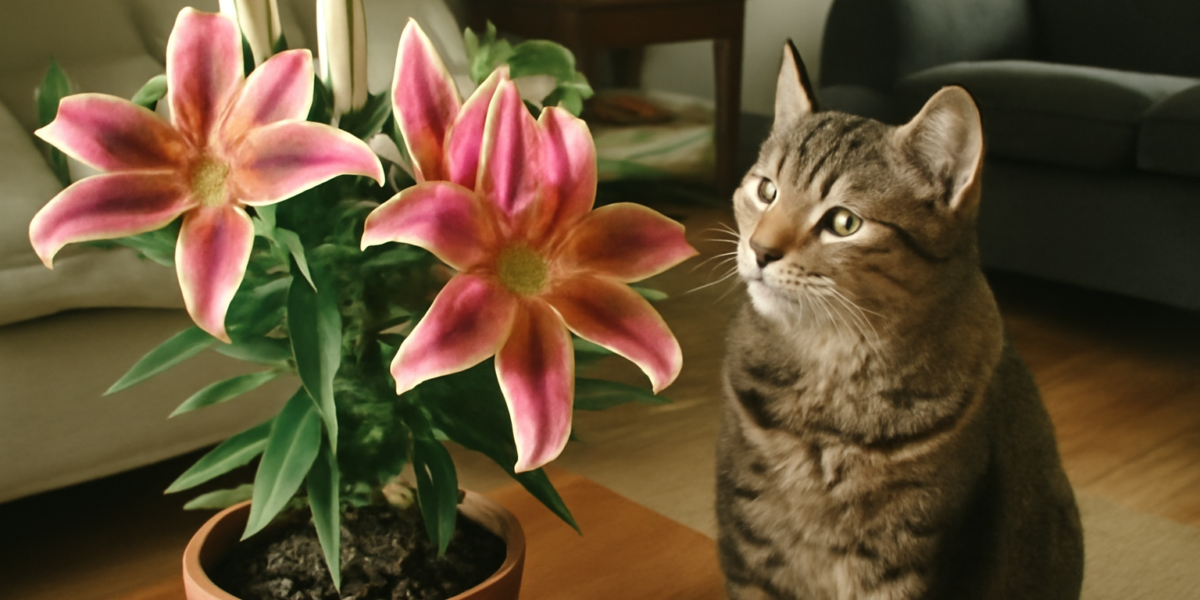
Are Stargazer Lilies Toxic to Cats? The Short Answer
Yes — Stargazer lilies are severely toxic to cats and sit in the highest-risk tier of household plant exposures. Stargazer is an Oriental lily cultivar, meaning it is a true Lilium hybrid, and every part of the plant — petals, leaves, stem, pollen, and vase water — can cause acute kidney injury (AKI) in cats. The toxicity is unique to felines; dogs typically experience only mild stomach upset from the same plant.
In this article
- Are Stargazer Lilies Toxic to Cats? The Short Answer
- Why Stargazer Lilies Threaten Cats Specifically
- How to Recognize a Stargazer
- Symptoms of Stargazer Lily Poisoning
- Pollen on the Fur — Why It Counts as Exposure
- Immediate Action Steps
- Treatment in the Clinic
- Prognosis After Stargazer Exposure
- Removing Stargazers and Choosing Safer Flowers
- Stargazer Within the True-Lily Family
- Why This Matters for Cat Adopters
- Frequently Asked Questions
Stargazer lilies toxic to cats are one of the most common true-lily exposures in floral arrangements because Stargazers are an iconic florist’s flower — large, heavily perfumed pink-and-white blooms with dark speckles, sold individually and in mixed bouquets. They show up at weddings, funerals, sympathy bouquets, anniversary gifts, and high-end grocery flower stands. If a Stargazer is in any room where a cat lives, you are looking at a kidney-failure risk severe enough that veterinary toxicologists treat any contact as a presumed exposure requiring immediate care.
Why Stargazer Lilies Threaten Cats Specifically
Stargazer is a hybrid of Asian Lilium species, and like all true lilies it contains a water-soluble nephrotoxin that selectively damages cat kidney tubules. The precise toxic compound is still incompletely characterized despite decades of research — toxicologists describe it as a fraction concentrated in the flower and pollen — but the clinical effect is extremely consistent: rapid tubular necrosis, oliguria, and untreated, death from kidney failure within 72 hours.
The cat-specificity is striking. Dogs, rabbits, and rodents do not develop the AKI syndrome after eating Lilium tissue; only cats do. The likely reason involves a metabolic pathway cats lack, but the mechanism is still under study. The practical bottom line is that even tiny Stargazer exposures in cats are emergencies, and the “wait and see” approach has cost many cats their lives.
Stargazer pollen is especially abundant and easily transferred. The rust-orange pollen on the long anthers gets onto tablecloths, fur, carpets, and human hands; cats then ingest it during routine grooming. Multiple published case reports describe cats who never directly chewed a flower but developed AKI from pollen alone. This is the most under-recognized route of exposure and the strongest argument for keeping Stargazers out of any cat’s environment entirely.
How to Recognize a Stargazer
Stargazers have large, upward-facing flowers in deep rose-pink with darker pink-to-red spots radiating from the center, edged in white, with prominent rust-colored anthers. The fragrance is intense and unmistakable — many people describe it as the “lily smell” of bouquets. Stems are typically two to four feet tall in garden plantings, shorter in cut bouquets, with broad lance-shaped leaves up the stalk.
You will see them most often in florist arrangements, wedding centerpieces, sympathy bouquets, and home gardens. Mixed bouquets labeled “fragrant lily” or “premium lily mix” almost always include Stargazers. If you see a large pink-and-white speckled flower in your home and you have a cat, identify it before you leave the room — it is very likely a Stargazer.
Symptoms of Stargazer Lily Poisoning
The symptom timeline of Stargazer poisoning matches the rest of the Lilium genus, with three clinically distinct phases. The early phase is deceptively mild, which is why so many cats are presented to the clinic later than they should be.
Within one to six hours, expect vomiting (sometimes with visible plant fragments), drooling, lip-licking, lethargy, and a refusal to eat. Some cats hide; some sit hunched. The signs are non-specific on their own, but in a cat with possible lily access they should always trigger a vet call.
From roughly six to twelve hours, many cats appear to improve. Vomiting may stop and the cat may seem subdued but stable. This false-improvement window is one of the most dangerous moments in the entire course of illness because owners often relax during it. Kidney damage is silently progressing.
From twelve to seventy-two hours, the AKI becomes obvious. The cat may urinate excessively at first as the failing kidneys lose concentrating ability, then produce little or no urine as the tubules collapse. Severe lethargy, dehydration, recurring vomiting, weakness, disorientation, and in advanced cases seizures or coma can develop. Cats who are anuric on arrival have a guarded prognosis even with intensive care.
Pollen on the Fur — Why It Counts as Exposure
One of the hardest things for owners to accept is that a cat does not need to eat a Stargazer to be poisoned. Pollen contact is enough. A cat that brushes against a vase, walks under a flower-laden table, or sleeps on a tablecloth dusted with pollen will groom that pollen off — and the toxin goes straight to the gut.
If you find rust-colored pollen on your cat’s muzzle, paws, or coat, treat it as an exposure. Bathe gently with mild pet shampoo if your cat tolerates it, save a sample of the plant for ID, and call the vet. Don’t wait for symptoms; by the time symptoms appear, the optimal treatment window is closing.
Immediate Action Steps
Time-to-IV-fluid-therapy is the single biggest factor in survival. Don’t read the rest of this section first — make the phone call.
Call your veterinarian or a 24-hour emergency vet immediately. If neither is reachable, call the ASPCA Animal Poison Control Center at (888) 426-4435 or the Pet Poison Helpline at (855) 764-7661. Both are staffed by veterinary toxicologists, both charge a consultation fee, and both will issue a case number that the treating vet can use to coordinate care.
Bring the plant — or a clear photo — to the clinic. Confirming Stargazer (versus a less-dangerous look-alike) sets the urgency. If you are not sure what you are looking at, our peace lily vs. true lily guide covers the most common confusion between true lilies and lower-risk look-alikes.
Do not induce vomiting at home unless poison control specifically tells you to. Cats are unreliable responders to over-the-counter emetics, and the wrong agent can cause additional harm. Decontamination decisions belong to the vet.
Treatment in the Clinic
There is no antidote for Stargazer lily toxicity. Treatment is aggressive supportive care designed to limit further absorption, then protect the kidneys long enough for the tubules to recover.
If the cat arrives within a few hours of ingestion, the team will typically induce vomiting under controlled conditions and give activated charcoal. The mainstay is intravenous fluid therapy run continuously for at least 48 to 72 hours, with bloodwork (BUN, creatinine, electrolytes, urinalysis) repeated every twelve to twenty-four hours.
If the cat is already in established AKI on arrival, the vet may recommend referral to a specialty hospital for hemodialysis. Dialysis is not available everywhere and is expensive, but for advanced cases it can be the difference between recovery and not recovering. Outpatient decontamination commonly costs several hundred dollars, inpatient AKI care climbs into the low thousands, and dialysis is on top of that. Ask your local emergency clinic for a written estimate.
Prognosis After Stargazer Exposure
Cats treated within roughly six hours of ingestion have the best prognosis. Cats still making urine on arrival generally do better than anuric cats. Some recover completely; others survive the acute phase but develop chronic kidney disease over weeks, months, or years.
Recheck bloodwork at one week, four weeks, and periodically afterward is the standard plan for clinically meaningful exposures. Our guide on chronic kidney disease in cats outlines the long-term monitoring rhythm for cats with reduced renal reserve.
Removing Stargazers and Choosing Safer Flowers
If you live with a cat, treat Stargazers as banned. Tell florists you have a cat and ask them to confirm every stem. Mixed bouquets routinely include Stargazers under labels like “garden lily” or “fragrant lily” — one hidden stem is enough to be lethal.
Cat-safe alternatives include roses (thorns trimmed), gerbera daisies, snapdragons, sunflowers, freesias, lisianthus, statice, and orchids. Our cat-safe flowers roundup walks through bouquet swaps, and cat-safe houseplants covers indoor potted alternatives that don’t pose the same risk.
Stargazer Within the True-Lily Family
Stargazer is one specific cultivar within a much larger lethal group. The same AKI mechanism applies to all Lilium hybrids, including tiger lilies, Asiatic lilies, other Oriental lilies, and Easter lilies, plus day lilies in the Hemerocallis genus. The pillar piece on lilies and cats covers the family.
“Lily” is also a casual name for several non-lily plants that pose much lower risk — Peruvian lilies (Alstroemeria), canna lilies, peace lilies, and calla lilies are in different families and typically cause only mild GI signs. Don’t conflate them with true lilies; the urgency is genuinely different.
Why This Matters for Cat Adopters
A surprising number of Stargazer poisonings begin with a thoughtful gift. Build a household culture of “no true lilies in the house” and tell visiting friends and family. Most people don’t know that the bouquet they brought as a kindness can be a death sentence for a cat.
If you are preparing to bring home a new cat, a walk-through to remove all true lilies, identify your remaining houseplants, and post emergency phone numbers on the fridge is some of the most valuable prep you can do. Walk Me Home Rescue’s cat adoption hub can help you find your next family member.
If you are a foster parent or volunteer with a rescue, the no-true-lilies policy is part of the basic kitten-proofing checklist. Communicate it clearly when bouquets are sent as thank-yous after adoption events, and consider adding a brief sentence to your foster-home agreement so visiting potential adopters know the household rule. The half-minute it takes to ask “what species are these flowers?” can prevent the kind of emergency that ends a cat’s life despite hours of intensive care.
Frequently Asked Questions
How is Stargazer different from a regular Oriental lily?
Stargazer is a specific Oriental lily cultivar — pink with darker spots and a white edge — but it is just as toxic to cats as any other Oriental, and just as toxic as Asiatics, tiger lilies, Easter lilies, and day lilies. From a toxicity standpoint, “Oriental lily” and “Stargazer” are interchangeable.
If pollen got on my cat, can I just wipe it off?
Wiping it off is reasonable, but it does not undo any pollen the cat has already ingested through grooming, and you can’t be sure when contact happened. Treat it as exposure: wipe or bathe, save plant material for ID, and call the vet. Don’t wait for symptoms.
What about pollen-free Stargazer cultivars?
Some florists sell Stargazers with anthers removed to reduce pollen mess. The rest of the plant — petals, leaves, stem, vase water — remains highly toxic to cats. Pollen-free does not equal cat-safe.
Can I keep Stargazers in a room my cat can’t access?
It is not worth the risk. Cats explore, doors get left open, and pollen drifts. Most veterinary toxicologists recommend a flat ban on true lilies in any home with a cat, rather than relying on physical separation.
Will a single sip of vase water really cause poisoning?
It can. Vase water from Lilium arrangements contains the toxin in solution, and small ingestions have caused acute kidney injury. There is no documented safe quantity. Treat any vase-water exposure as a presumed toxic exposure.


