
Last updated: May 16, 2026
In this article
- Are Asiatic Lilies Toxic to Cats? The Direct Answer
- What Makes Asiatic Lilies So Lethal to Cats?
- How to Recognize an Asiatic Lily
- Symptoms of Asiatic Lily Poisoning
- Immediate Steps If Your Cat Was Exposed
- What Veterinary Treatment Looks Like
- Prognosis After Asiatic Lily Exposure
- Removing the Risk and Choosing Cat-Safe Flowers
- Other Lilies and Look-Alikes Worth Knowing
- Why This Matters for Cat Adopters
- Frequently Asked Questions
Are Asiatic Lilies Toxic to Cats? The Direct Answer
Yes — Asiatic lilies are severely toxic to cats and belong to the most dangerous tier of household plants. Asiatic lilies are hybrids derived from several wild Lilium species, which means they are true lilies in the strictest sense, and every part of the plant can cause acute kidney injury (AKI) in cats. The toxicity covers the petals, leaves, stem, pollen, and even the vase water; ingestion of even a small fragment is treated as a medical emergency.
Asiatic lilies toxic to cats represent one of the most common true-lily exposures veterinary clinics see, simply because Asiatics are the workhorse of grocery-store bouquets and supermarket flower stands. They come in punchy oranges, pinks, yellows, and whites, last well in vases, and are inexpensive — which is why they end up everywhere a household cat might encounter them. If you have an Asiatic lily in the house and a cat in the same household, you are looking at a kidney-failure risk severe enough that veterinary toxicologists recommend immediate vet evaluation for any suspected contact.
What Makes Asiatic Lilies So Lethal to Cats?
The toxic principle in Lilium species is a water-soluble nephrotoxin that selectively damages the cells lining the cat’s renal tubules. After decades of research, the exact compound has still not been definitively isolated — veterinary toxicologists describe it as a fraction concentrated in the flower and pollen, but the molecular structure remains incompletely characterized. The clinical effect, however, is well-documented: rapid tubular necrosis, oliguria, and, untreated, death from kidney failure.
What makes this story so unsettling is the species-specificity. Dogs, rabbits, and rodents handle the same compound without renal injury — only cats develop the AKI syndrome. Some toxicologists hypothesize that cats lack a metabolic pathway that other mammals use to neutralize the toxin, but the mechanism is still being studied. The practical takeaway is unchanged: in cats, even tiny amounts of Asiatic lily can be lethal, and there is no margin for “watch and wait.”
Pollen alone is enough to cause poisoning. A cat that walks past an arrangement, brushes a flower, or sleeps on a tablecloth dusted with yellow pollen can ingest enough during normal grooming to develop AKI. This is the most under-appreciated route of exposure, and it explains why veterinarians take a phone call about a cat with pollen on its muzzle as seriously as a phone call about a chewed petal.
How to Recognize an Asiatic Lily
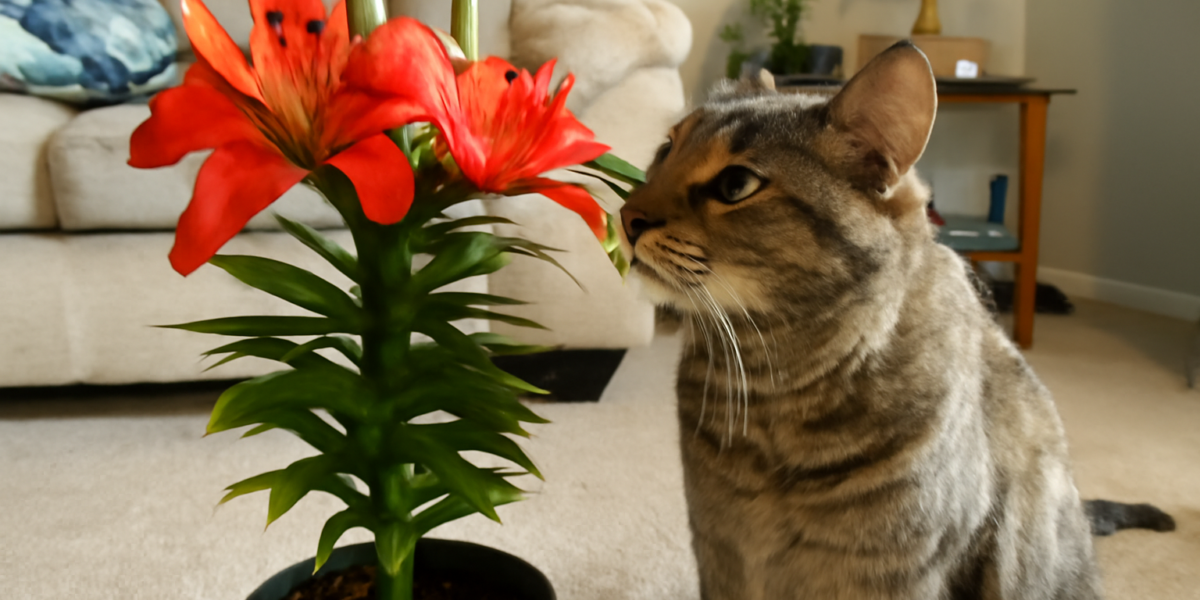
Asiatic lilies have upward-facing or outward-facing flowers (rather than the pendant blooms of tiger lilies or the recurved petals of Orientals) and come in vivid solid or two-tone colors — bright orange, hot pink, lemon yellow, deep red, and pure white are common. Stems are shorter than other true-lily groups, usually two to three feet, with relatively unscented flowers. The pollen is typically rust-orange and abundant.
You will see them most often in supermarket bouquets sold as “Asiatic mix” or “summer lily mix,” in big-box garden centers in spring, and in perennial garden borders. If a bouquet has trumpet- or bowl-shaped flowers labeled “lily” with prominent dark anthers and you have a cat, treat it as toxic and either remove it or rehouse the cat.
Symptoms of Asiatic Lily Poisoning
The symptom timeline mirrors what is seen across the Lilium genus and proceeds in clinically distinct phases. Recognizing the early phase is critical because the early signs are easy to mistake for a routine furball or mild stomach upset.
Within the first one to six hours, the most common findings are vomiting, drooling, lip-licking, lethargy, and refusal to eat. Plant fragments may be visible in the vomit. Some cats hide; others become unusually clingy. None of these signs alone confirms lily poisoning — but in any cat with possible lily access, they raise the index of suspicion enormously.
From roughly six to twelve hours, many cats appear to improve. Vomiting may stop and the cat may seem subdued but stable. This is the “false reassurance” window, and it is one of the most dangerous moments in the whole course of the illness because owners often delay the vet call here.
From twelve to seventy-two hours, kidney injury becomes clinically obvious. The cat may urinate excessively at first, then produce little or no urine. Severe lethargy, persistent vomiting, dehydration, weakness, disorientation, and in advanced cases seizures and coma can develop. Cats who are not making urine on arrival to the clinic have a guarded prognosis even with intensive treatment.
Immediate Steps If Your Cat Was Exposed
Do not wait for symptoms. The single most important variable in survival is time-to-IV-fluid-therapy, and the sooner you make the phone call, the better the outcome.
Call your veterinarian or a 24-hour emergency clinic immediately. If neither is reachable, contact the ASPCA Animal Poison Control Center at (888) 426-4435 or the Pet Poison Helpline at (855) 764-7661. Both are staffed by veterinary toxicologists, both charge a consultation fee, and both will issue a case number that your treating vet can use to coordinate care.
Bring the plant or a clear photo. Confirming the species removes uncertainty about whether your cat ate a true lily or a less-dangerous look-alike. Our guide to telling a peace lily from a true lily walks through the visual differences if you are not sure what you are looking at.
Do not induce vomiting at home. Cats do not respond reliably to home emetics, and the wrong product can cause caustic injury. Emesis decisions belong to the vet team in a controlled clinical environment.
What Veterinary Treatment Looks Like
There is no antidote for Asiatic lily toxicity. Treatment is aggressive supportive care: limit further toxin absorption, then protect the kidneys long enough for the tubules to recover.
If you arrive within the first few hours, the team will typically induce vomiting in a controlled setting and give activated charcoal. The mainstay of treatment is intravenous fluid therapy run continuously for a minimum of 48 to 72 hours; this maintains renal perfusion and helps flush whatever circulating toxin remains. Blood work (BUN, creatinine, electrolytes, urinalysis) is repeated every twelve to twenty-four hours to track kidney function.
If your cat is already in established AKI on arrival, the vet may recommend referral to a specialty hospital for hemodialysis. Dialysis is not available in every region and is expensive, but it can be the difference between recovery and not recovering. Outpatient decontamination typically costs several hundred dollars; inpatient AKI care commonly climbs into the low thousands; dialysis is on top of that. Ask your local emergency clinic for an honest estimate.
Prognosis After Asiatic Lily Exposure
Cats who receive IV fluids within roughly six hours of ingestion have the best prognosis. Cats who are still making urine on arrival generally do better than those who are anuric. Some cats recover completely with no lasting deficit; others survive the acute phase but develop chronic kidney disease over months or years.
Because lasting kidney damage is possible even in survivors, recheck bloodwork in the weeks following discharge is important. Our explainer on chronic kidney disease in cats outlines what long-term monitoring looks like for cats with reduced renal reserve after a toxic insult.
Removing the Risk and Choosing Cat-Safe Flowers
If you have a cat, the safest policy is a flat ban on Asiatic lilies in the home and yard. Tell florists you live with a cat and ask them to confirm every stem in any bouquet. Mixed bouquets routinely include Asiatics under generic labels, and a single hidden stem is enough to be dangerous.
You do not have to give up beautiful flowers. Roses (thorns trimmed), gerbera daisies, snapdragons, sunflowers, freesias, lisianthus, statice, and orchids are widely cited as cat-safe cut flowers. Our cat-safe flowers roundup walks through specific options for bouquets, and cat-safe houseplants covers the indoor potted-plant alternatives.
Other Lilies and Look-Alikes Worth Knowing
Asiatic lilies are one branch of a dangerous family. The same severe-AKI mechanism applies to tiger lilies, Oriental lilies, stargazer lilies, Easter lilies, and day lilies. The pillar piece on lilies and cats covers the genus in one place.
Several “lily” plants are not actually true lilies and pose much lower risk. Peruvian lilies (Alstroemeria), canna lilies, peace lilies, and calla lilies are in different families altogether and typically cause only mild GI or oral irritation rather than kidney failure. Knowing the difference is genuinely lifesaving — a panicked phone call about an Alstroemeria nibble has a very different urgency than a phone call about an Asiatic.
Why This Matters for Cat Adopters
Most Asiatic-lily poisonings happen by accident — a thoughtful gift, a wedding centerpiece, a grocery-store bouquet picked up on a Friday afternoon. Setting a household policy of “no true lilies, ever” is one of the simplest high-impact safety steps a cat owner can take.
If you are preparing to bring home a new cat, a once-over walk-through to remove all true lilies, ID the rest of your houseplants, and stash a vet’s phone number on the fridge is some of the most useful prep work you can do. Walk Me Home Rescue’s cat adoption hub can help you find your next family member, and our broader cat-care blog has more guides on cat-proofing.
The Asiatic-specific risk is worth flagging during the adoption conversation itself. Many shelter intake counselors now ask new adopters whether they have lilies in the home and provide a one-page handout if the answer is yes. If you are bringing home an adult cat after a previous loss to lily poisoning, talk through the emotional weight with your vet or shelter team — that grief is real, and learning the specifics about how to keep the next cat safe is part of healing.
Frequently Asked Questions
How much Asiatic lily is toxic to a cat?
There is no documented safe dose. Even small amounts — a chewed petal, a few grains of pollen groomed off the fur, a sip of vase water — have caused acute kidney injury in cats. Treat any contact as a presumed toxic exposure and call the vet.
Are Asiatic lilies dangerous to dogs too?
Dogs typically develop only mild gastrointestinal upset after eating Asiatic lily. The acute kidney injury seen in cats has not been documented in dogs from true-lily exposure. That said, plant ingestions in dogs still warrant a call to your vet, especially if vomiting persists.
What if my cat only got pollen on its fur?
Pollen exposure is a documented route of poisoning in cats, because grooming transfers it to the gut. If you find Asiatic lily pollen on your cat, gently wipe or bathe it off, save a sample of the plant for ID, and call the vet. Don’t wait for symptoms.
Will the symptoms always start with vomiting?
Vomiting is the most common first sign but not universal. Some cats present with drooling, lethargy, hiding, or refusal to eat first. The unifying point is that any change in a cat with possible lily access should trigger a call to the vet, not a wait-and-see approach.
If we got lucky and the cat is fine, do we need follow-up?
Yes, even cats who survive the acute phase can develop chronic kidney disease later. Your vet will usually recommend recheck bloodwork at one and four weeks post-discharge, and possibly periodic monitoring after that. Plan on lifelong renal-friendly care if your cat had clinically meaningful exposure.


