
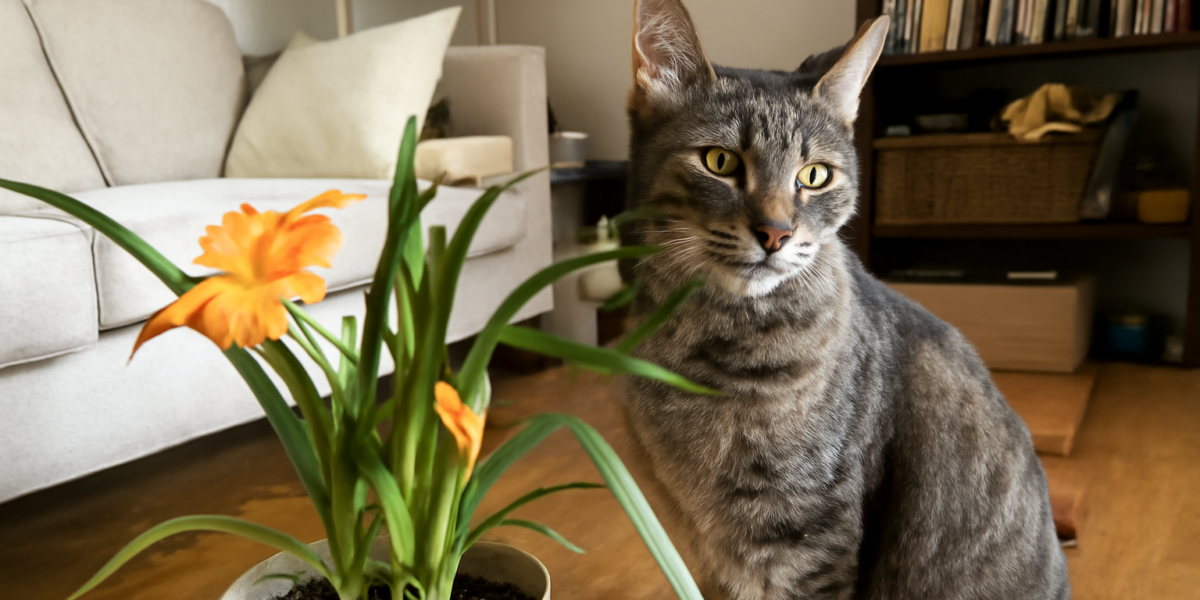
Are Day Lilies Toxic to Cats? The Direct Answer
Yes — day lilies are severely toxic to cats. Day lilies (Hemerocallis species and hybrids) are not in the genus Lilium, but they cause the same acute kidney injury (AKI) syndrome in cats that true lilies do, and they sit in the same severe-toxicity tier. Every part of the plant — petals, leaves, stem, pollen, even the water in a vase — can trigger kidney failure within roughly 24 to 72 hours of exposure. The toxicity is unique to cats; dogs typically experience only mild stomach upset from the same plant.
In this article
- Are Day Lilies Toxic to Cats? The Direct Answer
- Day Lily vs. True Lily — Why the Distinction Doesn’t Matter for Cats
- Identifying Day Lilies
- Symptoms of Day Lily Poisoning in Cats
- Outdoor Cats and Garden Day Lilies
- Immediate Steps After Suspected Exposure
- Veterinary Treatment for Day Lily Poisoning
- Prognosis and Long-Term Monitoring
- Cat-Safe Garden Alternatives
- Day Lilies Within the Wider Lily-Family Discussion
- Why a Cat-Safe Garden Matters for Adopters
- Frequently Asked Questions
Day lilies toxic to cats are particularly tricky because the name “day lily” makes them sound like a less-dangerous look-alike, but they are not. Veterinary toxicologists treat Hemerocallis exposure exactly as they treat Lilium exposure. If your cat has chewed on a day lily, licked pollen off its fur, or had any contact with the plant or its vase water, treat it as a true emergency and call your veterinarian or an animal poison control line immediately. Time-to-IV-fluid-therapy is the single biggest factor in whether a cat survives.
Day Lily vs. True Lily — Why the Distinction Doesn’t Matter for Cats
Botanically, day lilies and true lilies are different. Hemerocallis belongs to the family Asphodelaceae; Lilium belongs to Liliaceae. The two genera have different bulb structures, different growth habits, and different flowering patterns — day lilies famously open one flower at a time, each lasting only a single day, hence the name.
Clinically, however, the distinction is moot for cats. Both genera produce the same nephrotoxic effect, with the same timeline, the same severity, and the same treatment plan. The exact toxic compound in day lilies has not been fully isolated, just as in Lilium, but the kidney injury seen in cats after day-lily exposure is indistinguishable from Lilium-induced AKI.
This is one of the most important confusion-clearing points in cat plant safety. Searches like “are day lilies safe for cats” sometimes return reassurance because owners assume day lilies are unrelated to “real” lilies. They are not safe. They are equally dangerous, and they are far more likely to be planted in a home garden than true lilies because day lilies are a cheap, hardy, low-maintenance perennial that landscapers love.
Identifying Day Lilies
Day lilies have long, strap-like leaves arising in clumps from a fibrous root system, and tall flower stalks topped with several buds. Each individual flower opens for one day before wilting and being replaced by the next bud. Flowers come in oranges, yellows, reds, pinks, peaches, and burgundies, often with throat color contrasts. The classic “ditch lily” along American roadsides and old farm sites is Hemerocallis fulva — orange day lily — and it is everywhere.
You will find day lilies in perennial garden borders, foundation plantings, mass plantings along driveways, parking-lot landscaping, and naturalized along roadsides and old homesteads. Cut day-lily flowers occasionally appear in summer bouquets but more often the exposure risk for cats is in the garden — a cat that goes outside or has a window box can easily make contact.
Symptoms of Day Lily Poisoning in Cats
The symptom progression mirrors true-lily AKI exactly, with three clinically distinct phases. The early phase is deceptively mild, and the false-improvement window between roughly six and twelve hours is the most dangerous moment in the whole course because owners often relax during it.
Within one to six hours of exposure, expect vomiting (sometimes with visible plant material), drooling, lip-licking, lethargy, and refusal to eat. Some cats hide; some sit hunched and quiet. None of these signs alone confirms day-lily poisoning, but in a cat with garden access or possible day-lily contact they should trigger an immediate vet call.
From roughly six to twelve hours, many cats appear to bounce back. Vomiting may stop and the cat may seem subdued but stable. The kidneys are being damaged silently while the cat looks “better.”
From twelve to seventy-two hours, AKI becomes clinically obvious. The cat may urinate excessively at first as the failing kidneys lose concentrating ability, then produce little or no urine as the tubules collapse. Severe lethargy, recurring vomiting, dehydration, weakness, disorientation, and in advanced cases seizures or coma can develop. Cats who arrive anuric have a guarded prognosis even with intensive care.
Outdoor Cats and Garden Day Lilies
Because day lilies are so common in garden borders and along roadsides, cats with outdoor access are at higher exposure risk than cats whose lily exposure comes only through cut bouquets. If you have day lilies in your yard and your cat goes outside — even just on a leashed walk or a screened-porch — you should plan to remove them.
Removing established day-lily clumps takes some work because the fibrous roots are tenacious, but it is feasible. Dig out the entire root mass, dispose of it in a yard-waste bag (don’t compost — viable rhizomes can re-sprout), and replace the area with cat-safe perennials. Our pet-safe garden plants roundup walks through alternatives that fit similar growing conditions.
Immediate Steps After Suspected Exposure
Don’t wait. Time-to-IV-fluid-therapy is the single biggest variable in survival. Make the phone call before you finish reading the rest of this section.
Call your veterinarian or a 24-hour emergency vet first. If neither is reachable, contact the ASPCA Animal Poison Control Center at (888) 426-4435 or the Pet Poison Helpline at (855) 764-7661. Both lines are staffed by veterinary toxicologists, both charge a consultation fee, and both will issue a case number the treating vet can use to coordinate care.
Bring the plant or a clear photo. Confirming day lily versus a less-dangerous look-alike removes ambiguity. If you are not sure what you are looking at, our peace lily vs. true lily explainer covers some of the common confusions between true lilies, day lilies, and lower-risk plants.
Do not induce vomiting at home unless poison control specifically tells you to. Cats respond unreliably to over-the-counter emetics, and the wrong product can cause additional harm. Decontamination decisions belong to the vet.
Veterinary Treatment for Day Lily Poisoning
There is no antidote. Treatment is aggressive supportive care designed to limit further absorption, then protect the kidneys long enough for the tubules to recover.
If the cat arrives within a few hours of ingestion, the team will typically induce vomiting under controlled conditions and give activated charcoal. The mainstay of therapy is intravenous fluid therapy run continuously for at least 48 to 72 hours, with bloodwork (BUN, creatinine, electrolytes, urinalysis) repeated every twelve to twenty-four hours.
If the cat is already in established AKI on arrival, the vet may recommend referral to a specialty hospital for hemodialysis. Dialysis is not universally available and is expensive, but for advanced cases it can be lifesaving. Outpatient decontamination commonly costs several hundred dollars; inpatient AKI care climbs into the low thousands; dialysis is on top of that. Ask your local emergency clinic for a written estimate up front.
Prognosis and Long-Term Monitoring
Cats treated within roughly six hours of ingestion have the best prognosis. Cats still making urine on arrival generally do better than anuric cats. Some recover completely; others survive the acute phase but develop chronic kidney disease over weeks, months, or years.
Recheck bloodwork at one week, four weeks, and periodically afterward is the standard plan. Our guide on chronic kidney disease in cats covers what long-term monitoring looks like for cats with reduced renal reserve following a toxic insult.
Cat-Safe Garden Alternatives
You can have a beautiful summer garden without day lilies. Cat-safe perennials that fit similar sunny-border conditions include coreopsis, gaillardia (blanket flower), rudbeckia (black-eyed Susan), echinacea (coneflower), lambs ear, sedum, and many ornamental grasses. Roses are non-toxic to cats (just trim thorns to avoid mechanical injury). For shade borders, consider ferns (most species), heuchera, and astilbe.
Our pet-safe garden plants roundup walks through more alternatives by growing condition, and our cat-safe flowers guide covers cut-flower options for vases.
Day Lilies Within the Wider Lily-Family Discussion
Day lilies are functionally part of the same lethal-to-cats group as tiger lilies, Asiatic lilies, Oriental lilies, stargazer lilies, and Easter lilies. The pillar guide on lilies and cats covers the practical group as one safety category, even though day lilies are botanically separate.
Several plants called “lily” are genuinely lower risk — Peruvian lilies (Alstroemeria), canna lilies, peace lilies, and calla lilies are in unrelated families and typically cause only mild GI signs. Don’t conflate day lilies with those; the urgency is genuinely different.
Why a Cat-Safe Garden Matters for Adopters
If you are preparing to bring home a new cat — especially a cat who will have access to a yard, a screened porch, or a window box — taking inventory of your outdoor plants is one of the highest-impact safety steps you can take. Day lilies are so common in American landscaping that most people don’t realize they’re growing them.
Walk Me Home Rescue’s cat adoption hub can help you find your next family member, and our broader cat-care blog has more guides on cat-proofing both indoor and outdoor spaces. A weekend of garden audit and bouquet-policy setting is some of the most useful prep work a future adopter can do.
If you have just moved into a home with established landscaping, take a notebook around the yard and identify every perennial in flower beds and along property lines before letting your cat outside. Day lilies bloom in clumps with strap-like leaves and trumpet-shaped flowers each lasting a single day; once you’ve identified them, removal is a one-afternoon project that pays off in years of safety. The same audit is worth doing before you sign a lease or close on a house if you already live with cats.
Frequently Asked Questions
Are day lilies the same as orange “ditch lilies”?
Yes. The orange day lily found along American roadsides and old farmsteads is Hemerocallis fulva, and it is fully toxic to cats. The colloquial name “ditch lily” doesn’t make it safer.
How is day lily different from tiger lily?
Tiger lily (Lilium lancifolium) is a true lily — taller, with pendant orange flowers spotted with dark purple, growing from a true bulb. Day lily (Hemerocallis) is in a different family with strap-like leaves and trumpet-shaped flowers that each last only one day. Both are equally dangerous to cats.
Can a cat die from chewing one day-lily leaf?
Yes, this has been documented. There is no established “safe” quantity of Hemerocallis tissue for cats. Treat any contact as a presumed toxic exposure and call the vet.
Are day lilies edible for humans?
Day-lily flowers and buds are eaten in some Asian cuisines and are non-toxic to humans, which contributes to the confusion. The species-specific kidney toxicity is unique to cats.
What if I have day lilies in the yard but my cat is strictly indoor?
The risk is much lower if the cat truly never goes outside and does not have window-box or screened-porch access to the plants. Even so, if you ever cut day lilies for indoor arrangements, that brings the toxin inside. Many cat owners eventually choose to remove the plants altogether for peace of mind.


