
Last updated: May 16, 2026
In this article
- The Short Answer on Syngonium and Dogs
- What Syngonium Is and Why Dogs Find It
- The Aroid Family and the Raphide Defense
- Symptoms to Watch For
- Why Severity Stays Limited for Most Dogs
- What to Do If Your Dog Chewed Syngonium
- What the Vet Will Likely Do
- Puppy and Small-Breed Considerations
- Look-Alike and Name Confusion
- Dog-Safer Houseplant Swaps
- Keeping Your Existing Syngonium and Your Dog
- When to Skip the Wait-and-See
- The Bigger Picture for Dog Households
- Frequently Asked Questions
The Short Answer on Syngonium and Dogs
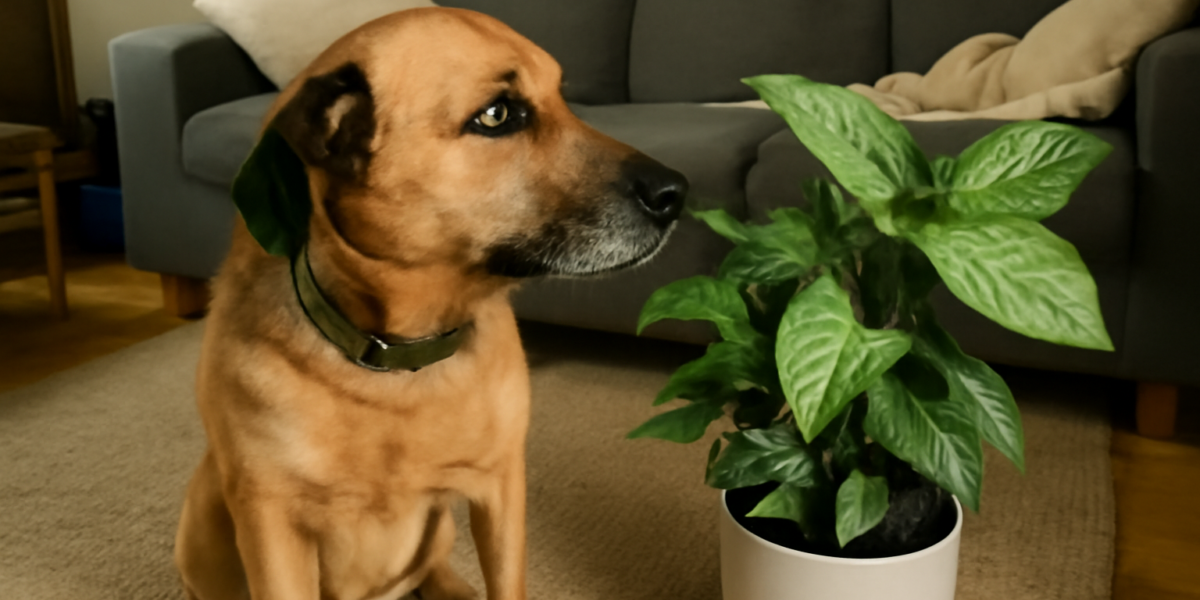
Syngonium is toxic to dogs. The ASPCA lists Syngonium podophyllum, sold as arrowhead plant, arrowhead vine, goosefoot, or nephthytis, on its toxic-to-dogs register. The toxic principle is insoluble calcium oxalate raphides, the same family of microscopic crystal needles found in monstera, pothos, philodendron, and dieffenbachia. Severity for most dog ingestions sits in the mild-to-moderate range, but it can climb if a teething puppy chews a whole stem rather than nibbling a leaf edge.
If your dog just chewed an arrowhead vine and is drooling, pawing at his mouth, or vomiting, that is the textbook reaction. Move the plant out of reach, gently rinse his mouth with cool water if he will tolerate it, and call your veterinarian or the ASPCA Animal Poison Control Center at 888-426-4435. The Pet Poison Helpline at 855-764-7661 is a second option. Most cases resolve in a few hours, but a same-day vet check is wise for any dog under twenty pounds, any senior dog, or any dog with a history of airway problems.
What Syngonium Is and Why Dogs Find It
Syngonium podophyllum is a climbing aroid native to tropical Central and South America. In the houseplant world it is sold as arrowhead plant, arrowhead vine, American evergreen, goosefoot, or nephthytis. Younger leaves are arrow-shaped, which is where most of the common names come from. The plant trails or climbs depending on whether you give it a moss pole, and it tolerates low light beautifully, which is why it ends up on so many side tables and hall consoles.
Dogs find syngonium because it is usually within reach. Floor pots, low coffee tables, and trailing vines from a hall console are all dog-height. Puppies in the teething phase will mouth almost anything green. Bored adult dogs left alone for long stretches sometimes turn to plants for novelty. And dogs who have learned to dig in houseplant pots may end up with sap on their muzzles long before they ever bite a leaf.
The Aroid Family and the Raphide Defense
Syngonium belongs to the Araceae family. Knowing that one fact tells you most of what you need to know about its toxicity. The aroids defend themselves with insoluble calcium oxalate raphides, microscopic needle-shaped crystals stored under pressure inside specialized cells. When a dog bites a leaf or stem, those cells rupture and fire the crystals like tiny biological darts into the soft tissue of the tongue, gums, and palate.
The crystals are insoluble in water, which is why a quick drink does not flush them away. They also carry inflammation-triggering enzymes on their surfaces. Together, the mechanical injury and the chemical irritation produce immediate burning pain, drooling, and swelling. This is the same defense found in monstera, pothos, philodendron, and dieffenbachia. Different leaf, same defensive system.
The reason most aroid exposures stay in the mild-to-moderate severity tier rather than escalating to life-threatening is that the pain itself usually stops the dog mid-bite. A sensible adult dog takes one chew and walks away. Teething puppies, food-motivated breeds, and high-drive working dogs are the higher-risk group because they may push past the sting and keep chewing.
Symptoms to Watch For
Signs of arrowhead vine ingestion appear within five to thirty minutes of the bite.
- Sudden, copious drooling, often described as foamy or ropey
- Pawing at the face or mouth, repeated lip-licking, head shaking
- Visible redness or swelling of the gums, tongue, or lips
- Whining, restlessness, or hiding from discomfort
- Vomiting, sometimes with chewed plant fragments
- Reluctance to eat or drink for several hours
- Hoarse-sounding bark if the throat is irritated
- Watery eyes if sap contacted the face during the bite
Severe airway swelling that compromises breathing is uncommon but possible, particularly in toy breeds, brachycephalic dogs (pugs, French bulldogs, Boston terriers), and dogs with a history of laryngeal disease. Open-mouth breathing, blue or grey gums, and a swollen tongue protruding from the mouth are emergency signs that warrant a same-hour drive to the nearest open vet clinic.
Why Severity Stays Limited for Most Dogs
Calcium oxalate raphides are an irritant, not a true systemic poison. Unlike yew or oleander, syngonium does not contain a heart-stopping cardiac glycoside or a kidney-damaging compound. The crystals injure local tissue and trigger inflammation but do not cross into the bloodstream and damage organs. That is why the prognosis for arrowhead vine exposures is overwhelmingly good.
The exception is a dog who manages to swallow a substantial volume of plant material before the discomfort registers. In that situation the raphides keep producing irritation as they pass through the esophagus and into the stomach, and you can see prolonged vomiting, abdominal pain, and dehydration over the following twelve to twenty-four hours. Those dogs benefit from anti-nausea medication, fluids, and a soft diet under veterinary supervision.
What to Do If Your Dog Chewed Syngonium
Take these steps in this order.
- Move the plant out of reach so the dog cannot take a second bite while you are dealing with the first.
- Gently wipe visible plant fragments out of the mouth with a damp soft cloth. Do not stick your fingers deep into a stressed dog’s throat.
- Offer cool water, a small amount of plain whole milk, or a tablespoon of plain yogurt. The dairy fat and protein help bind irritant chemistry and the cool temperature soothes the burn.
- Call your veterinarian or the ASPCA Animal Poison Control Center at 888-426-4435. Pet Poison Helpline at 855-764-7661 is the second option.
- Watch breathing closely for the first two hours. Open-mouth breathing, blue gums, or a tongue that visibly swells means an emergency drive to the nearest open clinic.
Do not induce vomiting at home. Hydrogen peroxide is sometimes recommended for other ingestions but is the wrong move for raphide exposure because vomiting re-exposes the esophagus and pharynx to more crystals on the way back up. Decontamination decisions belong to your veterinarian, who can choose between gastric lavage, anti-nausea medication, or watchful waiting based on what your dog actually swallowed.
What the Vet Will Likely Do
For most arrowhead vine cases, treatment is supportive and recovery is fast. Your vet will examine the mouth and throat for swelling, listen to the airway, and assess hydration. From there, the standard of care is rinsing the mouth, sometimes giving an anti-inflammatory medication, providing fluids under the skin if needed, and recommending a soft, bland diet for two to three days.
Bloodwork is rarely required for a straightforward syngonium ingestion because the toxin does not damage organs. Your vet will reach for it only if the dog has pre-existing kidney or liver disease that complicates recovery, or if the symptoms do not match the history (suggesting a second toxic exposure). The vast majority of dogs are back to their normal selves within twenty-four hours, and most of the cost of the visit is the exam fee plus a couple of medications.
Puppy and Small-Breed Considerations
Two populations deserve a lower threshold for vet evaluation. Puppies under sixteen weeks have small body masses, narrow airways, and the well-known habit of chewing past pain because they do not yet have the impulse control to stop. Toy breeds and brachycephalic breeds (pugs, French bulldogs, Boston terriers, English bulldogs) have anatomically narrower airways at any age, which means even modest swelling can compromise breathing.
If you have a puppy or a small-airway breed and you find chew marks on a syngonium leaf, call the vet even if the dog currently looks fine. A telephone consultation is free at most practices and the vet can decide whether to bring the dog in based on the size of the bite, the weight of the dog, and the breed risk profile. Better an unnecessary visit than a midnight crisis.
Look-Alike and Name Confusion
Syngonium has more common names than almost any other houseplant. If a friend mentions an arrowhead plant, an arrowhead vine, a goosefoot plant, an American evergreen, or a nephthytis, all five names refer to Syngonium podophyllum and all five are toxic to dogs. Some older houseplant references list Nephthytis as a separate genus, which is technically outdated, but the practical advice is the same.
Do not confuse syngonium with the aquatic arrowhead (Sagittaria), which is an unrelated wetland plant. Do not assume the pink, neon, or white-variegated cultivars are safer than the standard green form, because they share the same calcium oxalate chemistry. And do not confuse syngonium with alocasia or elephant ear, which is a different aroid genus with a similar but generally more severe toxicity profile.
Dog-Safer Houseplant Swaps
If you love the trailing-vine aesthetic that drew you to syngonium, several non-toxic plants give you the same look without the raphide problem. Spider plants trail beautifully and the ASPCA lists them as non-toxic to dogs and cats. Areca palms are non-toxic and tall enough that most dogs leave them alone once placed. Prayer plants deliver the patterned-leaf drama without toxicity.
For shelving and ledge displays, look at peperomia varieties, parlor palm, or hoya kerrii. Our full pet-safe garden plants guide and the indoor companion cat-safe houseplants guide cover trade-offs of each, including light requirements and how forgiving they are if a tail knocks them off a shelf.
Keeping Your Existing Syngonium and Your Dog
You do not necessarily have to rehome the plant. Plenty of households share space with both a curious dog and a syngonium without incident. The key is height, supervision, and substitution. Hang the syngonium from a ceiling hook in a room the dog does not occupy unsupervised, or set it on a tall plant stand in a corner. Cover the soil with smooth river stones so the dog is not tempted to dig and ingest sap-stained dirt. Offer a frozen kong, raw bone, or licki-mat at the times of day the dog tends to look for trouble.
If your dog is a confirmed plant chewer, the safer long-term answer is rehoming the syngonium to a friend without pets. Persistent plant chewing is often a symptom of boredom, deficient mental enrichment, or a missing fiber source in the diet. Talking with your vet about a fiber-rich snack rotation, plus more sniff-walks and training games, addresses the underlying drive rather than just the latest casualty.
When to Skip the Wait-and-See
Most arrowhead vine exposures resolve on their own with mild support. Take your dog to a vet right now if any of the following appear: difficulty breathing, blue or grey gums, a tongue that visibly swells and protrudes, repeated vomiting that does not stop within an hour, weakness or collapse, or refusal to drink for more than twelve hours. These are uncommon but real complications, and waiting until morning is the wrong move.
Puppies, toy breeds, brachycephalic dogs, and dogs with pre-existing heart, kidney, or liver disease deserve a lower threshold for an exam regardless of how the dog looks. The cost of an unnecessary same-day visit is a fraction of the cost of an overnight hospitalization for an avoidable complication.
The Bigger Picture for Dog Households
Houseplant toxicity is the kind of slow-burn worry most owners do not think about until something happens. A simple walk-through of every room, noting what plants live where, and cross-referencing them against the ASPCA database, prevents most midnight emergencies. Syngonium, monstera, pothos, philodendron, peace lily, dieffenbachia, dumb cane, calla lily, and elephant ear all share the same calcium oxalate chemistry and all are dog hazards.
If you are preparing for a dog you are about to bring home, our dog adoption hub includes a household-prep guide that walks through plants, foods, cords, and chemicals to relocate before the dog arrives. An afternoon of preparation buys you years of relaxed, plant-filled evenings without the constant low hum of plant-chewing anxiety.
Frequently Asked Questions
Is the pink syngonium safer than the green one for my dog?
No. Variegation is cosmetic. Pink, white, neon, and confetti cultivars all contain the same calcium oxalate raphides as the standard green Syngonium podophyllum. The toxicity profile is identical across cultivars.
My dog ate a leaf an hour ago and seems fine. Should I still call the vet?
If your dog is bright, eating, drinking, and breathing normally an hour after the bite, the exposure was likely mild and home monitoring is reasonable. Call the vet if drooling persists past three hours, if vomiting starts, or if the dog refuses water for more than half a day.
How long do syngonium symptoms last in dogs?
Mild oral irritation typically resolves within two to twelve hours. Drooling and reluctance to eat can stretch into a full day in dogs that swallowed a larger volume. Symptoms beyond forty-eight hours are unusual and warrant a vet exam to rule out a complication or a second exposure.
Can hydrogen peroxide help if my dog ate syngonium?
No. Hydrogen peroxide is sometimes used to induce vomiting after other toxin ingestions, but for raphide exposures it is the wrong choice because vomiting re-exposes the esophagus to more crystals on the way back up. Call your vet or the poison control hotline before giving any home decontamination.
What if my dog also has chronic kidney disease?
Dogs with pre-existing organ disease deserve a lower threshold for evaluation. Although syngonium itself does not damage the kidneys, dehydration from drooling and reduced water intake can stress already-compromised kidneys. Our guide to chronic kidney disease in dogs covers the broader picture, but in the moment, just call your vet.


