
Last updated: May 16, 2026
In this article
- The Reassuring Answer About Turnip Plants
- Identifying Turnip Plants in Your Garden
- What Turnip Plants Actually Contain
- Turnip Greens Versus Turnip Roots
- The Goitrogen Caveat
- Realistic Garden Risks
- Sharing Turnips With Dogs and Cats
- The Brassica Family Context
- Garden Setup for Pet Households
- When Turnip Is the Wrong Choice
- When to Call a Veterinarian
- Frequently Asked Questions
The Reassuring Answer About Turnip Plants
If your dog has been crunching a turnip pulled from the garden or your cat has been nibbling a peppery leaf, the situation is almost certainly fine. Turnip plants (Brassica rapa) are non-toxic to dogs and cats per the ASPCA, and the question of whether turnip plants safe for pets has a reassuring answer for both the white-and-purple root and the dark leafy tops. Both are part of the cabbage family (Brassicaceae) and share the same broadly pet-safe profile as kale, broccoli, cabbage, and bok choy.
The only practical caveats are gas and the small theoretical risk of goitrogenic compounds in extremely large daily intakes over time. For a pet that takes a curious bite in the garden, neither matters. For a pet being fed turnip as a daily ingredient, both are worth understanding.
This guide explains what turnip plants contain, the realistic garden scenarios, and where the genuine considerations lie versus where you can let the harvest happen.
Identifying Turnip Plants in Your Garden
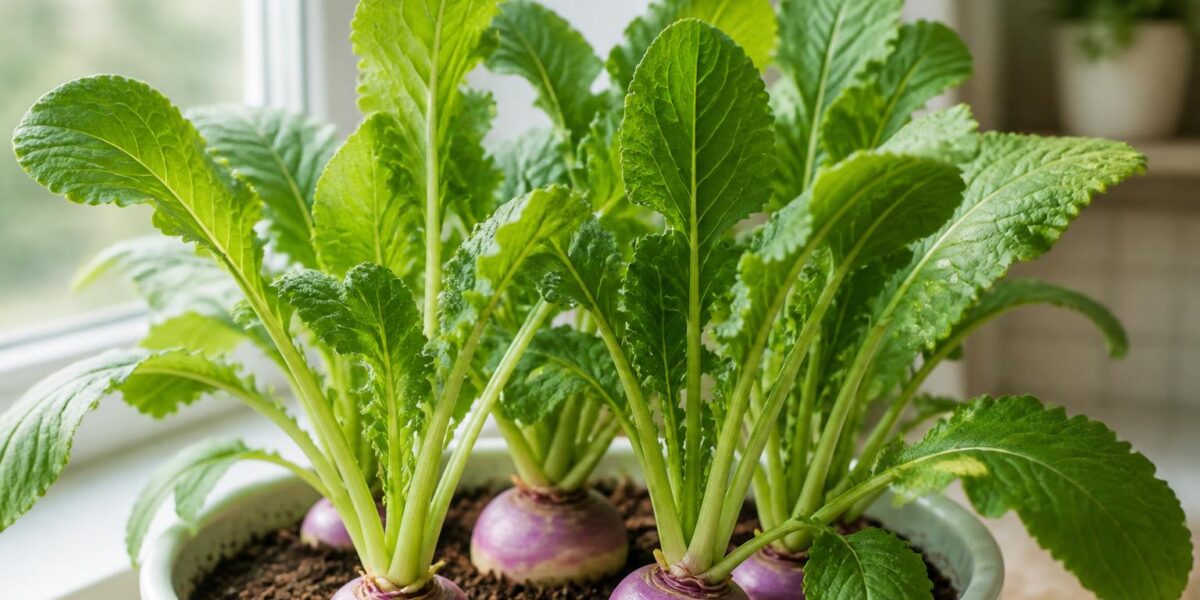
Turnips grow as cool-season biennials, harvested as annuals in most home gardens. The above-ground foliage forms a rosette of broad, slightly hairy, deeply lobed bright green leaves. The tops can reach twelve to eighteen inches tall when mature. Some cultivars are grown specifically for the greens (such as “Seven Top” and “Topper”) rather than the root.
The root is rounded or slightly elongated, typically white with a purple shoulder where the sun has hit. Some varieties are entirely white, golden, or red. Mature roots range from a small radish-size for baby turnips like Hakurei to softball-sized for storage varieties.
Brassica rapa also includes several other crops you may grow without realizing they are the same species: bok choy, Chinese cabbage, mizuna, tatsoi, and rapini are all Brassica rapa subspecies. They share the same safety profile.
What Turnip Plants Actually Contain
Turnips are part of the cruciferous-vegetable group and contain the family signature compounds: glucosinolates. When the plant tissue is bitten or crushed, glucosinolates break down into isothiocyanates and other sulfur compounds that produce the characteristic peppery cabbage flavor. These same compounds are credited with anti-cancer benefits in human nutrition research.
The greens are higher in calcium, vitamin K, vitamin A precursors, and glucosinolates than the root. The root is sweeter and starchier, with vitamin C and modest fiber. Neither part contains solanine, cyanogenic glycoside, allium sulfide, or any other compound that triggers a true ASPCA toxic-listing.
The two compound classes worth knowing about for pet portions are isothiocyanates (the same family that makes horseradish genuinely irritating to pets) and goitrogens. Both are present in turnip but at much lower concentrations than horseradish, and both are deactivated significantly by cooking.
Turnip Greens Versus Turnip Roots
The root is the round white-and-purple part of the turnip you pull from the soil. It is sweet-peppery, dense, and starchy. Cooked turnip root is a classic winter vegetable. It is non-toxic and a small amount is fine for both dogs and cats.
The leafy greens are the broad lobed leaves above ground. They are darker, more pungent, and more nutrient-dense than the root, with a flavor closer to mustard greens or kale. They are non-toxic and a small amount is fine for both dogs and cats. Many traditional Southern dishes feature turnip greens cooked low and slow.
For specifics on portions when you want to deliberately offer turnip as a treat, see the species-specific guides on whether dogs can eat turnips and whether cats can eat turnips. Both confirm turnip is a low-portion safe option for the appropriate pet.
The Goitrogen Caveat
Goitrogens are compounds that interfere with iodine uptake by the thyroid gland. In humans, the goitrogenic load of cruciferous vegetables is only meaningful in iodine-deficient diets. In pets, dogs and cats fed commercial complete diets get adequate iodine and the goitrogen content of an occasional turnip is irrelevant.
The scenario where this matters is the home-cooked or raw-fed pet whose diet is heavy in cruciferous vegetables (kale, cabbage, broccoli, turnip, collards) and where iodine sources are limited. In that scenario, cumulative goitrogen exposure can theoretically contribute to thyroid issues, especially in cats whose thyroid health is fragile.
Cooking turnip thoroughly reduces both glucosinolate and goitrogen content. If you are formulating a homemade diet, talk to a board-certified veterinary nutritionist rather than guessing — this applies to all cruciferous greens, not just turnip.
Realistic Garden Risks
The most realistic risks from a turnip patch are gas, loose stool from sudden quantity, and the rare choking hazard of a whole pulled root. None are acute toxicity. None warrant a panicked emergency vet drive.
Gas is real. Cruciferous vegetables produce sulfur-based gas during fermentation in the colon, and a Beagle that eats a pile of turnip greens will be a smelly Beagle for 24 hours. Open a window and ride it out.
Loose stool is real for a quantity-binge. The combination of fiber, sulfur compounds, and the unfamiliar food is enough to disrupt a pet’s stool consistency for a day. As always, fresh water and bland support is the answer if needed.
Choking happens when a small dog tries to gulp a whole baby turnip. The shape and size of an unsliced root is the worst possible chew shape. Cut roots into wedges before sharing intentionally, and discard pulled roots in the compost pile rather than leaving them where a dog can scavenge.
Sharing Turnips With Dogs and Cats
For dogs, cooked plain turnip (no salt, butter, garlic, or onion) is a safe occasional addition. Raw turnip root is also fine but harder to digest. A reasonable starting portion is a teaspoon of cooked turnip for a small dog and a tablespoon for a large dog, a few times a week. Cooked turnip greens are similarly safe at small portions.
For cats, a small amount of cooked plain turnip is harmless but nutritionally unnecessary. Cats are obligate carnivores and have no dietary need for root vegetables or cruciferous greens. Most cats are uninterested in the flavor.
Avoid pickled turnip, kimchi turnip, mashed turnip with butter and cream, and any preparation with added onion, garlic, or chive — those allium-family additions are the actual safety problem, not the turnip. Pickled forms add salt and vinegar that pets do not need.
The Brassica Family Context
Turnip belongs to the Brassicaceae family, which is one of the most pet-friendly vegetable families overall. The family includes kale, collard greens, bok choy, arugula, and radish among many others. All of these are listed non-toxic by ASPCA.
The notable exceptions in the family that are NOT pet-safe are mustard plants (high glucosinolate concentration in seed) and horseradish (extreme isothiocyanate concentration). The pattern is that pungency tracks with pet-irritation risk: the spicier the cruciferous, the more caution required.
Turnip sits firmly on the safe end of this spectrum. The flavor is mild, the glucosinolate concentration is moderate, and the practical risk in normal garden exposure is low.
Garden Setup for Pet Households
Turnips grow easily in cool weather and loose soil. They are typically direct-seeded in spring or late summer and harvested within 30 to 60 days depending on variety. The plants prefer consistent moisture and full sun.
Pets are not generally interested in turnip seedlings, but mature foliage is occasionally browsed by curious dogs. Cats may sniff but rarely chew the leaves. Neither species typically digs for the roots unless the bed has been disturbed and the smell of fresh soil draws them.
If a dog does pull a root from the row, the root is non-toxic and rinsing off the soil is mostly an aesthetic concern. Compost trimmings should be in a sealed bin rather than an open pile, both because dogs scavenge and because spoiled cruciferous compost can develop molds that produce other concerns.
When Turnip Is the Wrong Choice
Turnip is not right for every pet. Three populations should approach turnip with caution or avoidance:
First, pets with hypothyroidism or those at risk of it. The cumulative goitrogenic load of cruciferous vegetables is real. Discuss any homemade-diet plans with a veterinary nutritionist if your pet is on thyroid medication or has thyroid disease.
Second, pets with severe gastrointestinal sensitivity, especially those prone to flatulence-related discomfort or inflammatory bowel disease. Cruciferous vegetables produce sulfur gas reliably and can flare GI symptoms.
Third, pets recovering from intestinal surgery or pancreatitis. Bland chicken-and-rice diets are the standard during recovery, not high-fiber high-sulfur cruciferous additions.
When to Call a Veterinarian
For pure turnip plant exposure, you almost never need an emergency call. The plant is non-toxic and the realistic worst-case is gas, loose stool, or a brief stomach ache. That said, the right call list is the same one to keep handy for any plant exposure question.
Reach your own veterinarian first if your pet has thyroid disease, GI disease, or is on a special prescription diet. The ASPCA Animal Poison Control Center at 888-426-4435 (per-call consultation fee) is available 24/7 for plant questions. The Pet Poison Helpline at 855-764-7661 is the alternative 24/7 line.
If a pet shows respiratory distress, persistent vomiting, blood in stool, or collapse after a garden incident, those signs point to something other than turnip exposure and need prompt evaluation. The most likely confounders are an overlooked toxic plant in the same garden bed or a non-plant cause entirely.
Frequently Asked Questions
Are turnip greens poisonous to dogs?
No. Turnip greens are non-toxic to dogs and are a part of the cruciferous-vegetable family that ASPCA does not list as toxic. Cooked turnip greens in moderation are safe; large daily portions over time can contribute to gas and goitrogen load.
Can cats eat turnips?
A small amount of cooked plain turnip is harmless for cats but nutritionally unnecessary. Cats are obligate carnivores and most are uninterested in turnip flavor. Avoid any preparation with added onion, garlic, or salt.
Will raw turnip give my dog gas?
Yes. Raw cruciferous vegetables, including turnip, reliably produce sulfur-based gas in dogs during colonic fermentation. Cooked turnip is less gassy. The gas itself is uncomfortable but not dangerous.
Are baby turnips (Hakurei) safe for pets?
Yes. Baby turnips are the same species as standard turnips, just harvested earlier. They are non-toxic, but their small whole-root size makes them more of a choking hazard for medium-and-large dogs that gulp food. Slice before sharing.
How much turnip can a dog eat?
A teaspoon of cooked turnip for a small dog or a tablespoon for a large dog, a few times a week, is a reasonable upper limit as an occasional addition. Treats including vegetables should not exceed about ten percent of total daily calories.


