
Last updated: May 4, 2026
In this article
- The Short Answer on Cats and Starfruit
- What Makes Starfruit Toxic
- Why Cats Are Higher Risk Than Dogs
- Symptoms of Starfruit Poisoning in Cats
- What to Do If Your Cat Ate Starfruit
- Other Oxalate-Rich Foods to Watch
- Other Tropical Fruits to Skip or Approach with Caution
- Cross-Species Comparison: Dogs and Starfruit
- Long-Term Kidney Health in Cats
- If You Have a Starfruit Tree at Home
- Recognizing Early Kidney Trouble in Cats
- Frequently Asked Questions
The Short Answer on Cats and Starfruit
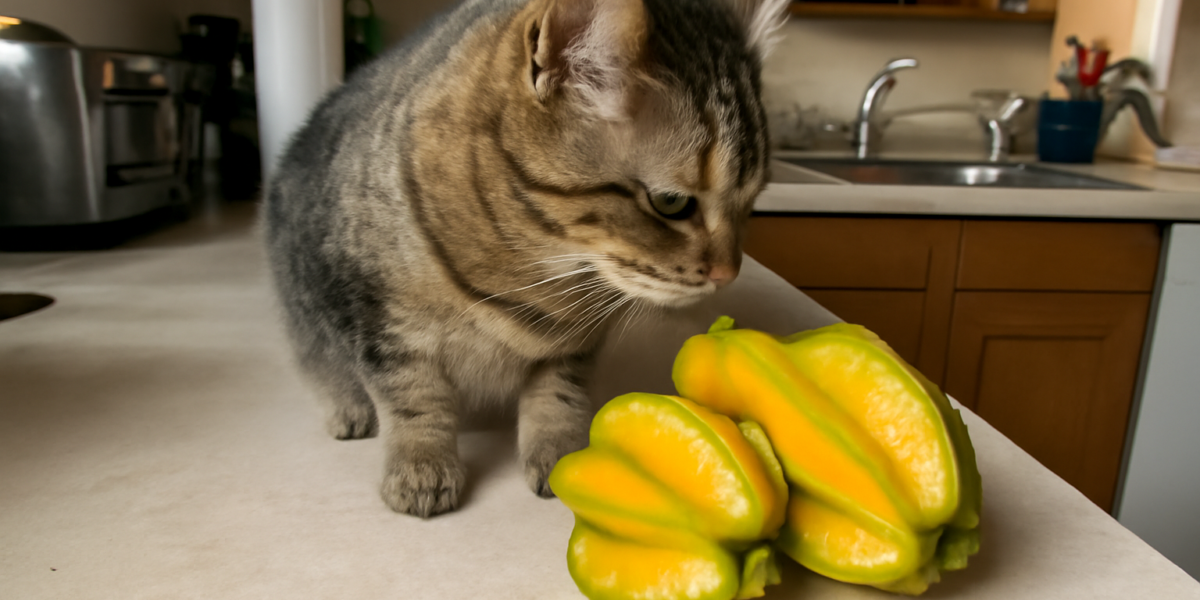
Cats should not eat starfruit. Carambola (Averrhoa carambola) contains high levels of soluble oxalates and a neurotoxin called caramboxin, both of which stress the kidneys. Cats already have a higher baseline risk of kidney disease than most species — chronic kidney disease affects an estimated 30 to 50 percent of cats over age 12, and many subclinical cases go undiagnosed in younger cats too. Adding a fruit specifically known to provoke acute kidney injury and neurological signs is a risk with no upside. The answer to “can cats eat starfruit” is a clear no.
If your cat has stolen a small piece of starfruit, do not panic — but do call your veterinarian or the Pet Poison Helpline. The toxic dose in cats is not well established, and individual sensitivity varies. Cats with even mildly impaired kidney function can react severely to amounts that would not bother a healthy dog or human.
What Makes Starfruit Toxic
Starfruit toxicity in mammals is driven by two main compounds. The first is oxalate, particularly soluble oxalate, which binds with calcium in the bloodstream and precipitates as calcium oxalate crystals in the kidney tubules. These crystals physically damage the nephrons and impair filtration. Cats are especially vulnerable because their kidneys are already a “weak point” in the species — feline urine is highly concentrated, and any insult that disrupts filtration tips quickly toward acute kidney injury (AKI).
The second compound is caramboxin, a phenylalanine-derived neurotoxin first characterized in human starfruit poisoning research. Caramboxin is normally cleared by healthy kidneys. When kidney function is impaired — even mildly — caramboxin accumulates and crosses the blood-brain barrier, causing seizures, hiccups, confusion, and in severe cases coma. In humans with chronic kidney disease, even a small slice of starfruit has caused fatal poisoning. Cats have not been studied as extensively, but feline kidney biology suggests a similar vulnerability.
Why Cats Are Higher Risk Than Dogs
Both dogs and cats can be poisoned by starfruit, but cats face additional risk factors. First, cats have a much higher background prevalence of kidney disease — roughly 30 to 50 percent of senior cats develop chronic kidney disease compared to about 10 percent of senior dogs. Many of these cats are subclinical at the time they encounter a toxin, meaning they look healthy but have reduced renal reserve. Second, cats are smaller, so a slice of starfruit represents a larger dose per kilogram of body weight.
Third, cats are less efficient than dogs at processing many xenobiotics because of differences in liver glucuronidation. While starfruit toxicity is primarily renal rather than hepatic, the overall pattern — that cats handle plant toxins worse than dogs — applies. For more on feline kidney biology and what damages it, see our chronic kidney disease in cats guide.
Symptoms of Starfruit Poisoning in Cats
Symptoms can appear within a few hours or be delayed by 24 to 48 hours depending on the amount eaten and the cat’s renal function. Early signs are usually GI and behavioral; later signs are renal and neurological.
- Vomiting, sometimes repeatedly
- Lethargy, weakness, or unusual sleepiness
- Loss of appetite and refusal of water
- Decreased urine output or absent urination
- Excessive urination paradoxically in early phases
- Hiccups (a classic human sign that can appear in cats too)
- Tremors, twitching, or muscle weakness
- Seizures in severe cases
- Confusion or unresponsiveness
Any cat showing decreased urination, seizures, or persistent vomiting after eating starfruit is a same-day emergency. Bring the fruit packaging or a piece of the remaining fruit if you can — it speeds diagnosis.
What to Do If Your Cat Ate Starfruit
Step one is to estimate the amount eaten. A single small bite from a healthy adult cat may resolve with monitoring, while half a slice or more in a small or senior cat warrants immediate veterinary care. Step two is to call your vet or the ASPCA Animal Poison Control Center (888-426-4435) or Pet Poison Helpline (855-764-7661). Have ready: your cat’s weight, age, any known health conditions, the time of ingestion, and how much fruit you think was eaten.
Do not induce vomiting at home unless a veterinarian directs you to. Cat vomiting is harder to induce than dog vomiting, and over-the-counter methods can cause aspiration pneumonia or chemical burns. At the clinic, treatment usually involves IV fluids to support kidney perfusion and dilute toxins, blood work to assess BUN, creatinine, SDMA, and electrolytes, anti-nausea medication, and seizure control if needed. Cats with elevated kidney values on admission may need 48 to 72 hours of inpatient fluid therapy and serial monitoring.
Other Oxalate-Rich Foods to Watch
Starfruit is the most concentrated single-fruit oxalate source most cats encounter, but it is not the only one. Other foods that are high in oxalate and worth limiting in cats with any kidney concerns include rhubarb (already known to be toxic to cats), spinach, swiss chard, beet greens, sweet potatoes, almonds, and certain teas. Most of these are not staples in feline diets, but they can sneak in via shared human food.
If your cat has been diagnosed with calcium oxalate urolithiasis (a type of bladder stone), your vet has likely already advised an oxalate-restricted diet. Even healthy cats benefit from staying away from concentrated oxalate sources because cats produce highly concentrated urine and have limited urinary water reserves. Hydration through wet food and accessible water stations is one of the simplest preventative measures — see our wet vs dry food guide for more.
Other Tropical Fruits to Skip or Approach with Caution
Several tropical fruits are problematic for cats beyond just starfruit. Citrus fruits contain limonene and psoralens that cause GI upset. Persimmons have seeds that can obstruct, and unripe persimmons cause severe GI symptoms. Soursop contains annonacin, a neurotoxin under active research. Tamarind is acidic and very high in tartaric acid. Sibling tropical-fruit articles in this batch like rambutan are tolerated in tiny amounts, but starfruit specifically is in a different toxicity tier.
Safer fruit choices in tiny amounts for healthy cats include peeled mango, watermelon with no rind or seeds, blueberries, and bananas. Even with these, the rule is “tiny pea-sized portion, occasional, healthy cats only.” Cats are obligate carnivores and never need fruit in their diet.
Cross-Species Comparison: Dogs and Starfruit
Dogs are also at risk from starfruit, though their higher baseline kidney function gives them slightly more margin. The same oxalate and caramboxin mechanisms apply. Our dog starfruit guide covers the canine specifics. The bottom line for both species is identical: skip starfruit entirely. There is no preparation method, ripeness level, or portion size that makes carambola a good choice for pets.
If you grow a starfruit tree in your yard, fence it off from where pets roam. Fallen fruit is especially attractive to cats and dogs, and the soft texture makes it easy to eat quickly. Pick up windfall daily during fruiting season.
Long-Term Kidney Health in Cats
Even cats that recover fully from a starfruit incident may have subclinical kidney damage. Schedule a follow-up renal panel and urine specific gravity test 4 to 6 weeks after the incident, and again at the cat’s annual wellness visit. Keeping cats hydrated, feeding wet food primarily, avoiding nephrotoxic plants and human foods, and catching kidney disease early all extend feline lifespan.
Senior cats benefit from twice-yearly bloodwork starting at age 10. The SDMA test detects kidney function decline earlier than creatinine alone. Our senior cat care checklist walks through the screening schedule. If your cat is already on a renal-support diet, talk with your vet about specialized prescription diets that lower oxalate, phosphorus, and protein loads simultaneously.
If You Have a Starfruit Tree at Home
Starfruit trees are common ornamental and fruiting plants in tropical and subtropical regions including Florida, Hawaii, Southern California, the Caribbean, Central America, India, Southeast Asia, and Northern Australia. If you have one in your yard, you have a year-round potential exposure source for any cat with outdoor access. Fallen fruit accumulates on the ground during the long fruiting season — sometimes two crops per year. Soft, ripe fallen fruit is especially attractive to cats because of its smell and easy texture.
Practical mitigation includes daily windfall pickup during fruiting season, a low fence around the drip line of the tree, and limiting cat outdoor access during peak fruit drop. Composting fallen fruit is fine if your compost bin is sealed against cat access. Birds also feed on fallen starfruit, so an attractive fruit pile can become a hunting spot, doubling the cat’s reasons to investigate. Indoor-only cats avoid the issue entirely; for indoor-outdoor cats, the tree may need to come out if a safer compromise cannot be reached.
Recognizing Early Kidney Trouble in Cats
Because so many cats have subclinical kidney disease, knowing the early warning signs matters more than memorizing food lists. Cats with developing CKD often show subtle changes that owners miss for months. Increased water intake, increased urine output, urinating outside the litter box, weight loss despite normal or increased appetite, and a duller coat are early signs that warrant bloodwork. Vomiting and decreased appetite tend to come later, as kidney function drops further.
Annual bloodwork including a renal panel and urinalysis becomes especially important from age 7 onward. The SDMA test, available since 2015, detects kidney function decline at the equivalent of 25 to 40 percent loss — much earlier than creatinine, which only rises after 75 percent of nephrons are damaged. Catching CKD early gives you years of opportunity to slow progression with diet, hydration support, and medications. For senior cats, twice-yearly bloodwork is the new standard of care among feline internal medicine specialists.
Cats that have been exposed to nephrotoxic foods (starfruit, lilies, antifreeze, NSAIDs given inappropriately) need follow-up renal panels even after they appear to recover. Subclinical damage can manifest months later. Document the exposure in the medical record so future testing can be compared to a known baseline.
Frequently Asked Questions
How much starfruit is toxic to a cat?
The exact toxic dose has not been quantified for cats, but cases in dogs and humans suggest that even small amounts (a single slice or less) can cause symptoms in sensitive individuals. Treat any amount as potentially toxic and call your vet.
Is unripe starfruit safer than ripe?
No. Both contain oxalates and caramboxin. Unripe starfruit may actually have higher levels of certain irritant compounds and is sour enough that most cats reject it anyway.
What about starfruit juice or dried starfruit?
Both are concentrated forms of the same toxic compounds and are if anything more dangerous than fresh fruit, ounce for ounce. Keep juices and dried fruits well out of cat reach.
My cat licked starfruit juice off the cutting board. Should I worry?
A small lick of juice from a cutting board is unlikely to cause clinical poisoning in a healthy cat, but it is still worth monitoring for vomiting, lethargy, or changes in urination over the next 24 hours. If anything seems off, call your vet.
Are there any safe tropical fruits for cats?
Yes — small amounts of peeled mango, watermelon, and banana flesh are generally well tolerated. Always plain, always tiny, always occasional.


