
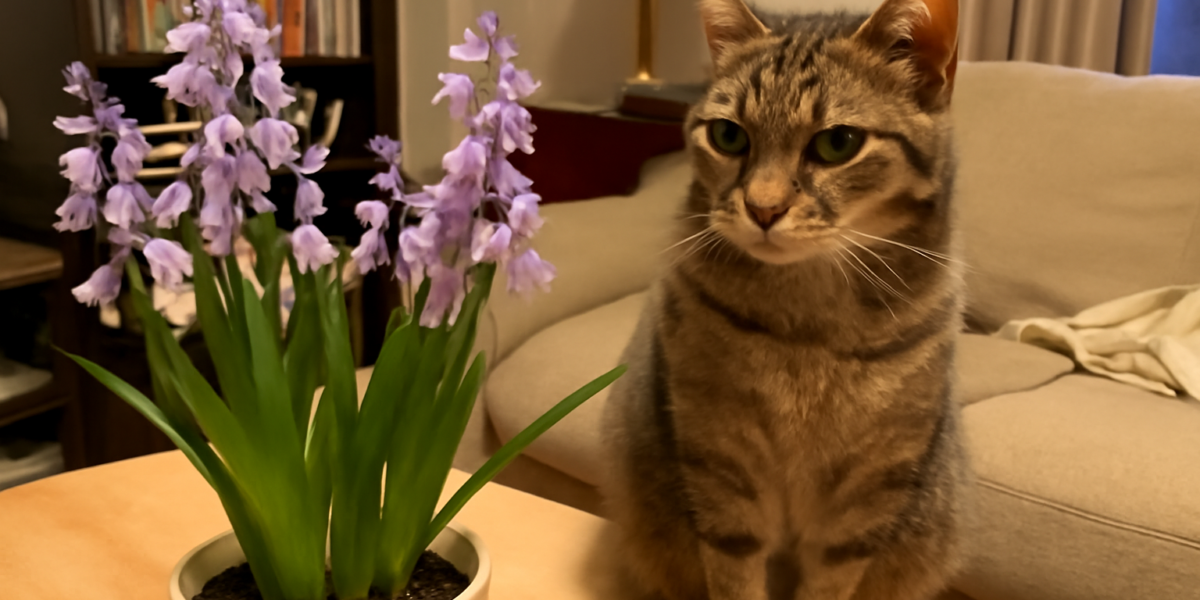
Are Bluebells Toxic to Cats? The Short Answer
Yes — bluebells (genus Hyacinthoides, family Asparagaceae) are toxic to cats. The plant produces a group of scillaren-A-like cardiac glycosides — a class of compounds related to those found in foxglove (digitalis), squill (Urginea), and lily of the valley. The bulb carries the highest concentration; flowers and leaves cause primarily gastrointestinal signs, but a chewed bulb can cause severe vomiting and diarrhea, dehydration, and in the worst cases cardiac arrhythmia. Bluebell toxicity sits in the moderate-to-severe tier depending on which part of the plant your cat consumed.
In this article
- Are Bluebells Toxic to Cats? The Short Answer
- What “Bluebell” Means Botanically
- The Toxic Compound: Scillaren-A-Like Cardiac Glycosides
- Which Parts of the Bluebell Plant Are Toxic?
- Symptoms of Bluebell Poisoning in Cats
- What to Do in the First Hour
- What Veterinary Treatment Looks Like
- Prevention in the Garden and Home
- Other Spring Bulbs Cat Owners Should Know
- Cardiac-Glycoside Plants More Broadly
- For Multi-Species Households
- Choosing a Cat for a Bluebell-Lover’s Home
- Frequently Asked Questions
If your cat has just chewed any part of a bluebell — flower, leaf, stem, or especially the bulb — call your veterinarian, the ASPCA Animal Poison Control Center at 888-426-4435, or the Pet Poison Helpline at 855-764-7661. Both poison lines charge a consultation fee. Do not wait for symptoms to appear before making the call. Bulb ingestions in particular benefit from early veterinary intervention because cardiac glycoside effects can be delayed by several hours.
What “Bluebell” Means Botanically
“Bluebell” is one of the most overloaded common names in horticulture. Three plants commonly called bluebells have different toxicity profiles, and pet owners need to recognize which is in the garden.
- English bluebell (Hyacinthoides non-scripta): the famous UK woodland flower with drooping, narrow bell flowers and a sweet scent. Forms vast carpets in ancient woodland in spring. The species protected by law in the UK from collection.
- Spanish bluebell (Hyacinthoides hispanica): upright flowers, larger, less scented. Hybridizes freely with English bluebells in gardens. Considered invasive in UK woodlands. Same toxicity profile.
- Virginia bluebell (Mertensia virginica): a North American spring wildflower in the borage family — different family entirely. ASPCA lists it as non-toxic. Pet owners in the US who say “bluebells” often mean this plant. The clinical picture is different.
This article is specifically about Hyacinthoides bluebells — the UK and European species — and their hybrids in domestic gardens. If you are in North America and you mean the woodland Virginia bluebell, your cat is probably not in chemical danger. If you are not sure, photograph the flower and confirm before assuming either way.
The Toxic Compound: Scillaren-A-Like Cardiac Glycosides
Hyacinthoides species belong to the family Asparagaceae (formerly classified in Liliaceae or Hyacinthaceae) and produce cardiac glycosides chemically similar to scillaren A — the same class of compound found in squill (Drimia maritima, formerly Urginea), historically used as a rat poison. These glycosides act on the sodium-potassium ATPase pump in heart muscle. At low doses they slow the heart and increase contraction strength; at higher doses they cause arrhythmia, bradycardia, and potentially fatal cardiac events.
This same mechanism is what makes foxglove (digitalis) and oleander dangerous. Bluebell glycosides are generally considered less potent than digitalis, but the bulb concentrates them, and a determined cat that chews on a freshly dug bulb is exposed to a meaningful dose. Bluebells also contain saponins and other GI irritants, which is why most cases also feature vomiting and diarrhea regardless of cardiac involvement.
Which Parts of the Bluebell Plant Are Toxic?
All parts contain cardiac glycosides, but concentrations differ.
- Bulb: highest concentration. The most concerning ingestion type. Most poisoning cases involve a cat that dug up or found a stored bulb.
- Flowers: moderate concentration. A cat chewing on a cut bouquet or a flower in the garden is exposed but usually shows GI signs more than cardiac signs.
- Leaves and stems: moderate concentration; the sticky sap causes oral irritation in addition to systemic effects.
- Sap: sticky and irritating; can cause contact dermatitis on cat lips and paws.
If your cat dug up a bluebell bulb in the garden, that is a more serious ingestion than a few chewed leaves and warrants prompt veterinary assessment.
Symptoms of Bluebell Poisoning in Cats
Signs typically begin within a few hours of ingestion and reflect a combination of GI irritation and cardiac glycoside effects. The cardiac signs may be delayed up to 12 hours.
- Drooling, foaming, or pawing at the mouth
- Vomiting, sometimes with chewed plant material or bulb fragments
- Diarrhea, occasionally bloody or with mucus
- Reduced or absent appetite
- Lethargy, weakness, hunched posture, or hiding
- Dilated pupils in some cases
- Slow or irregular heart rate (bradycardia or arrhythmia) — may not be obvious without veterinary monitoring
- Collapse or seizures in severe bulb ingestions
Mild ingestions of a flower or a leaf often produce only GI signs that resolve within 24 hours. Bulb ingestions are the cases where cardiac signs and severe dehydration emerge. Severity depends on the body weight of the cat, the amount eaten, and which part of the plant was consumed. Kittens and small adults are at higher risk for the same dose.
What to Do in the First Hour
Time matters more for bluebells than for many garden plants because of the cardiac component. The decontamination workflow is straightforward.
- Move the cat away from the plant. Pick up any chewed material — especially bulb fragments — so the cat cannot return.
- Rinse the mouth gently. Wipe the gums with a damp cloth and offer fresh water. Do not force water into the mouth with a syringe.
- Identify the plant and the part eaten. Take a photo of the plant in flower if possible, plus a photo of the chewed material. Note whether a bulb was involved.
- Call your veterinarian or poison control immediately. ASPCA APCC: 888-426-4435. Pet Poison Helpline: 855-764-7661. Both charge a fee.
- Do not induce vomiting at home. Hydrogen peroxide is dangerous for cats and may not be appropriate; let the clinician decide.
For confirmed bulb ingestions, an in-person veterinary visit is almost always warranted. For a cat that nibbled a leaf, the call may end with home monitoring and a careful watch for delayed signs over 12 to 24 hours.
What Veterinary Treatment Looks Like
There is no specific antidote routinely used for bluebell glycosides in cats (the digoxin-specific Fab fragments used in human digitalis overdose are extraordinarily expensive and rarely used in veterinary practice). Treatment is supportive and aimed at controlling vomiting, restoring fluid balance, and addressing any cardiac complications.
- Anti-emetic medication (maropitant or ondansetron) to control vomiting
- Subcutaneous or intravenous fluids to correct dehydration and support cardiovascular function
- Activated charcoal in selected early cases — only useful within roughly the first hour and only with a protected airway
- Continuous ECG monitoring for cats showing cardiac signs
- Anti-arrhythmic medication if specific dysrhythmias are documented
- Blood work to assess electrolytes — particularly potassium, which interacts with cardiac glycoside chemistry
- Hospitalization for 12 to 48 hours for confirmed bulb ingestions
Most cats with mild leaf ingestions recover fully within several days. Cats with confirmed bulb ingestions and cardiac involvement require longer hospitalization but generally recover with prompt supportive care.
Prevention in the Garden and Home
Bluebells are a beloved spring flower and you do not have to give them up — but a household with cats benefits from a few placement strategies.
- Plant bluebells where the cat does not patrol. A side garden, a fenced bed, or a far corner of the lawn keeps the cat away from bulbs and flowers.
- Store dormant bulbs in a closed container. Bulbs stored in the garage in mesh bags are tempting and accessible. Use a sealed plastic tub.
- Watch in autumn and spring. Autumn planting and spring digging are when bulbs are most accessible. Supervise outdoor cats during these windows.
- Discard cut bouquets carefully. Wilted bluebells in the compost bin can still be sampled by an indoor-outdoor cat.
- Replace risky borders with safer flowers. Our cat-safe flowers roundup lists alternatives with similar season and color.
Other Spring Bulbs Cat Owners Should Know
If your cat is interested in bluebell bulbs, the rest of the spring-bulb bed needs attention too. Most spring bulbs are toxic.
- Tulips and cats — tulipalin glycosides; bulbs concentrate the toxin.
- Hyacinths and cats — closely related to bluebells in modern classification; same family.
- Daffodils and cats — lycorine alkaloids; severe vomiting and cardiac signs.
- Narcissus and cats — same Amaryllidaceae family as daffodils.
- Snowdrops and cats — galanthamine; primarily GI signs in pets.
- Crocus and cats — distinguish spring from autumn; autumn crocus is much more dangerous.
If you garden with spring bulbs at all, it is worth doing a one-time audit of every species in the bed and checking each on the ASPCA database before declaring the area cat-safe.
Cardiac-Glycoside Plants More Broadly
Bluebells share their cardiac glycoside mechanism with several more dangerous plants. Knowing the family helps you spot risk in unfamiliar gardens.
- Foxglove and cats — digitalis; the original cardiac glycoside plant, severely toxic.
- Oleander and cats — oleandrin; severe cardiac toxicity.
- Yew and cats — taxine alkaloids; different chemistry but similar cardiac risk.
- Rhododendron and cats — grayanotoxin; cardiac and neurological.
For Multi-Species Households
Bluebells are toxic to dogs as well as cats. If you have both species and only one was caught with the plant, examine the other carefully too. For the dog-side picture, see our companion guide on bluebells and dogs. The clinical pictures are similar; cats often consume smaller amounts because they chew rather than gulp, while dogs can consume larger volumes in a single event, particularly if a bulb is involved.
Choosing a Cat for a Bluebell-Lover’s Home
The UK householder with bluebells in the garden does not have to choose between flowers and feline companions. A combination of placement, fencing, and supervision keeps both safe. If you are still in the adopting-a-pet phase, our adopt a cat hub helps you think through the lifestyle match. Many shelter cats come with notes on whether they are confirmed plant chewers — useful information when your spring garden depends on a bluebell carpet.
Frequently Asked Questions
Are English bluebells more or less toxic than Spanish bluebells?
The toxicity profiles are similar — both are Hyacinthoides species and produce the same scillaren-like cardiac glycosides. Treat them identically for pet-safety purposes.
My cat sniffed a cut bluebell bouquet but did not chew. Should I worry?
Sniffing is not ingestion. If the cat is bright and eating, monitor for delayed signs over 12 hours. Move the bouquet out of reach and check for fallen petals on the floor.
Are Virginia bluebells toxic to cats?
Virginia bluebells (Mertensia virginica) are a different family entirely (Boraginaceae) and are listed by ASPCA as non-toxic. The clinical concern in this article applies to Hyacinthoides only.
How long after a bluebell ingestion should I watch for symptoms?
GI signs typically appear within a few hours; cardiac signs can be delayed up to 12 hours. Plan to monitor closely for 24 hours after a confirmed ingestion, especially if a bulb was involved.
What can I plant instead of bluebells if I have a cat who digs?
Most spring bulbs are toxic to cats, so the safer alternative is non-bulb spring color: pansies, violets, primroses, or non-toxic flowering shrubs. See our cat-safe flowers roundup for a complete planting plan.


