
Last updated: May 16, 2026
In this article
- The Short Answer: Longan Trees Are Safe for Pets
- Meeting Dimocarpus longan
- Why the Tree Is Considered Non-Toxic
- The Hypoglycin Question
- Ripe Longan and Pet Diets
- Leaves, Bark, and Tree Material
- Dogs and Cats With Longan Trees
- What to Do If Your Pet Ate Longan
- The Sapindaceae Family Map
- Look-Alikes and Naming Confusion
- Living With a Longan Tree and Pets
- The Bigger Picture
- Frequently Asked Questions
The Short Answer: Longan Trees Are Safe for Pets
Longan trees (Dimocarpus longan), the brown-skinned, white-fleshed Sapindaceae cousins of lychee that fill orchards across southern China, Thailand, Vietnam, and northern Australia, are not on the ASPCA toxic-plant register and have no documented serious-toxicity record in cats or dogs. Leaves, bark, ripe fruit pulp, and the tree itself are all friendly to the dogs and cats that share the gardens around them. The phrase longan trees safe for pets is well supported by available data.
The realistic concerns are the same triumvirate that applies to most fruit trees: ripe fruit pulp is fine in small amounts but loaded with sugar; the hard, smooth, marble-sized seed is a choking and obstruction risk for small dogs; and the fibrous papery skin can upset a stomach if eaten in quantity. Longan does not exude toxic latex, the leaves are unappetizing to most pets, and a curious cat or dog rarely escalates beyond a soft-stool day after a fallen-fruit indulgence. Lead with reassurance, hold the line on seeds and rinds.
Meeting Dimocarpus longan
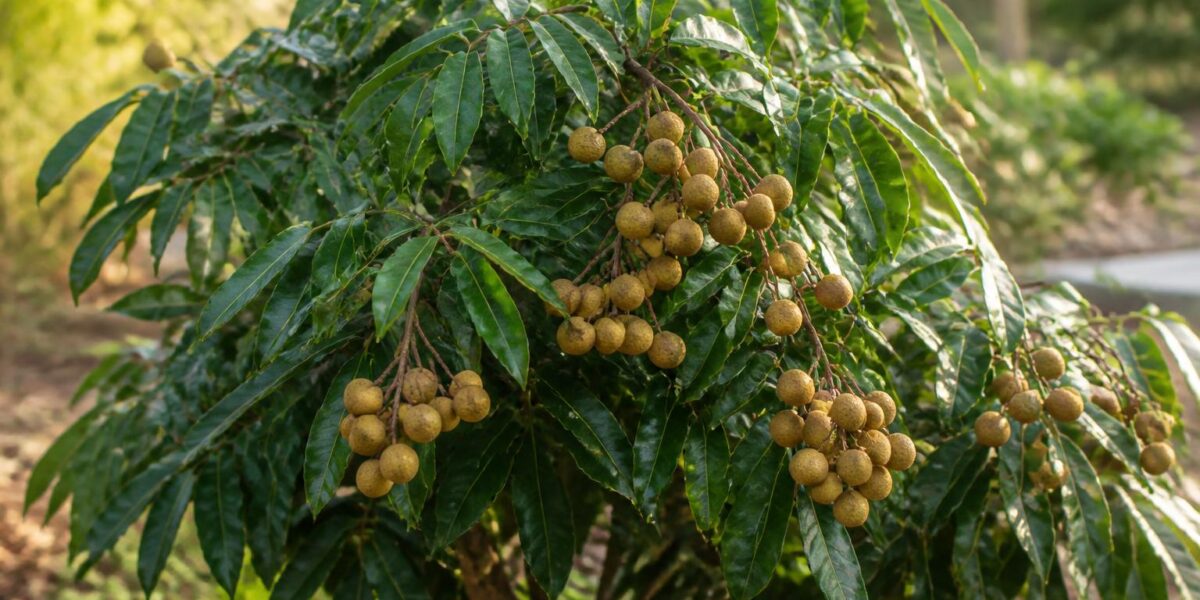
The longan is a medium-sized evergreen tree, 10 to 12 metres tall in mature gardens, with a spreading rounded crown of glossy compound leaves. Each leaf bears four to six lance-shaped leaflets and the canopy provides dense shade. The tree is closely related to the lychee — same family (Sapindaceae), same growing requirements, same orchard partners — but differs in fruit appearance and season.
Longan fruit hangs in branched clusters of small, round, brown-skinned berries. Crack the leathery skin and the inside is a translucent pearl-white aril surrounding a single shiny black seed with a distinctive pale spot — the feature that gives longan its Chinese name “dragon eye” (lóng yǎn). The flesh tastes sweet, slightly musky, and noticeably less floral than lychee. The fruiting season runs late summer in tropical and subtropical regions, slightly later than lychee, which is one reason orchards plant both.
For pet households, the realistic exposures are dropped fruit on the lawn during peak season, occasional leaf chewing, or a paw batting at low-hanging clusters. The tree itself is one of the more agreeable tropical-orchard residents to share a garden with a curious dog or cat.
Why the Tree Is Considered Non-Toxic
The non-toxic conclusion rests on several converging lines of evidence. First, longan has been a major human food crop in East and Southeast Asia for over a thousand years. The fruit is eaten fresh, dried (a staple in Chinese herbal cooking and tonic soups), canned, and made into wines. A plant this thoroughly integrated into human diets does not typically harbour serious toxicity for the dogs and cats that share human kitchens.
Second, longan is absent from the ASPCA toxic-plant database, the Pet Poison Helpline alert lists, and the tropical-veterinary case-report literature. There are no published case reports of dogs or cats developing serious illness from chewing longan leaves or eating modest amounts of ripe fruit. The species sits in the same friendly Sapindaceae cluster as lychee and rambutan.
Third, the chemical literature on the species describes flavonoids, polyphenols, and sugars in concentrations consistent with food crops. The seeds contain tannins and saponins at low levels — not zero, but not at concentrations associated with serious pet poisoning when small numbers of seeds are accidentally swallowed.
The Hypoglycin Question
Pet owners who have read about lychee ask a fair question: does longan share the unripe-fruit hypoglycin chemistry that makes lychee a public-health story in some communities? The honest answer is “less so, but not nothing.” Longan is in the same Sapindaceae family as lychee and ackee, and trace amounts of related cyclopropyl amino acids have been detected in some Sapindaceae seeds. However, the human-medicine outbreaks of acute hypoglycemic encephalopathy have been documented for lychee and ackee specifically, not for longan.
For pets, this translates to a low-concern note rather than a flag. Ripe longan fruit fed in small amounts as a treat is essentially safe. The unripe-fruit-on-empty-stomach scenario that produces serious illness in malnourished children eating green lychees is not a documented problem with longan and is not a realistic pet-household exposure for most owners.
The honest disclosure is the same one we offer for lychee: well-fed pets eating ripe fruit in small amounts have essentially no concern. Underweight, diabetic, or recently anorexic pets that gorge on a fallen fruit pile are the rare scenario worth a vet call. Most readers will never encounter that scenario.
Ripe Longan and Pet Diets
Ripe longan flesh is safe for pets in small amounts as an occasional treat. The pulp is high in natural sugar and water, modest in fibre, and contains vitamin C, copper, and trace minerals. A peeled, deseeded ripe longan or two is a fair summer treat for a healthy medium-size dog. Cats, as usual, are largely indifferent to fruit.
The seed is the part that demands attention. A longan seed is roughly marble-sized, smooth, slippery, and almost the perfect shape and consistency to lodge in a small dog’s throat or upper intestine. Choking on a swallowed seed is the most realistic veterinary scenario from longan exposure. Always remove the seed before offering longan to a pet, and never let a small dog chew a whole intact fruit.
The leathery brown skin is not chemically toxic but is fibrous and can produce a stomach upset if eaten in quantity. Whole fruit eaten with skin and seed is the worst-case scenario for an unsupervised dog raid on a fruit bowl.
Leaves, Bark, and Tree Material
Longan leaves are leathery, mildly bitter, and unpalatable to most pets. A dog or cat that chews a fallen leaf out of boredom typically experiences nothing more than a single soft stool the next day. The bark is similarly bland and is not a target for pet chewing.
Pruning a longan tree does not release dramatic latex or sap. There is no equivalent of the jackfruit sticky-latex cleanup problem. Wood shavings from light pruning, fallen twigs, and dropped leaves can be raked and composted normally.
Longan flowers are small, pale yellow, and grow in branched panicles. They are major nectar sources for honey bees in commercial production but are not a pet-safety concern. Cats may bat at the panicles; dogs are rarely interested.
Dogs and Cats With Longan Trees
Dogs are the species owners think about during longan season. A medium-size dog that finds a few dozen dropped fruits on the lawn can eat them all in a few minutes — fruit, skin, seed, and all. The dog will likely be uncomfortable that evening and produce loose stools, but the most realistic serious risk is the swallowed seeds rather than the chemistry. Three or four longan seeds in a small dog’s gut is an obstruction concern.
Cats almost never eat fruit. The realistic feline scenarios are paw-batting at clusters, chewing fallen leaves, or licking sticky residue off a counter. None of these escalate to a serious problem. Cats are slightly more likely than dogs to choke on a single accidentally swallowed seed because of their narrower throats.
For diabetic pets, overweight pets, or pets with chronic kidney disease, fruit treats including longan should be skipped. The sugar load is unhelpful for diabetics, the calorie load is unhelpful for the overweight, and the potassium load is unhelpful in advanced kidney disease.
What to Do If Your Pet Ate Longan
For the typical scenario — a few ripe fruits or a chewed leaf — home monitoring is appropriate. Withhold food for a single skipped meal, offer fresh water, and watch for vomiting or significant lethargy over the next few hours. Most pets are fine by the next morning, with at most a single soft stool.
Call the vet, the ASPCA Animal Poison Control Center at (888) 426-4435, or the Pet Poison Helpline at (855) 764-7661 (both charge a consultation fee) if you observe persistent vomiting, suspected swallowed seeds, signs of choking or gagging, weakness or collapse, or any sign of a possible intestinal obstruction (repeated retching with no production, swollen belly, no stool for 24 hours, refusal to eat for more than a single meal). The seed-obstruction scenario is the realistic vet-call trigger from longan, more than any chemical concern.
Do not induce vomiting at home. The risk of re-aspirating a smooth seed on the way back up is real, and longan is not toxic enough to require home decontamination. Decontamination decisions belong to the veterinarian.
The Sapindaceae Family Map
Longan belongs to the Sapindaceae or soapberry family. The family contains a friendly cluster of three Asian fruit cousins — longan, lychee, rambutan — all of which are largely safe for pets in normal use. It also contains some unfriendly relatives: horse chestnut (Aesculus hippocastanum), buckeye, soapberry, and the genuinely dangerous Caribbean ackee (Blighia sapida).
Pet owners often own one of these trees and want a quick “what about the others?” answer. For the three Asian fruit cousins, the answer is essentially the same: ripe fruit in moderation is fine, seeds are a choking risk, leaves are unpalatable but not dangerous, and tree material is benign. For horse chestnut and ackee, the answer is the opposite — those trees do contain documented toxic compounds and warrant a separate, careful look.
Read fruit-tree pet-safety articles by species rather than family. Even within a family that contains friendly relatives, the unfriendly cousins lurk and they earn their warnings honestly.
Look-Alikes and Naming Confusion
Longan is sometimes called dragon eye, dragon’s eye, or lóngyǎn (its Chinese name). In English-language tropical-fruit catalogues you may see it spelled “longan,” “longyan,” or “lung-an.” All refer to Dimocarpus longan, the same species under all spellings.
The closest visual confusion is with lychee — same general size, same arrangement in branched clusters, same single-seed-in-translucent-flesh structure. Lychee fruit is bright red or pink-red with a bumpy skin; longan is brown with a smoother, slightly leathery skin. Both are safe with the same caveats. Rambutan is the third cousin with hairy red spikes on the skin; same general safety profile.
Do not confuse longan with the unrelated yangmei (Myrica rubra, Chinese bayberry) or langsat (Lansium parasiticum, an unrelated Southeast Asian fruit). Both are different species in different families with their own pet-safety considerations.
Living With a Longan Tree and Pets
A longan tree in a pet-shared garden is a low-maintenance companion. The peak management period is the brief late-summer fruiting season. Pick up dropped fruit from the lawn daily, bag and dispose of skins and seeds where dogs cannot reach them, and store harvested fruit out of dog-jump range.
If you grow longan commercially or as part of a productive home orchard, the off-season management — pruning, spraying, fertilising — is uneventful from a pet-safety angle. Standard precautions about systemic insecticides apply: do not let pets onto recently treated lawn or eat dropped fruit from sprayed trees during the post-application withdrawal period.
For households welcoming a new pet into a tropical home with established fruit trees, our dog adoption hub and cat adoption hub include practical pet-proofing checklists. Companion non-toxic tropical trees that pair well with longan in a pet-friendly garden include jackfruit, papaya, guava, banana, and curry leaf.
The Bigger Picture
Longan earns its place in the friendly half of tropical fruit-tree articles without significant caveats. The realistic risks come down to common sense: deseed before sharing, pick up dropped fruit, and watch small dogs around fallen-fruit piles during peak season. The chemistry concerns that hover around lychee in human medicine do not transfer cleanly to longan, and even if they did, the realistic pet-household exposure scenarios do not approach the threshold for serious illness.
For broader tropical-garden planning, our pet-safe tropical houseplants guide covers the indoor companions, and the guide to tropical toxic plants in Singapore gardens covers the trees and shrubs you would rather plant on the other side of the fence from where the dog likes to dig. Longan is an easy “yes” in the welcome zone, alongside its Sapindaceae cousins and the broader cluster of safe fruit trees this batch covers.
Frequently Asked Questions
My dog ate longan fruit, including the seeds. What should I do?
Watch for choking, repeated vomiting, lethargy, abdominal distension, or absence of stool over the next 24 hours. Small dogs that swallowed multiple seeds are at obstruction risk; call your vet for guidance, especially for dogs under 10 kilograms or any dog showing distress.
Is longan safe for cats to eat?
Tiny pieces of ripe deseeded longan flesh are safe for cats but not nutritionally necessary. Most cats refuse fruit voluntarily. Skip the seed and skin, and treat any feline interest in longan as a curiosity rather than a routine treat.
Are dried longan (“dragon eye”) used in Chinese soups safe for pets?
Dried longan in plain form is safe in tiny amounts but is very high in concentrated sugar. The realistic concern is when dried longan is part of a herbal tonic soup containing onion, garlic, scallions, or unfamiliar herbs — those additions can be toxic to pets. Plain dried longan flesh as an occasional crumb is fine; herbal-soup leftovers are not.
What part of the longan tree is most dangerous for my pet?
The seed is the realistic danger — not because of chemistry but because of the choking and intestinal obstruction risk it poses to small dogs and cats. Always deseed before offering fruit. Leaves, bark, and ripe pulp are all low-concern.
Can I plant a longan tree in my yard if I have a Labrador and a young child?
Yes. Longan is among the friendlier tropical fruit trees for shared gardens. Plant where dropped fruit can be picked up daily during the brief fruiting window, deseed any fruit you share with kids or pets, and store harvested fruit out of dog-reach.


