
Last updated: May 4, 2026
In this article
- Quick Answer: Tiny Amounts of Plain Mild Gouda Only
- What Gouda Is and How Aging Changes It
- Lactose Content in Gouda
- Sodium Levels: Moderate, Not Extreme
- Fat Content and Pancreatitis Risk
- Mild vs Aged vs Smoked Gouda
- Safe Serving Size and Frequency
- Forms of Gouda That Are Not Safe
- Comparing Gouda to Other Cheeses
- Signs Your Cat Did Not Tolerate Gouda
- Cats Who Should Skip Gouda Entirely
- Frequently Asked Questions
Quick Answer: Tiny Amounts of Plain Mild Gouda Only
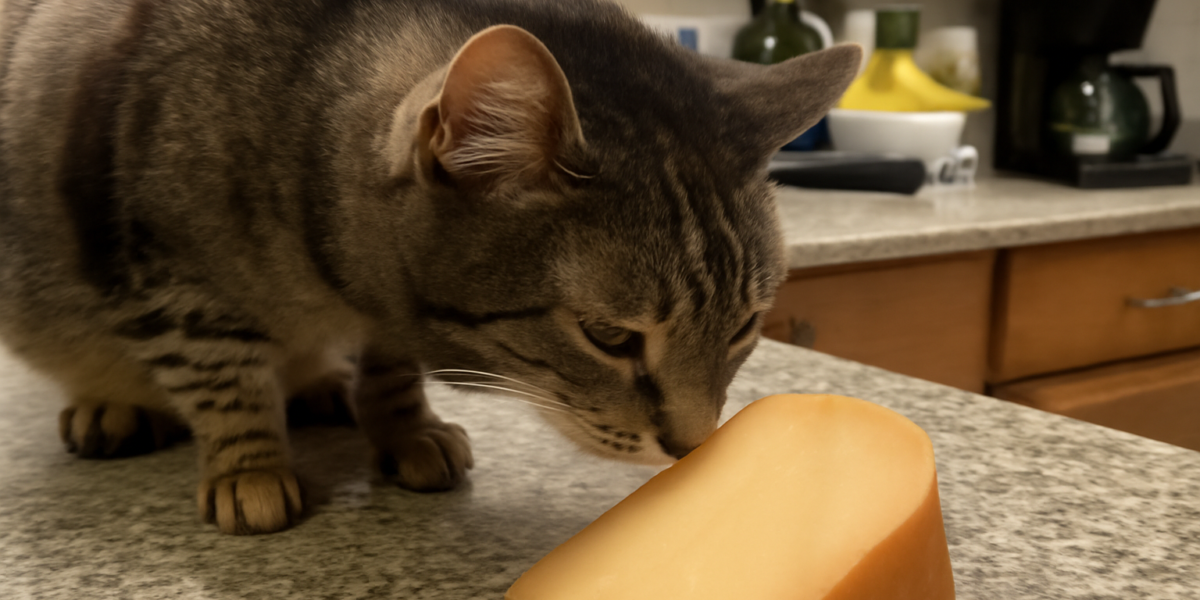
Cats can eat plain mild gouda in tiny amounts on rare occasions. Gouda is a Dutch semi-hard cow’s milk cheese aged anywhere from a few weeks (mild gouda) to several years (aged gouda). The aging process breaks down most of the lactose, so dairy intolerance is less of a concern with gouda than with fresh cheeses. The trade-off is moderate sodium content (around 600 milligrams per ounce) and high fat content (around 27 percent), both of which limit how much gouda is appropriate to share.
Plain mild gouda in a crumb-sized portion is the only version worth considering. Smoked gouda should be avoided because smoking compounds add risk and the sodium content is typically higher than the unsmoked version. Skip aged gouda over three years for cats; the sodium concentrates further and the texture becomes harder to manage in small portions. Cats with HCM, CKD, hypertension, or pancreatitis history should skip gouda entirely.
What Gouda Is and How Aging Changes It
Gouda is named after the Dutch city of Gouda, where the cheese has been traded since the Middle Ages. Production starts with whole or partially skimmed cow’s milk, with curds formed and then washed (a hallmark of the Dutch washed-curd technique that gives gouda its mellow, slightly sweet flavor). The cheese is pressed into wheels, brined, and aged for varying lengths.
Mild gouda is aged about four to six weeks. It has a soft, springy texture, high moisture, and a mild creamy flavor. Aged gouda (12 months and older) is firmer, drier, and develops crunchy tyrosine crystals as proteins continue to break down. Extra-aged gouda (3 to 5 years) is granular, intensely flavored, and as concentrated in flavor as parmesan, with similar sodium implications.
For cat-feeding purposes, mild gouda is the preferred form because it has more moisture (less concentrated sodium) and a softer texture that does not splinter. Gouda sits in the same general aged-cheese category as parmesan but with more fat and less extreme sodium. Our broader cheese for cats overview covers the spectrum.
Lactose Content in Gouda
Aging breaks down lactose, but mild gouda still has small amounts (around 0.1 to 0.3 grams per ounce). Aged gouda is essentially lactose-free, similar to parmesan. For most adult cats, the residual lactose in mild gouda is low enough to tolerate in tiny portions, but cats with severe lactose intolerance can still react.
The relevant comparison is not gouda versus milk; it is gouda versus other cheeses cats might encounter. Gouda has noticeably less lactose than fresh cheeses like ricotta or cottage cheese, comparable to or slightly more than fully aged parmesan. If your cat has tolerated a bit of parmesan or aged cheddar without issue, mild gouda is likely to be similarly tolerated. If your cat has struggled with any dairy, do not assume gouda will be different.
Casein, the dominant milk protein, is still present in gouda regardless of aging. Cats with milk-protein allergy will react to casein-containing cheese regardless of lactose content. Skip if your cat has shown previous dairy-protein reactions.
Sodium Levels: Moderate, Not Extreme
Mild gouda contains roughly 600 milligrams of sodium per ounce. That is meaningfully higher than fresh cheeses (cottage cheese is around 380 milligrams per cup, ricotta around 100 milligrams per quarter cup) and lower than extreme cases like halloumi (over 1,000 milligrams per ounce). Aged gouda climbs higher, often 800 to 1,000 milligrams per ounce.
For an average ten-pound adult cat, daily sodium maintenance is around 42 milligrams. A typical commercial diet supplies 100 to 200 milligrams per day, which is comfortably within tolerance. A pea-sized piece of mild gouda (about a gram) contains about 20 milligrams of sodium. That is meaningful relative to maintenance but not catastrophic for a healthy cat eating a complete diet.
Cats with HCM benefit from sodium control because high sodium increases blood volume and cardiac workload. Read our HCM guide for detail. Cats with CKD also benefit from sodium discipline; see our CKD overview. For these cats, even moderate-sodium gouda is a poor choice.
Fat Content and Pancreatitis Risk
Gouda runs around 27 percent fat by weight, similar to brie and cream cheese. That is high for a cat treat, and it is the practical limiter on portion size. A crumb-sized piece (one gram) contains about 0.27 grams of fat, which is small in absolute terms but proportionally significant for sensitive cats.
Cats with pancreatitis history should skip gouda. Even small high-fat treats can contribute to pancreatitis triggers in repeat-flare cats. Our pancreatitis guide covers diet implications. For healthy cats, a single crumb of gouda is unlikely to cause issues, but repeated high-fat sharing builds risk over time.
Cats with weight management issues should also be cautious. Gouda is calorie-dense (around 100 calories per ounce), and what looks like a small piece can deliver a meaningful percentage of an overweight cat’s daily caloric budget.
Mild vs Aged vs Smoked Gouda
Three forms of gouda show up in supermarkets, and only one is acceptable for occasional cat sharing.
Mild gouda: The default choice. Low to moderate sodium for a cheese, moderate lactose, manageable texture. Crumb-sized portion only.
Aged gouda: Higher sodium concentration as moisture evaporates during aging. Crunchy tyrosine crystals can be sharp on tongue tissue. Firmer texture is harder to portion to crumb size. Skip in favor of mild gouda.
Smoked gouda: Avoid entirely. Smoking adds polycyclic aromatic hydrocarbons and other compounds that cats process differently than humans. Smoked gouda also typically contains slightly elevated sodium because brining is more aggressive on smoked cheeses to balance flavor. Smoke flavor often appeals strongly to cats, which is exactly why we recommend keeping it off-limits; an interested cat is more likely to overconsume.
Safe Serving Size and Frequency
A pea-sized piece of plain mild gouda, about one gram, is the realistic upper bound for an occasional treat for a healthy adult cat. That is roughly an eighth of a teaspoon if you are measuring loosely. Offer once, watch for 24 hours, and only repeat if your cat showed no GI changes or other symptoms.
Frequency: no more than once a week, and many cats are fine with never having gouda. Treats should stay under ten percent of total caloric intake, and gouda’s calorie density makes it easy to overshoot. Stick to species-appropriate treats most of the time, and reserve gouda for rare curiosity tastings.
Cut a small piece from a fresh wedge rather than letting your cat lick a larger piece. Licking encourages additional bites, and you lose portion control quickly.
Forms of Gouda That Are Not Safe
Beyond plain mild gouda, several variants are off-limits:
- Smoked gouda. See above. Skip entirely.
- Truffle gouda. Truffle oil and truffle pieces add flavor compounds cats do not need. Many truffle-flavored cheeses use synthetic truffle aroma compounds.
- Pesto gouda or herb-crusted gouda. Often contains garlic, onion, and herb blends. Garlic and onion are toxic to cats at low doses.
- Cumin gouda or seed-flecked gouda. Seeds add texture but can be irritating; some seed varieties (poppy, for example) are problematic for cats.
- Gouda dips and spreads. Almost always contain additional ingredients (cream, sour cream, garlic, onion powder). Skip.
- Gouda crackers or crisps. Wheat-based, sodium-heavy, often with added flavors. Skip.
If the gouda has anything in it, on it, or paired with it beyond plain cheese, do not share with your cat.
Comparing Gouda to Other Cheeses
Within the cheese spectrum, gouda sits in a middle position. Lactose is lower than fresh cheeses but higher than fully aged parmesan. Fat is higher than fresh cheeses, comparable to brie and cream cheese. Sodium is moderate, lower than parmesan or halloumi but higher than ricotta.
Compared to other cheeses we cover, mild gouda is similar to mild cheddar in fat and sodium profile and similar to feta in sodium (slightly lower) but lower in lactose. Mascarpone is much higher in fat. Paneer is fresher and lower in sodium and fat. None of these are necessary cat foods.
Signs Your Cat Did Not Tolerate Gouda
Watch for changes in the 24 to 48 hours after the tasting. Lactose intolerance signs include loose stool, gas, and mild bloating. Fat sensitivity signs include vomiting and decreased appetite. Allergic reactions can include itching, ear scratching, or skin redness over the following days.
If symptoms persist beyond 48 hours, are severe at any point, or include lethargy or signs of abdominal pain, contact your vet. Cats can dehydrate quickly with persistent diarrhea, especially smaller cats and seniors.
For a healthy cat that tolerated a tiny portion well, you have learned that gouda is occasionally acceptable for that individual. That does not make it a regular treat; the calorie and sodium math still apply.
Cats Who Should Skip Gouda Entirely
Several profiles warrant complete avoidance. Cats with HCM should not have gouda; even moderate sodium adds cardiac workload. Cats with CKD should stick to phosphorus-controlled prescription diets. Cats with hypertension benefit from strict sodium control. Cats with pancreatitis history should skip high-fat cheeses, gouda included.
Cats with confirmed dairy allergy will react regardless of cheese type. Cats with IBD often have hair-trigger reactions to any new food, dairy or otherwise. Diabetic cats benefit from caloric stability and consistent diet, which occasional cheese disrupts. Kittens under six months should stay on kitten food.
Frequently Asked Questions
Can my cat have aged gouda or just mild gouda?
Mild gouda is preferred. Aged gouda has more concentrated sodium and harder texture; while not toxic, it is a worse choice than mild gouda for occasional sharing.
Is smoked gouda ever safe for cats?
No. Smoking compounds add unnecessary risk. Skip smoked gouda entirely.
How often can a healthy cat have gouda?
No more than once a week, in a pea-sized portion. Many cats can go their whole lives without gouda; there is no nutritional case for adding it.
What if my cat ate a larger piece of gouda by accident?
A small accidental piece is unlikely to cause acute problems in a healthy cat. Watch for vomiting, diarrhea, or excessive thirst over 24 hours. Call your vet if symptoms develop or your cat has known health conditions.
Can kittens have gouda?
No. Kittens under six months should stay on kitten food. After six months, the same tiny-amount caution applies as with adult cats.


