
Last updated: May 4, 2026
In this article
- The Short Answer on Mulberries for Cats
- Ripe vs Unripe: The Critical Distinction
- How Much Is Actually Safe
- What’s Actually in a Ripe Mulberry
- The Tartaric Acid Question and Other Berries
- How Mulberries Compare to Other Cat-Curious Fruits
- Mulberry Trees in the Yard: Outdoor Cat Considerations
- Mulberry Products Worth Skipping
- Cats With Specific Health Conditions
- What to Do If Your Cat Eats Unripe Mulberries
- The Stained-Tongue Test and City Park Considerations
- Frequently Asked Questions
The Short Answer on Mulberries for Cats
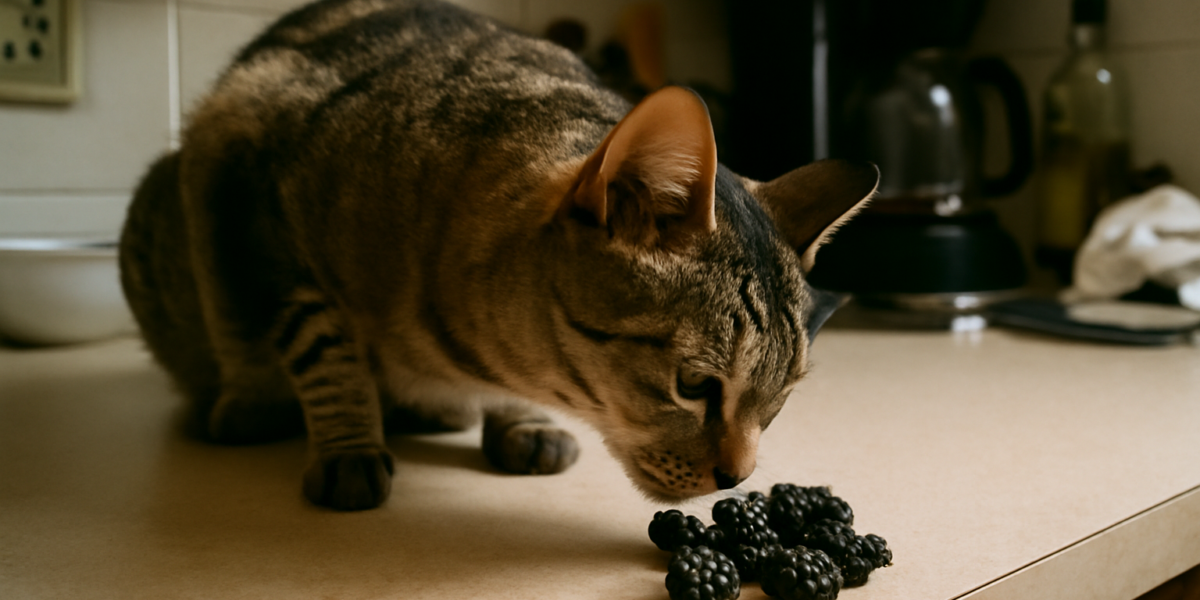
Can cats eat mulberries? In tiny amounts, fully ripe black or red mulberries are generally tolerable for healthy adult cats as an occasional taste. Unripe mulberries — the white, green, or pink ones that have not finished ripening — should not be fed to cats because they contain compounds that cause stomach upset and, in some animal reports, transient neurological signs. Mulberries are not a necessary food for cats and most cats will show little interest, but a single ripe berry is unlikely to cause harm.
Cats are obligate carnivores and have no nutritional need for fruit. The question of whether to share a berry usually comes up because mulberry trees grow in many backyards and gardens, and cats who roam outdoors may sniff at fallen fruit. Knowing which berries are safe to ignore and which need attention helps you keep your cat out of trouble.
Ripe vs Unripe: The Critical Distinction
Mulberries change dramatically as they ripen. Black mulberry (Morus nigra) and red mulberry (Morus rubra) start out white or pale green, turn pink, then red, then deep purple-black when fully ripe. White mulberry (Morus alba) ripens to white or pale yellow at maturity, which makes ripeness harder to judge by color alone — texture matters more for that species.
Across all species, the unripe fruit and the milky sap of the leaves and twigs contain compounds that can cause gastrointestinal upset and, in some accounts, mild hallucinogenic or stimulant effects in animals who eat large quantities. The ripe fruit lacks meaningful concentrations of these compounds. So the rule for cats is simple: if you are sharing a mulberry, it should be fully soft, deeply colored (for black or red varieties), and easily squashable between your fingers. Anything firmer, lighter in color, or harder to crush is not ready and not safe.
How Much Is Actually Safe
For a healthy ten-pound cat, “tiny amount” means one ripe mulberry per tasting moment, with no repeats for at least a week. Mulberries are about the size of a small grape or a large blueberry, which is already at the upper limit of what makes sense for a cat’s stomach. Cut the berry in half so you can see the fully ripe interior, mash it slightly, and offer the half-berry on your finger or a plate.
Most cats will sniff, taste, and walk away. A few will eat the piece eagerly. Either response is normal. What you do not want to do is leave a bowl of mulberries on the counter where your cat can graze, or let her eat fallen fruit from under a backyard mulberry tree without supervision. The dose matters, and the line between “harmless tasting” and “stomach upset” is much closer in cats than in humans.
What’s Actually in a Ripe Mulberry
Ripe mulberries are rich in vitamin C, vitamin K, iron, and a class of antioxidants called anthocyanins, the pigments that give the deep purple-black color. They also contain resveratrol, fiber, and natural sugars. None of these compounds is essential for cats, who synthesize their own vitamin C and meet vitamin K requirements through their normal diet. The antioxidant story you have read about for humans does not translate cleanly to feline nutrition.
The natural sugar content is the practical concern for cats. A single mulberry is not a glycemic event for a healthy cat, but cats with diabetes mellitus should not get fruit treats of any kind. Their pancreas is already struggling with carbohydrate handling, and there is no sugar-free version of fruit that gives the experience without the sugar.
The Tartaric Acid Question and Other Berries
Recent veterinary toxicology research has refocused attention on tartaric acid as the likely culprit in grape and raisin toxicity in dogs and, by extension, raised questions about cats. Mulberries are not in the grape family and are not on toxic-fruit lists. They contain only trace tartaric acid, well below the levels found in grapes. So the mulberry-versus-grape comparison is reassuring in that direction.
That said, when in doubt, default to caution. If your cat ate a fruit you cannot identify confidently, photograph the leaves, the cluster, and a fruit, and call your veterinarian. The visual difference between mulberry and certain less-friendly berries is obvious to a botanist but not always to a worried owner at midnight.
How Mulberries Compare to Other Cat-Curious Fruits
Among small berries that cats may encounter, mulberries are roughly comparable in safety profile to ripe blueberries and blackberries — all are tolerated by most healthy cats in tiny amounts when fully ripe. Strawberries are also broadly safe in small portions. Cranberries sit a little to the side because they are too tart for most cats and are usually offered in dried, sweetened forms that are not appropriate.
The fruits to actively avoid are very different: cherries for their cyanide-containing pits, grapes entirely, and citrus like kumquats for their psoralens and essential oils. Mulberries do not belong in that risky group.
Mulberry Trees in the Yard: Outdoor Cat Considerations
If you have a mulberry tree where your cat goes outside, walk under it during fruiting season and rake up fallen unripe fruit. Cats are not enthusiastic fruit eaters, but they will sometimes lick, chew, or bat at fallen berries, especially if other prey is scarce or boredom is high. The bigger risk is not the fruit itself but a high-traffic mulberry tree that attracts birds, which then become hunting opportunities — and a cat carrying half a bird home rarely brings only feathers.
The leaves and unripe fruit of mulberry trees contain a milky latex sap that can irritate skin and gut. Cats who chew on a fresh leaf or branch may drool or vomit. Most chew incidents are self-limiting, but for any persistent vomiting or appetite loss after suspected mulberry exposure, call your veterinarian. Indoor cats who never encounter a mulberry tree are obviously not at risk.
Mulberry Products Worth Skipping
Beyond fresh ripe fruit, almost every mulberry product humans buy is not appropriate for cats. Dried mulberries are concentrated sugar and often dusted with extra ingredients. Mulberry jam is loaded with added sugar and possibly pectin, lemon, or other additives. Mulberry juice is sugar-rich and offers no real benefit. Mulberry leaf tea, sometimes sold as a blood sugar supplement, has not been studied in cats and contains alkaloids that should not be given to a feline patient without veterinary supervision.
Mulberry-flavored human candies, gummies, and yogurts often contain artificial flavoring, sugar, dairy, and sometimes xylitol — particularly in sugar-free versions. None of these belong in your cat’s bowl. If you want her to taste mulberry, the form is fresh, ripe, and unprocessed.
Cats With Specific Health Conditions
Cats with inflammatory bowel disease, sensitive stomachs, or chronic vomiting and diarrhea should skip mulberries entirely. Even small amounts of new fruit can trigger flares in some cats. The same is true for cats on prescription therapeutic diets, where extras can disrupt the carefully calibrated nutrient targets.
Diabetic cats, as noted, should not get fruit. Cats with chronic kidney disease are usually on potassium- and phosphorus-controlled diets, and mulberries do contain modest amounts of both, so any tasting should be cleared with your veterinarian. Pregnant or nursing queens and kittens should also skip experimental fruits.
What to Do If Your Cat Eats Unripe Mulberries
If you saw your cat eat a small unripe mulberry, the most likely consequence is mild gastrointestinal upset — drooling, vomiting, soft stool, or temporarily reduced appetite. Most cats settle within twelve to twenty-four hours with a quiet space, fresh water, and her normal feeding schedule. Hold off on any extra treats during the recovery window so you can read her appetite cleanly.
Call your veterinarian if she ate more than a couple of unripe berries, if vomiting continues past twenty-four hours, if she becomes lethargic or uncoordinated, or if she has a pre-existing condition. The neurological-style signs (wobbliness, disorientation) some sources mention with unripe mulberry ingestion in animals are dose-dependent and unusual at the small quantities cats typically consume, but any wobble or confusion warrants a veterinary call regardless of the food involved.
The Stained-Tongue Test and City Park Considerations
Mulberries stain everything they touch — fingers, cutting boards, fur, tongues. If your cat eats a few ripe mulberries, you may notice a purple tint on her tongue, gums, or chin. This is harmless cosmetic staining and will fade within a day or two as new cells replace the surface ones. It is also useful evidence that she ate the fruit, which can help your veterinarian if questions come up later.
The staining can also help you tell whether what your cat ate was ripe. Fully ripe black or red mulberries leave deep purple stains. Unripe mulberries leave thin, faintly pink stains, or sometimes none at all. If your cat shows signs of having eaten mulberries but the staining is light, lean toward calling your veterinarian for guidance — that pattern points toward unripe fruit, which carries more risk of digestive upset.
If you walk your cat outdoors on a harness or live in a neighborhood where she has access to public spaces, mulberry trees in parks and along sidewalks are worth knowing about. Many cities have mulberry trees as ornamental plantings, and during the late spring and early summer fruiting season, sidewalks below them can become slick with fallen fruit. Cats may sniff and lick the fallen fruit, especially if it is ripe and sweet-smelling.
The risk is twofold. First, fallen fruit on the ground may be partly fermented or contaminated, which adds gastrointestinal risk beyond the fruit itself. Second, fallen mulberries attract birds, ants, and rodents, which can pull cats’ attention into hunting mode. The simplest answer is to know where the mulberry trees are and steer her past them during fruiting season.
Frequently Asked Questions
Can cats eat mulberry leaves?
Mulberry leaves contain milky latex sap and compounds that can irritate the gut. They are not a recommended food for cats. If your cat chews leaves and shows mild drooling, monitor her, but do not encourage leaf eating.
Are dried mulberries safe for cats?
Dried mulberries are too concentrated in sugar for a small cat and offer no benefit she does not already get from her diet. They are also more prone to being mixed with other dried fruit (raisins, currants) that are toxic to cats. Skip them.
What about white mulberries?
White mulberry (Morus alba) ripens to a white or yellowish color, so judging ripeness by color is unreliable. If you have a white mulberry tree, look for fruit that is fully soft and easily squashed. Unripe white mulberries carry the same gastrointestinal risk as unripe black mulberries.
My cat ate a handful of mulberries from the yard. What now?
If they were fully ripe, expect mild stomach upset at most. If they may have been partly unripe, watch closely for vomiting, drooling, or unsteadiness over the next twenty-four hours and call your veterinarian if anything seems off. Bring a sample berry or photo to the visit.
Is mulberry juice safe for cats?
Commercial mulberry juice is sugar-rich and not appropriate for cats. Even fresh-pressed homemade juice concentrates the sugars and removes the fiber. Skip juice entirely and offer one ripe berry instead if you want a tasting moment.


