
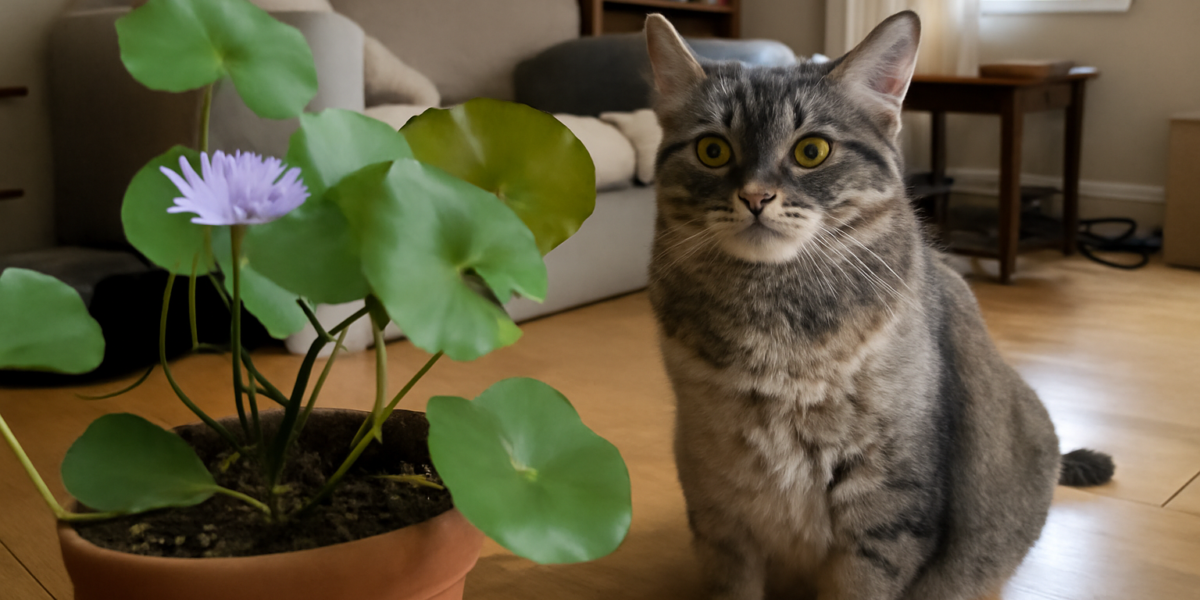
The Short Answer — Water Lilies Are Not True Lilies
If you found this article in a panic because your cat chewed on a pond plant, breathe out. Water lilies are NOT toxic to cats in the way true lilies are. Water lilies (genus Nymphaea) belong to a completely different botanical family from the deadly true lilies that cause acute kidney failure in cats. The water lily on your garden pond does not contain the as-yet-unidentified nephrotoxin found in Lilium and Hemerocallis. This is one of those plant-name traps where the common name is doing all the scaremongering.
In this article
- The Short Answer — Water Lilies Are Not True Lilies
- Why the Name “Lily” Causes So Much Confusion
- What Water Lilies Actually Are
- The Chemistry Behind Water Lily Safety
- What Could Go Wrong Anyway
- Symptoms to Watch For After a Water Lily Encounter
- Why This Article Matters — The Panic Cycle
- What to Do If Your Cat Eats Water Lilies
- Pond Safety in General
- Other Confusing “Lily” Plants in Cat Households
- Frequently Asked Questions
The realistic severity tier for a cat-water-lily encounter is mild — minor GI upset is possible if a cat ingests a large amount of plant material, primarily because some Nymphaea species contain low-grade tannins and trace calcium oxalate. That is not the same thing as the life-threatening kidney emergency caused by true lilies. If your cat licked or chewed a water lily, you do not have a 24-to-72-hour emergency window. You have a “monitor at home, call the vet if anything looks wrong” situation. Read on for the full picture.
Why the Name “Lily” Causes So Much Confusion
The word “lily” in plant common names is wildly imprecise. Calla lilies, peace lilies, day lilies, peruvian lilies, water lilies, and lily of the valley are all called lilies — and almost none of them are actually true lilies. True lilies belong to the genus Lilium; day lilies belong to the related genus Hemerocallis. Both are in the lily family (Liliaceae) and both cause acute kidney injury in cats by an incompletely understood mechanism.
Water lilies belong to the family Nymphaeaceae. They are an entirely separate evolutionary branch that diverged from the lineage leading to true lilies tens of millions of years ago. The two groups share a common name only because Western botanists, several centuries back, used “lily” loosely for any showy flower with a particular shape. The toxin profile of true lilies absolutely does not transfer to water lilies, calla lilies, peace lilies, or canna lilies.
This article is partly a public service announcement: when you see a “lily” plant, the first question to answer before panicking is which kind. The differences are huge. Peace lily vs. true lily for cats covers the most commonly confused pair; for water lilies specifically, the verdict is much less alarming than for true lilies.
What Water Lilies Actually Are
Water lilies are aquatic perennials with floating leaves and showy flowers that rise just above the water surface. The most common ornamental species belong to the genus Nymphaea. Native species are found on every continent except Antarctica. Hardy varieties survive temperate winters; tropical varieties need heated ponds in cold climates.
The flowers come in white, pink, yellow, red, blue, and purple, with a multi-petaled spiral arrangement that looks lotus-like to non-botanists. The leaves are circular or ovate, typically 6–12 inches across, and float on the water surface. The roots and rhizomes anchor in the pond mud below.
Water lilies are sometimes confused with lotus (genus Nelumbo), which is a different family entirely. Lotus leaves stand above the water on tall stems; water lily leaves float flat on the surface. Lotus is also generally low-toxicity for pets and is commonly mistaken for water lily in articles online — fortunately the safety profile is similar.
The Chemistry Behind Water Lily Safety
Water lilies contain trace amounts of various plant alkaloids (notably nupharidine in some species), tannins, and small amounts of calcium oxalate. None of these compounds are present at concentrations that cause significant toxicity in normal exposures. The plant has been studied in some traditional medicine contexts and in toxicology surveys; large clinical poisonings of pets from water lilies are not a feature of the veterinary literature.
The most relevant chemistry is the calcium oxalate. Many aquatic plants contain low levels of this compound, which can cause oral irritation if a cat chews a leaf or stem aggressively. The level in water lilies is much lower than in true calcium-oxalate plants like dieffenbachia or peace lily. A cat who chews a water lily leaf may drool briefly or paw at their mouth; this resolves on its own in most cases.
Critically, water lilies do NOT contain the nephrotoxin associated with true lilies. The exact mechanism by which Lilium and Hemerocallis cause acute kidney injury in cats is still not fully characterized — researchers have proposed several candidate compounds — but whatever the toxic principle is, water lilies do not produce it. This is the single most important point of this article.
What Could Go Wrong Anyway
The realistic risks for a cat encountering water lilies fall into three categories. First, mild oral irritation from calcium oxalate (drooling, lip licking). Second, mild GI upset from a large ingestion of plant material (a single episode of vomiting, soft stool). Third, drowning or pond-related injury if a cat falls in trying to chase a fish or pluck a flower — this is a real concern around backyard ponds, regardless of plant species.
Pond-water-related illness is a separate issue from water lily toxicity. Cats who drink from ornamental ponds can pick up algae (some blue-green algae produce serious toxins), parasites, leptospira, and various bacterial contaminants. None of these are water-lily specific, but if your cat is sick after pond exposure, the differential includes pond-water illness more than plant toxicity.
Algal blooms, especially blue-green algae (cyanobacteria) in stagnant warm water, are genuinely dangerous and can cause acute liver and neurological signs in pets. If your pond has a green scum on the surface and your cat has drunk from it, that is a real emergency — but it is the algae, not the water lilies, causing the problem.
Symptoms to Watch For After a Water Lily Encounter
If your cat has mouthed or chewed a water lily, expect to see either no symptoms or mild oral signs: brief drooling, pawing at the mouth, head shaking, or a single moment of distress. These usually resolve within minutes as the calcium oxalate sensation fades. Offer fresh water and watch for the next several hours.
For larger ingestions (a cat who actually consumed leaves rather than just sampled them), watch for a single episode of vomiting and possibly a soft stool the next day. Most cats recover on their own. Call the vet if symptoms persist beyond 24 hours, if your cat refuses food or water, if vomiting becomes repeated, or if any neurological signs appear.
Symptoms that do NOT match water lily exposure — and that should make you suspect either pond water contamination or a different plant ingestion — include lethargy progressing over hours, any signs of jaundice (yellowing of gums or whites of eyes), tremors, weakness, repeated vomiting, or signs of acute kidney injury (excessive drinking, excessive urination then nothing). These are red flags for serious illness regardless of the plant involved.
Why This Article Matters — The Panic Cycle
Anytime a cat owner sees their pet near a “lily” of any kind, the appropriate first question is whether this is a true lily or one of the safer look-alikes. True lilies are genuinely lethal — every part of the plant, including pollen and vase water, can cause acute kidney injury in cats within 24 to 72 hours. Treatment relies on rapid decontamination and aggressive IV fluid therapy, with the prognosis depending heavily on time-to-treatment.
Water lilies do not carry that risk. Calla lilies cause oral irritation only. Peace lilies are mild calcium oxalate plants. Canna lilies are largely non-toxic. Peruvian lilies (Alstroemeria) are mild GI plants. Distinguishing these from true lilies is the difference between an emergency and a “watch and see” situation.
If you are not sure which kind of lily you have, treat it as a true lily until proven otherwise. Take a photograph, call your vet or a poison hotline, and bring the plant in for ID if you head to the clinic. The cost of mistakenly treating a true lily exposure as benign is far worse than the cost of mistakenly treating a water lily exposure as serious.
What to Do If Your Cat Eats Water Lilies
For an isolated water lily incident, the response is observation. Note appetite, water intake, and any unusual behavior over the next 12–24 hours. Most cats will be entirely fine. Offer fresh water and a small bland meal if your cat seems normal. If your cat has chronic kidney disease (see chronic kidney disease in cats), ANY GI upset from any plant is more concerning because their margin for dehydration is narrower.
Call your veterinarian if symptoms persist beyond a single mild episode, if your cat is very young, very old, or has chronic illness, or if you are not 100% certain that what was eaten was actually a water lily and not a true lily. ASPCA Animal Poison Control (888-426-4435) and Pet Poison Helpline (855-764-7661) are available for paid telephone consultations. For water lilies, they will almost always advise monitoring; for true lilies, they will direct you to immediate ER care.
Do not induce vomiting at home. The calcium oxalate compounds can cause mild esophageal irritation, and induced emesis can make that worse. Modern guidance is that decontamination decisions belong to the vet.
Pond Safety in General
If you have a pond your cat can access, the safety conversation is bigger than just the plants. Falls into deep water are a drowning risk for cats who chase fish or are startled by a sudden noise. Cold water in spring and fall causes hypothermia quickly. Algal blooms in warm summer water are genuinely toxic — separate from any plant chemistry.
For households with ponds, consider a low fence around the perimeter, a shallow shelf around the edge to allow easy escape, and seasonal algal bloom monitoring. If your pond ever develops a green scum on the surface, keep all pets away until it has been treated and tested.
For the plants themselves, if you want lily-look pond color, water lilies are actually one of your safer choices for a multi-pet household. Pair them with other low-toxicity aquatic plants and keep the truly dangerous land plants like oleander away from the pond edge where cats might brush against them.
Other Confusing “Lily” Plants in Cat Households
For cat owners trying to navigate the lily naming chaos, here is the quick map. Tiger lilies, Asiatic lilies, Oriental lilies, stargazer lilies, Easter lilies, and day lilies are all in the genuinely-lethal-for-cats category. Treat any of these as a true emergency.
Water lilies, calla lilies, peace lilies, canna lilies, peruvian lilies, and lily of the valley are all NOT true lilies, but the toxicity varies widely among them. Lily of the valley, despite the name, contains cardiac glycosides and is genuinely dangerous in its own way. Peace lilies and calla lilies cause oral irritation. Canna and peruvian lilies are mild. Water lilies are the most reassuring of the bunch.
If you are part of a cat adoption household and are weighing pond plants for a future home, water lilies are a fine pick. Ask your local horticulturalist about hardy versus tropical cultivars suited to your climate. The non-toxic-to-cats roundup at cat-safe flowers covers other reassuring choices.
Frequently Asked Questions
My cat drank from the pond water around the water lilies. Should I worry?
The water lily itself is not the concern. The pond water might be — drinking pond water exposes cats to algae (potentially toxic blue-green algae), parasites, and bacteria. If your pond water is clear and well-maintained, brief drinking is usually fine. If there is any green scum or strong smell, that is a separate emergency and you should call the vet.
How is water lily different from a true lily?
Different family entirely. True lilies (Lilium) cause acute kidney injury in cats from a still-not-fully-understood toxin in every part of the plant. Water lilies (Nymphaea) contain only trace background compounds and are not associated with kidney injury. The shared common name is misleading.
Can my cat eat a water lily flower from a bouquet?
Most cut flowers labeled “water lily” really are water lilies, and a small chew is usually low-risk. However, florists sometimes mix bouquets with true lilies (which would be deadly to cats), so before letting your cat near any cut flower arrangement, identify every species. A florist can tell you the names. When in doubt, keep all bouquets out of reach.
What about lotus flowers?
Lotus (Nelumbo) is a different family from water lilies but has a similar low-toxicity profile. A cat who chews a lotus is unlikely to have a serious reaction. The same monitoring approach applies — watch for any persistent symptoms and call the vet if anything looks wrong.
If water lilies are non-toxic, why does my cat seem sick after a pond visit?
The plant is most likely not the cause. Check for algal blooms in the pond, parasites or bacteria in the water, or another plant nearby that might have been chewed. Cats can also get GI upset from drinking unfamiliar water in any setting. If symptoms persist, take your cat to the vet and mention all possible exposures.


