
Last updated: May 4, 2026
In this article
- The Short Answer on Pomegranate Seeds for Cats
- What’s Actually in a Pomegranate Aril
- Tannins and Their Irritant Effect
- The Tartaric Acid Question
- Cats With Kidney Disease: A Specific Concern
- How Much Is “A Tiny Amount”
- Pomegranate Products Worth Avoiding
- What to Do If Your Cat Eats Pomegranate
- Better Cat-Friendly Fruit Options
- Why Cats Rarely Want Pomegranate Anyway
- The Staining Factor and Pomegranate in Mediterranean Cooking
- Frequently Asked Questions
The Short Answer on Pomegranate Seeds for Cats
Can cats eat pomegranate seeds? Better not. Pomegranate seeds are not on standard feline toxic-food lists, but they sit in a “skip it entirely” category for several practical reasons. They contain tannins (astringent plant compounds that can irritate the digestive tract), tartaric acid (the same family of compounds that current veterinary research is investigating in connection with grape and raisin toxicity), and a fibrous seed core that is hard for cats to digest. The combination produces vomiting, diarrhea, and reduced appetite in many cats who eat more than a tiny amount.
If your cat licks the juice off your finger or grabs a single aril (the juice-filled sac around each seed), she is unlikely to develop a serious problem. But there is no nutritional reason to share pomegranate seeds with a cat, and the risk-to-benefit calculation simply does not favor making this a habit. Cats are obligate carnivores who get nothing useful from pomegranate.
What’s Actually in a Pomegranate Aril
Each “seed” of a pomegranate is technically an aril — a small juice-filled sac containing a hard inner seed. The juice is rich in vitamin C, vitamin K, potassium, and a class of polyphenols called punicalagins, which have drawn human nutrition research because they are powerful antioxidants. The seeds themselves are firm, fibrous, and high in roughage. The pith and inner membrane that humans discard are bitter and concentrate the tannins.
For human nutrition, the antioxidant story is genuine and well-studied. For cats, none of those compounds is essential. Cats synthesize their own vitamin C, get vitamin K from a normal diet, and have no documented benefit from polyphenol supplementation in any controlled feline study. So the rationale for sharing — “it’s healthy for me, so a little should be fine for her” — does not hold.
Tannins and Their Irritant Effect
Tannins are astringent compounds that bind to proteins. In small doses, they give wine and tea their dryness; in larger doses, they irritate the lining of the gastrointestinal tract. Pomegranate, especially the white inner pith and the seed coats, contains meaningful tannin levels. Cats who eat pomegranate often respond with vomiting, drooling, and soft stool because the tannins cause direct mucosal irritation.
Tannin-related upset is usually mild and self-limiting. A cat who eats a small piece of pomegranate may vomit once or twice, refuse her next meal, and recover within a day. The reaction is more pronounced in cats with sensitive stomachs, inflammatory bowel disease, or chronic vomiting and diarrhea.
The Tartaric Acid Question
The grape and raisin story has shifted in recent veterinary toxicology. For years, the toxic component of grapes that causes acute kidney injury in dogs was unknown. Current veterinary research is investigating tartaric acid (and its salts, particularly potassium bitartrate) as a probable culprit. The mechanism appears to involve direct kidney tubular damage.
Pomegranate contains tartaric acid, but at levels significantly lower than grapes. The cat literature on grape and raisin toxicity is more limited than the dog literature, and the pomegranate-specific cat literature is essentially nonexistent. The honest summary is: pomegranate is not on the same toxicity tier as grapes for cats, but in light of the tartaric acid investigation, there is more reason to be cautious about feeding any tartaric-acid-containing fruit to cats — particularly cats with reduced kidney function.
Cats With Kidney Disease: A Specific Concern
If your cat has chronic kidney disease, pomegranate seeds should be a clear “no.” A cat managing CKD is already living with reduced renal reserve, and even a small dose of any compound that may stress kidney tubules is poorly timed. The same caution applies to cats with a history of acute kidney injury, urinary stones (especially calcium oxalate), or recent toxin exposure.
This is not the time to test how your cat responds to a new fruit. Stick to the prescription therapeutic diet your veterinarian has recommended, and use single-protein lean treats sparingly when treats are appropriate. CKD cats benefit far more from consistent hydration and a clean diet than from any antioxidant fruit.
How Much Is “A Tiny Amount”
If you have already given your cat a few arils and want to know whether to worry, the answer depends on the dose and her size. One or two arils for a healthy ten-pound cat is most likely to produce nothing more than a brief tasting moment. A heaping teaspoon of arils may produce vomiting and diarrhea later that day. A bowl’s worth (which a cat is unlikely to eat voluntarily but might if you puree it into food) could produce more significant upset.
The point of describing dose is not to encourage you to push a “tiny amount.” It is to set a realistic baseline for what to expect if your cat got into pomegranate accidentally. The recommended daily amount of pomegranate for cats is zero. There is no version of “they need this in their diet.”
Pomegranate Products Worth Avoiding
Most pomegranate products are even less suitable than fresh seeds. Pomegranate juice concentrates the tannins, sugar, and tartaric acid into a more potent dose per swallow, and it is often blended with other fruit juices that add their own concerns. Pomegranate molasses, used in Middle Eastern and Mediterranean cooking, is a reduced syrup with very high sugar and acid concentration. Pomegranate-flavored yogurts and baked goods bring dairy or grain issues alongside the fruit content.
Pomegranate-flavored alcoholic beverages (the “pom martini” of dinner parties) are doubly concerning because alcohol is toxic to cats independent of the pomegranate. Pomegranate dietary supplements marketed to humans should never be given to cats — the concentrated extracts magnify every concern listed in this article.
What to Do If Your Cat Eats Pomegranate
If your cat ate a few arils or licked some juice, watch for vomiting, diarrhea, drooling, decreased appetite, and lethargy over the next twenty-four to forty-eight hours. Most healthy cats recover at home with fresh water available, a quiet space, and her usual feeding schedule. Hold off on any extra treats so you can read her appetite cleanly.
Call your veterinarian if she ate more than a small amount, if vomiting persists past twenty-four hours, if she becomes lethargic or stops drinking, or if she has any pre-existing kidney, liver, or gastrointestinal condition. Bring a sample or photograph of what she ate to help the team identify it. The ASPCA Animal Poison Control Center is also a useful resource if you cannot reach your veterinarian quickly.
Better Cat-Friendly Fruit Options
If you want to share a small fruit moment with your cat, several options are gentler than pomegranate. Blueberries are commonly tolerated and small enough to portion easily. Blackberries work similarly. Watermelon (no rind, no seeds) is mostly water and rarely causes problems in tiny pieces. Mango in a small cube without skin is another option for adventurous cats.
The fruits to avoid for the same and related reasons include grapes (toxic), cherries (cyanogenic pits), and kumquats and other citrus (essential oils and psoralens). Among the “tannin-rich and acidic” group, cranberries are similar in concept to pomegranate — too tart for most cats and not necessary in their diet.
Why Cats Rarely Want Pomegranate Anyway
Cats lack the sweet taste receptor entirely, so the bright sweet-tart pop that humans love about pomegranate registers very differently to a feline tongue. Most cats will sniff a pomegranate and walk away. The owners who end up worrying about pomegranate exposure usually have a specific scenario: a cat licked juice off a cutting board, a kitten batted an aril off the counter, a senior cat with reduced sense of smell ate a piece because it was warm and food-shaped on a holiday platter.
Knowing that your cat does not actually want pomegranate makes prevention easier. Keep the fruit on a closed counter, wipe up juice promptly, and resist the urge to “share” a healthy human food with her. She is not missing out.
The Staining Factor and Pomegranate in Mediterranean Cooking
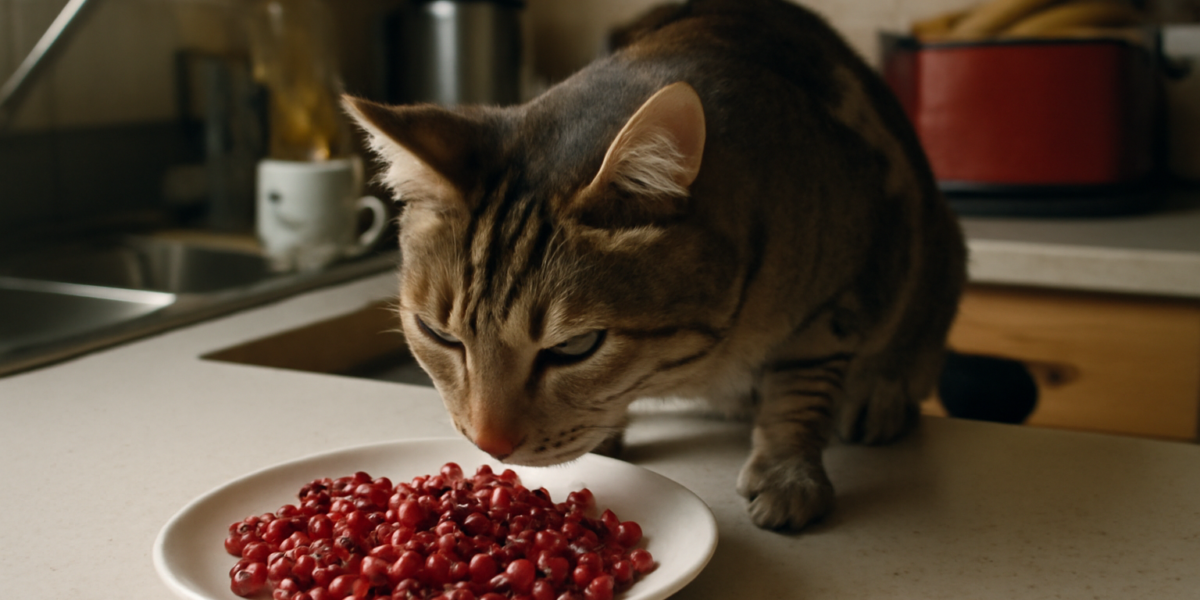
Pomegranate juice stains everything it touches — fabric, grout, wood, fur. If your cat sticks her face into a bowl of arils or licks a cutting board where pomegranate has been processed, you will probably know immediately because of the dramatic red staining on her chin and chest. The staining itself is harmless and fades within a few days, but it can be alarming the first time you see it.
The staining can also tip you off to ingestion you did not directly observe. If your cat shows mysterious red around her mouth and the kitchen has fresh pomegranate in it, you have a likely cause. Note approximately how much fruit she may have accessed and call your veterinarian for guidance based on dose and her health history. Bring a fresh aril or photo to the visit if helpful.
Pomegranate appears more often in cuisine than many cat owners realize. Middle Eastern and Mediterranean dishes use pomegranate seeds as garnish on salads, grain bowls, and roasted meat platters. Persian recipes feature pomegranate molasses in stews and sauces. Holiday entertaining often includes pomegranate as a festive jewel-tone garnish on cheeseboards and salads.
This means leftover plates and serving platters often contain pomegranate alongside other foods that may or may not be cat-safe. A cat licking a cheeseboard with pomegranate, fig, walnut, and brie residues is getting a stew of small problems rather than just the pomegranate concern. The simplest management is to clear platters promptly and rinse before leaving them on the counter overnight.
Frequently Asked Questions
Are the inner seeds (the hard part) of pomegranate dangerous?
The inner hard seeds contain less juice but more fiber, and they pass through cats relatively intact. They are not specifically toxic, but they can contribute to gastrointestinal irritation when eaten in volume. They are also a minor choking and obstruction risk in very small kittens.
What about pomegranate juice as a “kidney support” supplement?
Despite human marketing claims, there is no validated feline benefit to pomegranate juice for kidney support, and the tartaric acid and sugar content makes it a poor choice for cats with CKD. Use only veterinarian-prescribed therapies for kidney disease.
My cat ate a pomegranate-glazed dish from my plate. Should I worry?
The pomegranate itself is the smaller concern. The glaze probably contains sugar, salt, garlic, or onion, any of which is more troubling. Watch for vomiting, weakness, or pale gums and call your veterinarian for guidance based on what was in the dish.
Is pomegranate extract safe in cat foods or treats?
Some commercial pet foods include very small amounts of pomegranate extract for antioxidant marketing. The doses in those products are tiny and have been formulated for pet feeding. That is different from giving your cat fresh fruit or human juice. Stick to commercial cat foods that have undergone feeding trials.
How long after eating pomegranate would symptoms appear?
Most gastrointestinal symptoms (vomiting, drooling, diarrhea) appear within two to twelve hours. Kidney-related concerns from any tartaric acid exposure tend to develop over twenty-four to seventy-two hours. If your cat seems off in the days following an exposure, call your veterinarian even if the timing seems delayed.


