
Last updated: May 16, 2026
In this article
- Carolina Jessamine Is Severely Toxic to Pets — Treat as Emergency
- The Critical “Not a True Jasmine” Distinction
- The Gelsemium Alkaloid Story
- Symptoms — Time-Critical Recognition
- Immediate First Aid — But Get to the Vet
- Treatment at the Clinic
- Severe-Tier Neighbors in the Garden
- Why Carolina Jessamine Is Common in Landscapes
- Living With or Removing Carolina Jessamine
- Pet-Safer Climbing Vine Alternatives
- Frequently Asked Questions
Carolina Jessamine Is Severely Toxic to Pets — Treat as Emergency
Carolina jessamine, Gelsemium sempervirens, is severely toxic to pets. This is a SEVERE-tier plant — the same level of clinical concern as oleander, foxglove, and lily of the valley. Every part of the plant is toxic, including the leaves, stems, flowers, sap, and nectar. The toxic compounds are gelsemine and related strychnine-like alkaloids that attack the central nervous system. Ingestion can produce muscle weakness, seizures, respiratory paralysis, and death — sometimes within hours of exposure. There is no antidote. Treatment is supportive and time-sensitive.
If you suspect your pet has chewed any part of a Carolina jessamine plant, this is not a “wait and see” situation. Call your owner’s veterinarian, the ASPCA Animal Poison Control Center at 888-426-4435, or the Pet Poison Helpline at 855-764-7661 immediately, and head to a veterinary clinic. The focus keyword for this page is carolina jessamine toxic to pets, and we are not softening the framing — owners need accurate severity information to make fast decisions.
This guide covers the chemistry, the critical species distinction from true jasmine (which has lower toxicity), the symptom timeline, and the safer climbing alternatives if you are removing this plant from your property.
The Critical “Not a True Jasmine” Distinction
Carolina jessamine is also commonly called “yellow jasmine,” “evening trumpet flower,” or simply “jessamine,” and that nomenclature drives a serious confusion in the marketplace and in emergency calls. Carolina jessamine is NOT a true jasmine. True jasmines are in the genus Jasminum, family Oleaceae — many of which are not on the ASPCA toxic list and have a much milder profile. We cover them at jasmine for cats, jasmine for dogs, the alternate-form jasmine page, and the tropical jasmine page.
Carolina jessamine is in the family Loganiaceae (or Gelsemiaceae depending on which taxonomic system you follow), genus Gelsemium. The chemistry is completely different from Jasminum and is closer pharmacologically to strychnine and the most potent CNS toxins in horticulture.
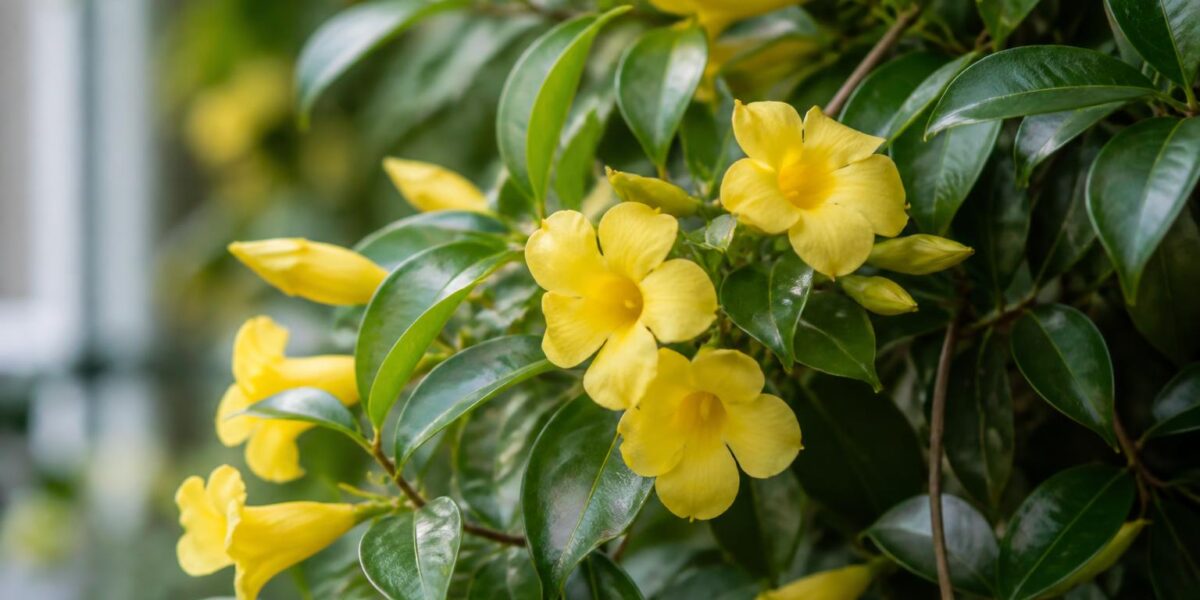
The practical implication: if you are searching “is jasmine toxic to my dog,” you may be looking at a true jasmine (lower-tier concern) or at Carolina jessamine (SEVERE-tier emergency). Identification matters. The visual rule: Carolina jessamine has bright yellow trumpet-shaped flowers with five lobes, glossy lance-shaped evergreen leaves, and twining woody stems; it is the state flower of South Carolina and grows wild across the southeastern US. True jasmines have white or pale pink flowers in most ornamental species, with very few yellow forms in common landscape use.
If your pet has chewed something you call “jasmine,” and you are in the southeastern US or your plant has yellow trumpet flowers, treat it as Carolina jessamine until proven otherwise.
The Gelsemium Alkaloid Story
Carolina jessamine contains a cocktail of indole alkaloids, including gelsemine, gelsemicine, gelseverine, sempervirine, and others. The dominant clinical concern is gelsemine, which acts on the central nervous system in ways pharmacologically similar to strychnine — interfering with inhibitory neurotransmission and causing increased neuronal excitability followed by paralysis as the toxicity progresses.
The mechanism produces a characteristic clinical picture: initial restlessness, weakness, and incoordination, progressing to muscle tremors and convulsions, then to ascending paralysis and respiratory failure. Death, when it occurs, usually comes from respiratory paralysis — the diaphragm and chest wall muscles stop working. Cardiac effects are also possible.
The dose required to produce serious signs is small. There is no published reliable canine or feline LD50 in the standard veterinary toxicology references that we are willing to cite, but pet poison hotlines treat any meaningful ingestion as a true emergency. The concentration of alkaloids varies by plant part — generally highest in the roots, flowers, and seeds, with leaves and stems also toxic at problematic levels.
Even nectar and pollen are toxic — there are documented cases of honey from Gelsemium nectar causing illness in humans, and bees foraging on the plant can carry alkaloids into hive products. Pets that drink from puddles under a flowering jessamine vine could potentially be exposed.
Symptoms — Time-Critical Recognition
The clinical picture progresses through phases. Early signs typically appear within 30 minutes to a few hours of ingestion and can be subtle:
- Restlessness, agitation, or pacing
- Drooling or excessive salivation
- Vomiting
- Mild weakness or staggering
- Dilated pupils
- Refusal of food and water
The picture deteriorates as the toxicity progresses:
- Pronounced weakness, especially in the hind limbs
- Muscle tremors, fasciculations, or twitching
- Convulsions or seizures
- Difficulty breathing or shallow rapid breathing
- Slowed or irregular heart rate
- Loss of reflexes
- Ascending paralysis
- Respiratory failure
The progression from “subtle restlessness” to “respiratory failure” can take less than a few hours in a small pet with a meaningful ingestion. There is no waiting period during which you can safely watch and decide. Any suspected ingestion of Carolina jessamine warrants an immediate emergency call and trip to a veterinary clinic.
Immediate First Aid — But Get to the Vet
If you witness or suspect Carolina jessamine ingestion, the only safe response is to call your veterinarian or a poison hotline and get to a clinic immediately. There is no home treatment that fixes Gelsemium toxicity.
While arranging transport:
- Gently remove any visible plant material from the mouth if your pet is calm enough to allow it
- Do not induce vomiting unless your veterinarian or the poison hotline specifically directs you to — with seizure-causing toxins, induced vomiting risks aspiration if the animal becomes ataxic during the process
- Do not give activated charcoal at home — administration without professional support risks aspiration and incorrect dosing
- Do not give milk, food, or water as a “dilution” — there is no evidence it helps and it may delay diagnostic options at the clinic
- Bring a sprig or clear photograph of the plant for identification
- Note the approximate time of ingestion and the rough quantity if known
Call ahead to the clinic so they can prepare. Carolina jessamine toxicity may require seizure management, mechanical ventilation support, IV fluids, and intensive monitoring — these resources are not available at every general practice and a referral to an emergency or critical care facility may be necessary.
The vet routing remains: owner’s veterinarian first, then ASPCA APCC at 888-426-4435 (per-call fee) or Pet Poison Helpline at 855-764-7661. With SEVERE-tier toxins, the per-call fee is irrelevant compared to the value of expert triage.
Treatment at the Clinic
There is no specific antidote for Carolina jessamine toxicity. Treatment is supportive and aggressive:
- Decontamination — induced vomiting if recent and animal stable, gastric lavage in some cases, activated charcoal under veterinary supervision
- IV fluids to maintain blood pressure and support kidney function
- Anticonvulsants for seizure control — diazepam, phenobarbital, or other agents as needed
- Muscle relaxants for severe tremors
- Cardiac monitoring and management of arrhythmias if they appear
- Respiratory support — oxygen, and mechanical ventilation in severe cases
- Atropine or other supportive medications as clinically indicated
- Intensive monitoring for 24 to 72 hours depending on severity
The prognosis depends heavily on how quickly the pet receives care, how much was ingested, body weight, and general health. Pets that receive prompt veterinary intervention before serious neurologic signs develop have a meaningful chance of full recovery. Pets that present already in convulsions or with respiratory compromise have a guarded-to-grave prognosis.
Severe-Tier Neighbors in the Garden
Knowing the SEVERE-tier company helps you recognize that Carolina jessamine sits alongside a small group of plants that warrant the same level of vigilance:
- Foxglove for cats, foxglove for dogs, the alternate cat-form page, and the alternate dog-form page — cardiac glycosides
- Lily of the valley for cats and lily of the valley for dogs — cardiac glycosides
- Aconite (monkshood) with the cat-specific monkshood for cats and monkshood for dogs — sodium channel toxin
- Yew for cats and yew trees for dogs — cardiac arrhythmias
- Sago palm (Cycas revoluta) — fulminant liver failure
If your property contains Carolina jessamine alongside any of these, the cumulative SEVERE-tier exposure profile is high. Realistic risk reduction means either physically separating pets from these plants with sturdy fencing or removing the plants entirely.
Why Carolina Jessamine Is Common in Landscapes
Carolina jessamine is widely planted across the southeastern US for several reasons. It is the South Carolina state flower. It is evergreen, which provides screening through winter. It blooms in late winter and early spring with masses of fragrant yellow trumpet flowers — long before most other vines have leafed out. It tolerates poor soil, full sun to partial shade, and minimal watering once established. It supports early-season pollinators.
The plant is also widely sold without prominent warning labels. Many garden centers and landscape contractors are unaware of the SEVERE toxicity, and homeowners installing the plant rarely receive a specific caution about pets and children. The first time many owners learn about Gelsemium toxicity is when their dog or cat presents at the emergency clinic.
If you are new to a property in the Southeast and are not sure what is climbing your fence, identify the vine before letting your pets roam unsupervised. Early-blooming yellow trumpet flowers on glossy evergreen foliage are a strong red flag for Carolina jessamine.
Living With or Removing Carolina Jessamine
Honest framing: most pet poison resources recommend removing Carolina jessamine from properties where pets have unsupervised access, particularly for dogs and outdoor cats. The risk-benefit calculation does not favor keeping a SEVERE-tier toxic vine within reach of curious animals.
If you are unable or unwilling to remove the plant — for example, if it is established on a shared property line or covers a large structural feature — risk reduction strategies include:
- Sturdy fencing that physically prevents pet access to the plant and any fallen leaves or flowers
- Frequent cleanup of fallen leaves, flowers, and debris under and around the vine
- No unsupervised pet access to the area at any time
- Removing all parts of the plant within ground-level reach of any pet (the lower 4 to 6 feet of stems and foliage)
- Education for everyone in the household about the plant’s identity and the emergency response if ingestion occurs
For removal, wear gloves and long sleeves — the sap can irritate human skin. Cut back the woody stems mechanically, dig the root crown, and dispose of all material in sealed bags with household trash, not in compost or yard waste collection where pets or wildlife may access it. Do not burn the cuttings — there are anecdotal reports of human respiratory irritation from smoke.
Pet-Safer Climbing Vine Alternatives
If you remove Carolina jessamine, several climbing vines provide similar visual function without SEVERE-tier toxicity. Each has trade-offs in growth habit, hardiness, and bloom season.
- Coral vine — Mexican creeper, full sun, prolific bloomer in southern zones
- Black-eyed Susan vine — Thunbergia alata, an annual climber with similar bright color
- Passionflower — read the cultivar caveats; some species safer than others
- Climbing roses — not on toxic list; mechanical thorn hazard only
Avoid the other toxic vines while you are at it: mandevilla, dipladenia, wisteria for cats, wisteria for dogs, the alternate-form wisteria page, the wisteria bonsai page, trumpet vine, the calcium-oxalate Boston ivy and Virginia creeper, and clematis for cats / clematis for dogs.
Frequently Asked Questions
Is Carolina jessamine the same as the jasmine that grows on my fence?
Almost certainly not, if your jasmine has white flowers — true jasmines (genus Jasminum) are typically white-flowered and are in the olive family with a much milder toxicity profile. Carolina jessamine has bright yellow trumpet flowers and is in the genus Gelsemium with SEVERE-tier toxicity. Identification matters because the emergency response is different. See our jasmine for cats and jasmine for dogs guides for the true jasmine story.
Can my dog be poisoned by drinking from a puddle under a flowering jessamine vine?
Theoretically yes, although the dose from a puddle is typically much lower than from chewing the plant. The nectar contains alkaloids, and rain washing flowers and pollen into puddles can transfer some chemistry. The bigger risk by far is direct chewing, but if your pet shows any neurologic symptoms after time near a flowering jessamine, mention the puddle exposure to your veterinarian.
Is one bite of Carolina jessamine likely to kill my pet?
The toxic dose depends on body weight, plant part, and individual sensitivity. A single bite of a leaf in a large dog may produce significant signs but is less likely to be lethal than the same exposure in a small dog or cat. Either way, treat any suspected ingestion as a true emergency and seek veterinary care immediately — the prognosis is much better with early intervention than with watchful waiting.
Can pets be poisoned by smoke from burning Carolina jessamine cuttings?
There are anecdotal reports of human respiratory irritation from smoke, and the same risk likely applies to pets. Do not burn cuttings; dispose of plant material in sealed bags with household trash. Keep pets away from the burn area if smoke is unavoidable.
What if my pet just sniffed the flower without eating it?
Sniffing alone with no ingestion is unlikely to cause significant toxicity. However, pollen and nectar on the muzzle could be groomed off and ingested later, especially in cats. Watch for any of the symptoms above over the next few hours. If anything seems off, call your veterinarian or the ASPCA APCC. Better to make a precautionary call than to miss the early window for treatment.


