
Last updated: May 16, 2026
In this article
- Pomegranate Bonsai and Pet Safety at a Glance
- Bonsai Toxicity in One Sentence
- What Pomegranate Bonsai Looks Like
- Why Pomegranate Is Mild Caution Rather Than Toxic or Safe
- Symptoms in Pets After Pomegranate Bonsai Ingestion
- First Aid: What to Do at Home
- When to Call the Vet
- Pomegranate Seeds: A Specific Sub-Risk
- How Pomegranate Bonsai Compares to Other Bonsai Species
- Care Basics and Pet-Safe Placement
- Comparing Pomegranate Bonsai to the Rest of Your Plant Collection
- Frequently Asked Questions
Pomegranate Bonsai and Pet Safety at a Glance
A bonsai is a miniaturized version of a full-size plant — its toxicity profile matches the underlying species exactly. So a pomegranate bonsai (Punica granatum trained in a shallow tray) shares the toxicity profile of a full-size pomegranate tree. The framing here is a mild caution rather than an outright safe or toxic verdict. Ripe fruit pulp (the juicy red arils that humans eat) is not toxic to cats or dogs in small amounts, but the seeds within those arils, the leathery red-brown peel of the fruit, and the leaves and bark of the plant can all cause mild GI upset — vomiting, diarrhea, and occasional drooling — when ingested in volume.
For most bonsai pomegranate owners, the practical risks are: a curious dog that eats fallen fruit (peel, seeds, and all), a cat that chews leaves stripped from the plant during play, or a small pet that crunches a hard-shelled seed and develops a brief GI upset from the tannins and ellagitannins in the seed coat. None of these are emergency-tier, but they warrant supervised placement and a sensible first-aid response. Below we cover the toxin profile, symptoms, and how pomegranate bonsai compares to safer and more dangerous bonsai species.
Bonsai Toxicity in One Sentence
The single most important concept for any bonsai owner: a bonsai is the same plant as a full-grown specimen of the same species, just smaller and trained into a particular shape. The toxicity (or safety) of a bonsai is identical to the underlying species. A pomegranate bonsai shares the mild caution status of a backyard pomegranate tree.
For broader context on safer bonsai species, see the B122 sibling guides: juniper bonsai, pine bonsai, and Chinese elm bonsai are the standout low-risk options. For toxic-tier bonsai, see ficus bonsai, jade tree bonsai, schefflera bonsai, ginseng ficus bonsai, and the severe-tier azalea bonsai, wisteria bonsai, plus moderate boxwood bonsai.
What Pomegranate Bonsai Looks Like
Punica granatum is native to a wide range from the eastern Mediterranean through Central Asia to northern India. It is a deciduous shrub or small tree typically growing 10 to 20 feet in the landscape, with narrow glossy leaves, bright orange-red trumpet-shaped flowers in summer, and the iconic round red-orange fruit in autumn — a leathery rind enclosing hundreds of juicy red arils, each surrounding a hard seed.
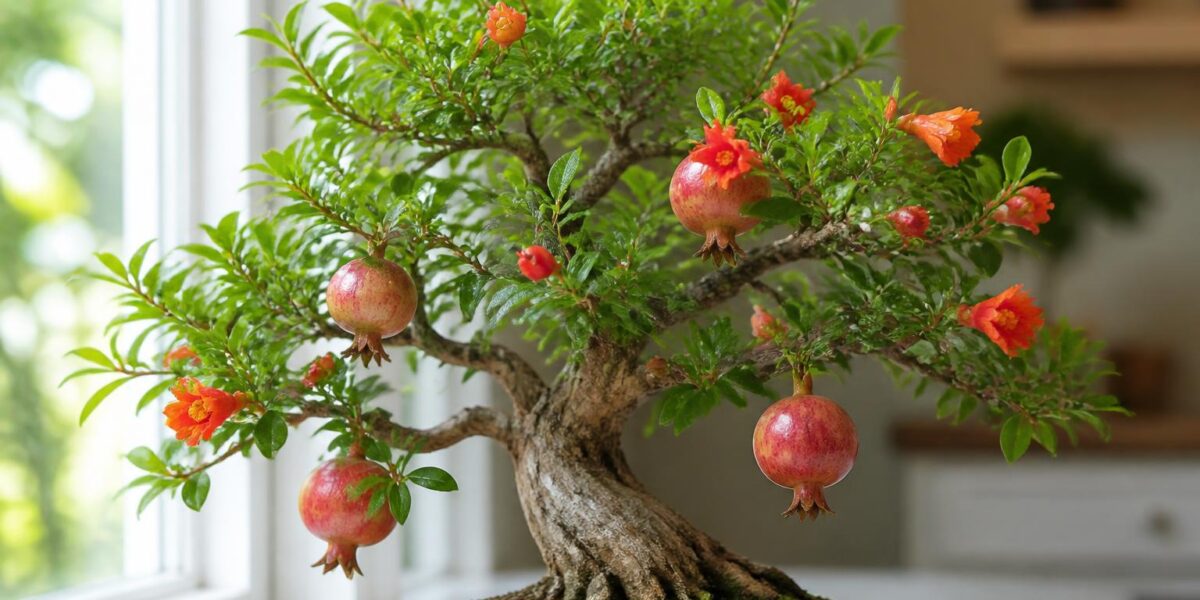
As a bonsai, pomegranate is a popular fruiting and flowering species — the bright flowers and miniature fruit set are dramatic on a small tree. Specimens are usually 10 to 24 inches tall with a thick gnarled trunk (especially in the dwarf cultivar P. granatum ‘Nana’), narrow lance-shaped leaves, summer flowers, and small fruit that ripen in late summer or autumn. The dwarf nana cultivar is the most common bonsai form because its small leaves scale appropriately for the bonsai canopy. The fruit on a bonsai is genuine miniature pomegranate — the same chemistry as full-size fruit, just smaller.
Why Pomegranate Is Mild Caution Rather Than Toxic or Safe
Pomegranate occupies an interesting middle ground in pet plant safety. The ripe fruit pulp — the juicy red arils — is non-toxic to cats and dogs and is sometimes even given as a small treat. The hard inner seeds within each aril are non-toxic chemically but can pose a choking or GI obstruction risk in small pets if many are swallowed without chewing. The leathery red-brown peel surrounding the fruit contains higher concentrations of tannins, ellagitannins, and small amounts of pelletierine alkaloids, which can cause vomiting, diarrhea, and mild abdominal discomfort. The leaves, bark, and roots contain similar compounds at varying concentrations.
For broader context on pomegranate and pets, see are pomegranate trees toxic to pets as the umbrella piece. For food-safety angles see can cats eat pomegranate, can cats eat pomegranate seeds, and can dogs eat pomegranate. The framing across all of these is consistent: small amounts of ripe fruit pulp are fine; the peel, leaves, and large seed loads are mildly problematic.
Symptoms in Pets After Pomegranate Bonsai Ingestion
Pomegranate ingestion in pets typically produces mild GI symptoms within 4 to 8 hours: drooling, one or two episodes of vomiting (often with chewed plant material or seeds visible), soft stool or mild diarrhea, brief reduced appetite, and short-lived lethargy. Most exposures resolve within 24 hours without medical intervention. The seeds may pass through stool intact — owners sometimes find pomegranate seeds in the next day’s litter or yard cleanup, which is harmless and expected.
Severe symptoms — repeated forceful vomiting, blood in vomit or stool, profound lethargy, tremors, or any change in mental status — are not consistent with pomegranate alone. If you see those signs, consider whether your pet may have eaten a different, more dangerous plant in the same area, or whether seed crunching may have caused dental injury that is producing the actual distress. A particular concern in small pets that swallow many seeds at once is the (uncommon but real) risk of GI obstruction; persistent vomiting, abdominal distension, or repeated unproductive retching warrants a vet visit.
First Aid: What to Do at Home
If you catch your pet chewing pomegranate bonsai, gently remove any plant material from the mouth and wipe the muzzle and paws. Note approximately how much was eaten and which parts (leaves, twigs, fruit pulp, seeds, peel). For most exposures the right plan is to offer fresh water, withhold food for one to two hours, and watch for the mild GI signs above over the next 12 to 24 hours.
Do not induce vomiting at home unless directed. For a mild-caution plant like pomegranate, the risks of induced vomiting outweigh any benefit in most cases. If symptoms appear and persist, or if a small pet swallowed many seeds and you are concerned about obstruction, call your veterinarian or a 24/7 poison-control hotline: ASPCA Animal Poison Control at 888-426-4435 or the Pet Poison Helpline at 855-764-7661.
When to Call the Vet
Most pomegranate bonsai exposures need no medical contact at all. Reach out to your vet if vomiting continues past two or three episodes, if diarrhea persists past 24 hours, if your pet refuses water and seems dehydrated, if there is any blood in vomit or stool, or — for small pets that consumed many whole seeds — if you see signs that suggest GI obstruction (abdominal distension, repeated unproductive retching, severe abdominal pain).
If your pet shows symptoms that do not match a mild-caution plant — pale gums, profound lethargy, neurologic changes, or repeated forceful vomiting — that picture is not consistent with pomegranate alone. Consider whether your pet may have eaten a different, genuinely toxic plant in the same area (lily, sago palm, oleander, aroid family species, or — in a bonsai household — a more toxic bonsai species). Bring a photo or sample of any chewed plant material to the appointment.
Pomegranate Seeds: A Specific Sub-Risk
Pomegranate seeds get their own discussion because owners ask about them frequently. The seed itself is the hard inner core of each aril; humans eat the juicy red flesh and either swallow or spit out the seed. Pets are not selective and tend to swallow seeds whole. Chemically, seeds are not toxic — but mechanically, a load of them can cause issues in small pets.
For cats specifically, see can cats eat pomegranate seeds for the dedicated discussion. The general guidance: a few seeds passed through a healthy adult dog or cat without problem; a small puppy or kitten swallowing dozens of whole seeds at once may need monitoring for GI obstruction. The bonsai-specific application: because bonsai pomegranates produce miniature fruit, the seeds are also smaller and lower-risk than full-size pomegranate seeds.
How Pomegranate Bonsai Compares to Other Bonsai Species
Pomegranate bonsai sits in the mild-caution tier — more concerning than the truly safe juniper, pine, Chinese elm, olive, and Japanese maple (presumed safe), but far less concerning than the moderate boxwood or severe-tier wisteria and azalea bonsai. Among the fruit-bearing bonsai options, pomegranate is one of the lower-risk choices — most other fruiting bonsai (citrus, fig, pyracantha) carry their own caveats.
Compared to bougainvillea bonsai (low chemical risk but thorns), pomegranate bonsai has slightly higher chemistry concern but no thorn hazard. The pomegranate tree does have small short spines on some cultivars, but they are nowhere near the size or sharpness of bougainvillea thorns and are usually trimmed off in bonsai cultivation.
Care Basics and Pet-Safe Placement
Pomegranate bonsai wants warm to hot summers, full sun, a winter dormancy (the species is deciduous in cooler zones), and well-draining soil. It does best as an outdoor bonsai in mild to hot climates and as a sheltered indoor or cold-frame plant through winter in cooler zones. Indoor display is fine for short stretches but the plant needs the temperature variation to flower and fruit properly.
From a pet-safety angle, the simple practice of cleaning up fallen leaves, flowers, and especially fallen fruit handles most of the risk. Pomegranates that ripen on a bonsai may drop in late autumn; a fallen fruit on the floor is the most common pomegranate exposure scenario for indoor pets. Pick up any fallen fruit promptly. For outdoor placement, use a stand high enough that small dogs cannot reach the canopy or any fallen fruit on the soil surface. For pet-safe garden inspiration, see the pet-safe garden plants guide.
Comparing Pomegranate Bonsai to the Rest of Your Plant Collection
Pomegranate bonsai is a striking flowering and fruiting species with manageable pet-safety considerations. For pet-safe alternatives if pomegranate’s mild caution is not acceptable in your household, consider the truly safe juniper, Chinese elm, olive, or Japanese maple bonsai — all of which lack the GI-irritant chemistry and the seed-load mechanical risk of pomegranate.
Rescue-minded readers can browse cats waiting for homes and dogs available for adoption while you set up a pet-safe display area in your home. For pet-safe houseplant inspiration beyond bonsai, see the cat-safe houseplants list.
Frequently Asked Questions
Is pomegranate fruit safe for my dog as a treat?
The juicy red arils (the pulp) are non-toxic in small amounts. The peel and large quantities of seeds can cause GI upset. See can dogs eat pomegranate for the food-safety detail.
What if my cat ate pomegranate leaves from a bonsai?
Mild GI upset is possible — drooling, one or two vomits, soft stool. Watch for 24 hours, offer water, and call your vet if vomiting persists past two or three episodes. The chemistry is not severe-tier.
Is pomegranate juice safe for pets?
Plain pomegranate juice in very small amounts (a few licks) is not toxic but is high in natural sugars and acids. It is not recommended as a regular drink for pets.
Are pomegranate flowers more or less toxic than the fruit?
The bright orange-red flowers contain similar mild irritants to the leaves and peel — mild GI upset territory if consumed in volume. They are not severely toxic but should not be considered a safe nibble.
Can the small spines on pomegranate branches injure a pet?
Some pomegranate cultivars have small short spines, but these are usually pruned off in bonsai cultivation and are far less hazardous than bougainvillea thorns. Eye injury is theoretically possible but uncommon.


