
Last updated: May 16, 2026
In this article
- Japanese Maple Bonsai and Pet Safety at a Glance
- Bonsai Toxicity in One Sentence
- What Japanese Maple Bonsai Looks Like
- Why Japanese Maple Is Considered Presumed Safe
- The Important Maple Caveat: Red and Silver Maple Are Toxic
- Possible Mild Symptoms After Japanese Maple Bonsai Ingestion
- First Aid: What to Do at Home
- When to Call the Vet
- How Japanese Maple Bonsai Compares to Other Bonsai Species
- Maple Syrup, Sap, and Pets
- Care Basics and Pet-Safe Placement
- Frequently Asked Questions
Japanese Maple Bonsai and Pet Safety at a Glance
A bonsai is a miniaturized version of a full-size plant — its toxicity profile matches the underlying species exactly. So a Japanese maple bonsai (Acer palmatum) shares the toxicity profile of a full-size Japanese maple tree. The good news is that Acer palmatum is not listed by the ASPCA Animal Poison Control Center as toxic to cats or dogs, and there are no documented cases of meaningful systemic poisoning in either species. We frame Japanese maple bonsai as presumed safe — not aggressively pet-friendly the way an ASPCA-confirmed non-toxic species would be, but also not on the watchlist of plants to keep out of pet reach.
Critical caveat: not all maples are safe. Red maple (Acer rubrum) and silver maple (Acer saccharinum) are documented toxic — primarily to horses, where their wilted leaves cause hemolytic anemia, but with concerning case reports in dogs and uncertain risk in cats. The species name on the bonsai tag matters. A. palmatum (Japanese maple) is the presumed-safe species. If your bonsai is sold simply as “maple bonsai” without a species tag, ask the vendor before assuming safety.
Bonsai Toxicity in One Sentence
The single most important concept for any bonsai owner: a bonsai is the same plant as a full-grown specimen of the same species, just smaller and trained into a particular shape. The toxicity (or safety) of a bonsai is identical to the underlying species. A Japanese maple bonsai is no more or less toxic than a full-size Japanese maple, and that means the conversation about whether maples are pet-safe applies directly here.
For broader context on safer bonsai species, see the B122 sibling guides: juniper bonsai, pine bonsai, and Chinese elm bonsai are the standout low-risk options that share Japanese maple’s pet-safe framing. For toxic-tier bonsai, see ficus bonsai, jade tree bonsai, schefflera bonsai, ginseng ficus bonsai, and the severe-tier azalea bonsai, wisteria bonsai, and moderate boxwood bonsai.
What Japanese Maple Bonsai Looks Like
Acer palmatum is native to Japan, Korea, and parts of China and Russia. It is a small to medium deciduous tree, typically 15 to 25 feet tall in the wild but capable of staying much smaller. There are hundreds of named cultivars selected for leaf color (deep red, bright green, variegated), leaf shape (palmate, dissected, lace-leaf), and growth habit (upright, weeping, dwarf).
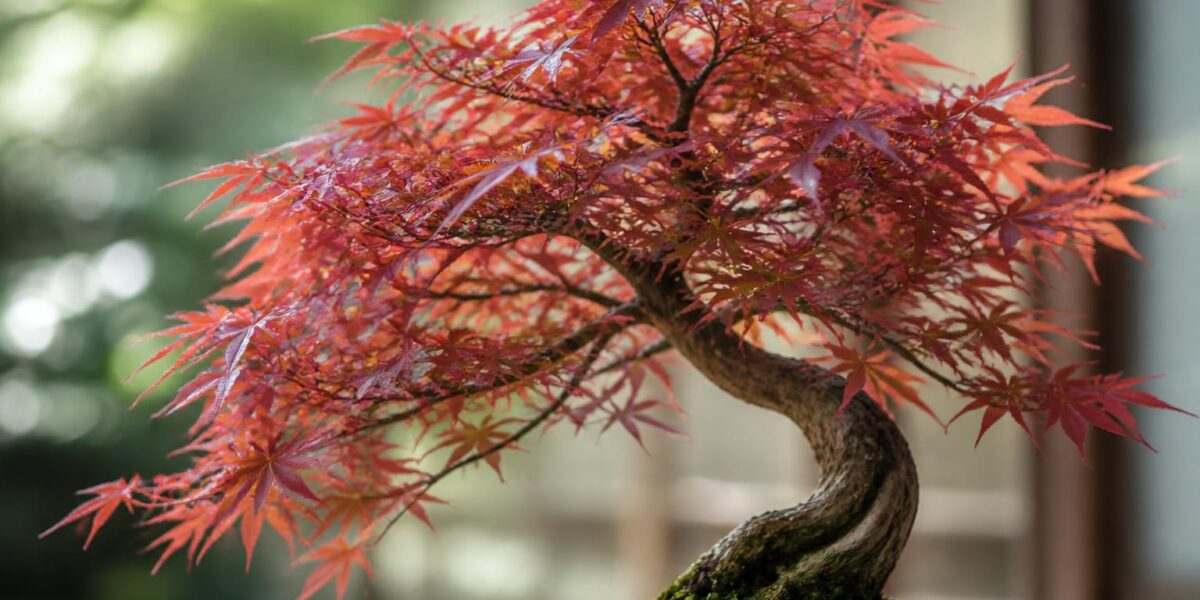
As a bonsai, Japanese maple is one of the most beloved and visually striking species. Specimens range from 8 to 30 inches tall with a thick gnarled trunk, fine ramification, and proportionally tiny palmate leaves that flush bright in spring, deepen in summer, and turn brilliant red, orange, or yellow in autumn. The species is deciduous, so a bonsai goes through a leafless winter dormancy that is itself part of the display. Common bonsai cultivars include ‘Deshojo’ (red spring flush), ‘Kiyohime’ (compact), ‘Arakawa’ (corky bark), and ‘Beni Schichihenge’ (variegated).
Why Japanese Maple Is Considered Presumed Safe
The ASPCA Animal Poison Control Center does not list Acer palmatum as toxic to cats, dogs, or horses. Reviews of veterinary toxicology databases similarly do not flag Japanese maple as a species of concern. This puts Japanese maple in the “presumed safe” category — not actively confirmed non-toxic with positive ingestion studies, but absent from the lists of plants that cause documented harm.
For broader context on Japanese maple and pets, see are Japanese maple toxic to pets. The umbrella article covers the species in full-tree form; the bonsai version of the same plant has the same chemistry. The reason we use “presumed safe” rather than “definitively safe” is that the published literature on Japanese maple toxicity in companion animals is thin — there simply are not many cases either way. The absence of toxic case reports across decades of widespread cultivation is a meaningful safety signal.
The Important Maple Caveat: Red and Silver Maple Are Toxic
Other Acer species are not safe. Acer rubrum (red maple) is documented to cause severe hemolytic anemia in horses, particularly when wilted leaves are consumed in late summer or fall — the wilting process generates hydroxyl-mediated oxidative damage to red blood cells. Companion-animal data is less robust but case reports in dogs include hemolysis, and the ASPCA classifies red maple as toxic.
Acer saccharinum (silver maple) is similarly flagged for horses and similarly cautioned for dogs. Acer saccharum (sugar maple) is generally considered safer but data is limited. For more on these distinctions, see are red maple leaves toxic to pets and are silver maple toxic to pets. The bottom line: when you buy a maple bonsai, confirm it is Acer palmatum (Japanese maple) specifically. The name “maple bonsai” alone does not guarantee the safer species.
Possible Mild Symptoms After Japanese Maple Bonsai Ingestion
Even though Japanese maple is presumed safe, a pet that chews multiple leaves can produce mild GI upset from the volume of fiber alone. Possible signs include one or two episodes of vomiting with chewed leaf material, soft stool or mild diarrhea within 6–12 hours, brief appetite loss for a few hours, and short-lived lethargy that resolves within a day. These are mechanical effects, not toxin effects, and they are common with any plant ingestion regardless of toxicity status.
Severe symptoms — repeated forceful vomiting, blood in vomit or stool, profound lethargy, tremors, ataxia, pale gums (suggesting hemolysis), or any change in mental status — are not consistent with Acer palmatum alone. If you see those signs after a maple ingestion, the urgent question becomes: was this really Japanese maple, or could the species actually be red or silver maple? A photograph of the plant, a leaf sample, and any nursery tag information is critical for the vet team.
First Aid: What to Do at Home
If you catch your pet chewing Japanese maple bonsai, gently remove any plant material from the mouth and wipe the muzzle and paws. Note approximately how much was eaten and which parts (leaves, twigs, bark, or — in autumn — fallen leaves that may have wilted). For a confirmed Japanese maple (Acer palmatum), the right plan for most exposures is to offer fresh water, withhold food for one to two hours, and watch for the mild GI signs above over the next 12 to 24 hours.
Do not induce vomiting at home unless directed by a vet. For a presumed-safe plant, the risks of induced vomiting (aspiration, esophageal injury) outweigh any benefit. If you are unsure of the species, or if your bonsai might be a different Acer species, treat the exposure with more caution and call your veterinarian or a 24/7 poison-control hotline: ASPCA Animal Poison Control at 888-426-4435 or the Pet Poison Helpline at 855-764-7661. Bring a photo of the plant.
When to Call the Vet
Most Japanese maple bonsai exposures need no medical contact at all. Reach out to your vet if vomiting continues past two or three episodes, if diarrhea persists past 24 hours, if your pet refuses water and seems dehydrated, if there is any blood in vomit or stool, or — most importantly — if you cannot confirm that the bonsai is Acer palmatum specifically rather than a more dangerous Acer species.
If your pet shows symptoms that do not match a presumed-safe plant — pale gums, brown or red urine (suggesting hemolysis), profound lethargy, or any change in mental status — that picture is consistent with red or silver maple toxicity, not Japanese maple. Treat the call as urgent and bring the plant material with you. Hemolytic anemia from maple toxicity is treatable but requires recognition.
How Japanese Maple Bonsai Compares to Other Bonsai Species
Japanese maple bonsai sits firmly in the safer-bonsai tier alongside juniper, pine, Chinese elm, olive, and the mild-caution pomegranate and bougainvillea (the bougainvillea adds thorns rather than chemistry). Compared to the toxic peers — wisteria, azalea, boxwood, ficus, jade, schefflera, ginseng ficus — Japanese maple is among the lowest-concern bonsai you can keep around pets.
If you are choosing a first bonsai for a multi-pet home, Japanese maple, Chinese elm, juniper, and pine are the four standouts. Japanese maple’s seasonal display (spring flush, autumn color) is uniquely dramatic among the safe options.
Maple Syrup, Sap, and Pets
A frequently asked sidebar question with maple bonsai involves the sap. Japanese maple does not produce significant tappable sap, but the question often comes from owners who associate maple with maple syrup. Maple syrup is from sugar maple (Acer saccharum), and pure maple syrup in small amounts is not toxic — it is, however, very high in sugar and inappropriate as a regular treat. See can cats eat maple syrup and can dogs eat maple syrup for the food-safety angle.
The sap that Japanese maple does produce when pruned is non-toxic and not a meaningful exposure concern. Pruning fresh-cut maple branches is safe to do around pets, although as with any plant pruning, it is sensible to clean up debris promptly so curious pets do not investigate fallen twigs.
Care Basics and Pet-Safe Placement
Japanese maple bonsai wants cool to moderate temperatures (it is a temperate-zone tree, not a tropical), bright filtered sun, well-draining slightly acidic soil, and a true winter dormancy. It is not a year-round indoor plant; it does best outdoors most of the year and on a cool sheltered porch through winter. Indoor display is fine for short stretches (a week or two) when the plant is in full leaf or autumn color.
From a pet-safety angle, Japanese maple’s preferences happen to align with practical pet-proofing. The outdoor display means it is mostly out of cat reach by location alone, and the brief indoor stints are usually on a display table or shelf where cats and small dogs cannot easily browse. For pet-safe garden inspiration, see the pet-safe garden plants guide. Rescue-minded readers can browse cats waiting for homes and dogs available for adoption while you set up a pet-safe display area in your home.
Frequently Asked Questions
Is Japanese maple bonsai really safe for cats and dogs?
Acer palmatum is not listed as toxic by the ASPCA, and there are no documented cases of meaningful systemic poisoning. We frame it as presumed safe rather than aggressively non-toxic. Mild GI upset from large-volume ingestion is possible.
What if my bonsai is just labeled “maple” without a species name?
Confirm the species before assuming safety. Acer palmatum (Japanese maple) is presumed safe. Acer rubrum (red maple) and Acer saccharinum (silver maple) are toxic, particularly when leaves are wilted. Ask the nursery or check the original tag.
Are wilted Japanese maple leaves more dangerous than fresh ones?
The wilted-leaf hazard is specific to red maple, where wilting generates compounds that cause hemolytic anemia in horses (and possibly dogs). Japanese maple does not share this mechanism in the published literature. That said, large-volume ingestion of any wilted plant material can cause GI upset.
Can my pet drink maple syrup if it spills near the bonsai?
Pure maple syrup is not toxic in small amounts but is very high in sugar. Wipe up spills promptly and do not offer maple syrup as a regular treat. See the cat- and dog-specific food safety articles for detail.
How does Japanese maple compare to Chinese elm as a pet-safe bonsai?
Both are pet-safe options, but Japanese maple is deciduous and outdoor-preferred while Chinese elm is semi-evergreen and tolerates indoor display year-round. Choose based on your display setup. Both share the lowest-risk profile among popular bonsai species.


