
Last updated: May 16, 2026
In this article
- The Short Answer on Shiitake Mushrooms for Cats
- Why Cats Are Often Curious About Mushrooms
- Cooked Plain Shiitake: The Tolerable Scenario
- Raw Shiitake and the Dermatitis Question
- Wild Mushroom Foraging Is a Hard No
- Shiitake Supplements and Pet Immune Products
- Other Mushrooms and How They Compare
- Better Treat Alternatives Your Cat Will Actually Want
- Symptoms to Watch After a Mushroom Nibble
- The Umami Trap: Sharing Without Habituating
- Frequently Asked Questions
The Short Answer on Shiitake Mushrooms for Cats
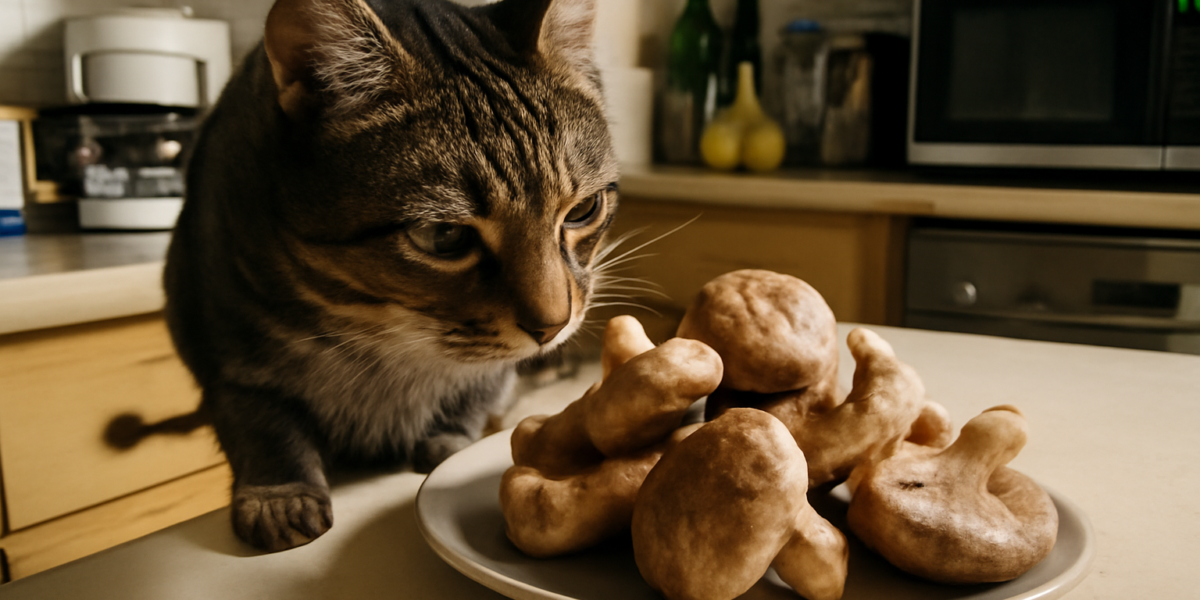
Can cats eat shiitake mushrooms? In tiny, cooked, plain amounts, most healthy cats will tolerate a small bite of shiitake without obvious problems, but this mushroom is not a food cats need or benefit from in any meaningful nutritional way. Cats are obligate carnivores, which means their bodies are wired to extract energy, amino acids, and vitamins from animal tissue rather than fungi. A nibble of cooked shiitake from your stir-fry is not a poisoning emergency, but a regular habit of feeding mushrooms to your cat is unnecessary and carries small but real risks.
The reasonable approach is to think of shiitake as a curiosity food, not a treat. If your cat licks a piece off the floor, you do not need to panic. If you are tempted to add mushrooms to her bowl because you read about immune-boosting fungi for humans, slow down and talk to your veterinarian first. There is a meaningful gap between what works for human nutrition and what works for a small obligate carnivore weighing eight to twelve pounds.
Why Cats Are Often Curious About Mushrooms
Cats are famously sensitive to umami, the savory taste linked to glutamates in meat, aged cheese, and certain fungi. Shiitake mushrooms are unusually rich in glutamate compounds, which is why they smell so strong when sauteed and why some cats will sniff around a shiitake stir-fry with sudden interest. That curiosity is a flavor response, not a nutritional craving. Your cat is not telling you she needs fungi; she is telling you the umami molecules in the mushroom remind her of meat.
This is the same reason cats will bat at parmesan rinds or steal anchovy paste off a cutting board. The umami pull is powerful, but acting on it by feeding mushrooms regularly is a mistake. Meat already provides umami in a form built for feline digestion. If you want to satisfy her food-stealing instinct, a flake of plain cooked chicken or a lick of unsalted bone broth is a better answer than a mushroom cap.
Cooked Plain Shiitake: The Tolerable Scenario
If you decide to offer your cat a tiny taste of shiitake, the only acceptable preparation is plain, fully cooked, and unseasoned. That means no butter, no oil, no soy sauce, no garlic, no onion, no salt, and no sake or mirin. Most home shiitake dishes are loaded with at least two of those ingredients, and onion and garlic are specifically toxic to cats in even small amounts because they damage red blood cells. A piece of shiitake that has been simmered in a soy-garlic sauce is not a safe cat food, no matter how small.
To prepare a tolerable taste, simmer or steam a single shiitake cap in plain water until it is soft and chewable. Let it cool fully, then chop one quarter-inch piece for your cat. That is the ceiling for an occasional taste, not a portion to repeat daily. Most cats will sniff, lick, and walk away. If your cat actually eats the piece, watch her for the next twenty-four hours for any vomiting, diarrhea, drooling, or appetite changes before you ever consider offering another taste.
Raw Shiitake and the Dermatitis Question
Raw shiitake mushrooms are a different story. In humans, eating raw or undercooked shiitake can occasionally cause shiitake dermatitis, a striking whip-like rash on the skin caused by an unstable polysaccharide called lentinan that breaks down with heat. The reaction is rare and self-limiting in people, but it is real and well documented in dermatology literature.
The exact same reaction has not been clearly described in cats, partly because cats almost never eat raw shiitake on purpose and partly because it has not been carefully studied. The theoretical risk exists because the compound and the immune machinery are similar. Beyond dermatitis, raw shiitake is also tough, fibrous, and harder for a small carnivore stomach to break down. The simple rule: if you are going to share a mushroom with your cat, cook it first.
Wild Mushroom Foraging Is a Hard No
This is the part of the conversation that matters most. Cultivated shiitake from a grocery store or farmers market is one thing. Wild mushrooms growing in your yard, a park, or the woods are something else entirely. North America and Europe contain dozens of mushroom species that look like edible varieties but contain compounds that cause severe liver failure, kidney damage, neurological signs, or death. Amanita species in particular have killed pets, including cats, who nibbled fallen caps in a backyard.
If your cat goes outdoors, walk your yard regularly during damp seasons and pull any mushrooms you find. If you see your cat eat or chew an unidentified mushroom, take a photograph of the cap, gills, and stem (or bring an intact specimen) and call your veterinarian or the ASPCA Animal Poison Control Center immediately. Do not wait for symptoms. Many of the worst mushroom toxins have a delayed onset of six to twenty-four hours, by which time treatment is far harder.
Shiitake Supplements and Pet Immune Products
Shiitake extract, lentinan, and other mushroom-derived compounds appear in some pet supplements marketed for immune support, cancer co-care, or general wellness. The marketing language can be persuasive, especially if you are caring for an older cat or one with a serious diagnosis. The honest answer is that the evidence base for these products in feline patients is thin. A handful of small studies in dogs exists; controlled feline studies are scarce.
If you are considering a mushroom-based supplement for your cat, the right move is to bring the exact product label to your veterinarian or, even better, a board-certified veterinary internist or oncologist. They can tell you whether the dose is reasonable, whether it interacts with any medication your cat takes, and whether the product has any third-party testing. Do not start a supplement based on a Reddit thread or a pet-store recommendation. Cats metabolize many compounds differently than humans or dogs do.
Other Mushrooms and How They Compare
Common cultivated mushrooms most cats may encounter include white button, cremini, portobello (which is just a mature cremini), oyster, and enoki, in addition to shiitake. The general rule for all of them is the same: plain, cooked, tiny portions are tolerable; raw, wild, or seasoned forms are not appropriate. If you are curious about button mushrooms specifically, our guide on cooked versus raw button mushrooms for cats walks through that comparison in detail.
Shiitake stands out from button mushrooms in two ways: stronger flavor compounds (which is why cats may show more interest) and the lentinan-related dermatitis risk in raw form. Practically, this means shiitake is slightly less appropriate for raw nibbling than a button mushroom would be, and even more clearly out of place as a regular feeding ingredient.
Better Treat Alternatives Your Cat Will Actually Want
If you are looking for a tiny-treat moment to share with your cat, mushrooms are near the bottom of the useful list. Cats are designed to enjoy and digest meat-based snacks, and small amounts of plain protein are far better suited to her body than fungi. A pea-sized piece of plain cooked chicken breast or a small flake of plain cooked salmon offers real protein, real satisfaction, and zero of the gastrointestinal questions a mushroom raises.
You can also explore species-appropriate vegetable curiosity foods that are safer than mushrooms, like a small piece of steamed broccoli floret, a tiny strip of cooked bok choy, or a sliver of cooked cauliflower. None of these are nutritionally necessary, but they are all gentler than fungi and give a cat with a vegetable-curious nose something low-risk to investigate.
Symptoms to Watch After a Mushroom Nibble
If your cat eats a piece of cultivated shiitake from your kitchen and you saw exactly what she got, you can usually monitor at home. Watch for vomiting, diarrhea, drooling, lip-smacking, lethargy, hiding, refusing food, or any tremor or wobble in her gait. Most reactions to a small piece of cooked plain shiitake will be mild stomach upset that resolves in a day. Offer a quiet space, fresh water, and her normal food on the usual schedule.
Call your veterinarian sooner rather than later if you saw your cat eat a wild or unidentified mushroom, if symptoms appear within a few hours of any mushroom ingestion, if she eats a seasoned mushroom dish containing onion, garlic, or leek, or if she has a pre-existing condition like chronic kidney disease or liver issues that would make even a mild toxin harder to clear. With pets, calling earlier is always cheaper and easier than calling later.
The Umami Trap: Sharing Without Habituating
One subtle issue with sharing any human food with cats is that even tiny exposures can shape preferences. A cat who learns that the kitchen counter sometimes produces an interesting taste will return to the kitchen counter more often. A cat who learns that her person’s plate sometimes produces a taste will hover near the plate at every meal. With shiitake specifically, the umami pull is strong enough that some cats will become persistent counter-surfers if they get a few rewarding tastes.
The practical implication is that even if a single piece of plain cooked shiitake is harmless, you may be teaching a behavior pattern that costs you peace at every future dinner. If your cat is already a counter-surfer, do not reward it with mushroom tastes. If she is not, do not start. Reserve treat-giving for predictable, structured moments — her own dish, after a play session — rather than from your plate or cutting board.
Frequently Asked Questions
Can my cat eat dried shiitake mushrooms?
Dried shiitake is concentrated, woody, and difficult to chew. Even rehydrated, it is more pungent than fresh and often soaked in seasoned broth in home cooking. Skip dried shiitake entirely as a cat snack.
What about shiitake broth or dashi?
Most dashi is made with kombu (kelp) and either bonito flakes or shiitake, and it is almost always salted. Even unsalted homemade shiitake broth is not appropriate for routine feeding, though a single lick from a finger is unlikely to cause harm. Plain unsalted chicken or beef broth is a better umami treat.
My cat ate a shiitake mushroom out of my stir-fry. Should I worry?
If the stir-fry contained onion, garlic, leek, scallion, soy sauce, or excessive oil, call your veterinarian for guidance. If it was a plain piece, watch for vomiting and diarrhea over the next twenty-four hours and offer plenty of fresh water. Most cats will be fine.
Are mushroom supplements safe for cats with cancer?
Some mushroom-derived compounds are studied in veterinary oncology, but products vary widely in quality and dosing. Never add a supplement to a cancer treatment plan without your veterinary oncologist’s input. Interactions with chemotherapy and other medications are possible.
Can kittens eat shiitake mushrooms?
Kittens have small bodies and developing digestive systems. There is no reason to give a kitten any mushroom. Stick to a balanced kitten diet and save the curiosity foods for an adult cat at a stable weight under your veterinarian’s care.


