
Last updated: May 16, 2026
In this article
- Swiss Chard Plants and Your Pets: The Short Answer
- What Swiss Chard Actually Is
- The Oxalate Footnote — Why Chard Is Not “Just Like Kale”
- Cats and Swiss Chard
- Dogs and Swiss Chard
- What Volume Is “Too Much” Swiss Chard?
- Other Oxalate-Family Plants to Recognize
- Designing a Bed Around Sensitive Pets
- If Your Pet Just Ate Swiss Chard
- Frequently Asked Questions
Swiss Chard Plants and Your Pets: The Short Answer
Swiss chard plants (Beta vulgaris subsp. cicla) are not on the ASPCA’s specific toxic-plants list, and small foraging amounts are very unlikely to cause a true poisoning in dogs or cats. But Swiss chard is one of the leafy greens that earns a footnote rather than an unqualified green light: the leaves contain soluble oxalates at moderate concentration, less than rhubarb leaves but more than spinach in many varieties. For most pets, a casual mouthful from a garden bed is fine. For pets eating large amounts repeatedly, or for pets with kidney disease, the oxalate content matters.
This article covers the Swiss chard PLANT — what happens if your dog or cat nibbles the colorful stems and leaves in your vegetable garden. For whether cooked Swiss chard is appropriate to feed your pet on purpose, search our food-safety side for the matching can-dogs-eat or can-cats-eat guide. The plant-side answer: low concern for casual exposure, more nuanced for repeated or large feedings.
What Swiss Chard Actually Is
Swiss chard is the leaf-grown form of the beet plant. Botanically it’s Beta vulgaris subsp. cicla — the same species as table beets and sugar beets, just bred for the leaves and the showy stems instead of the swollen root. It is NOT a member of the Brassica family despite often being grown alongside kale, collards, and bok choy. Swiss chard belongs to the Amaranthaceae family (formerly Chenopodiaceae), which puts it in the same broad relatives group as spinach, beet greens, lambsquarter, and amaranth.
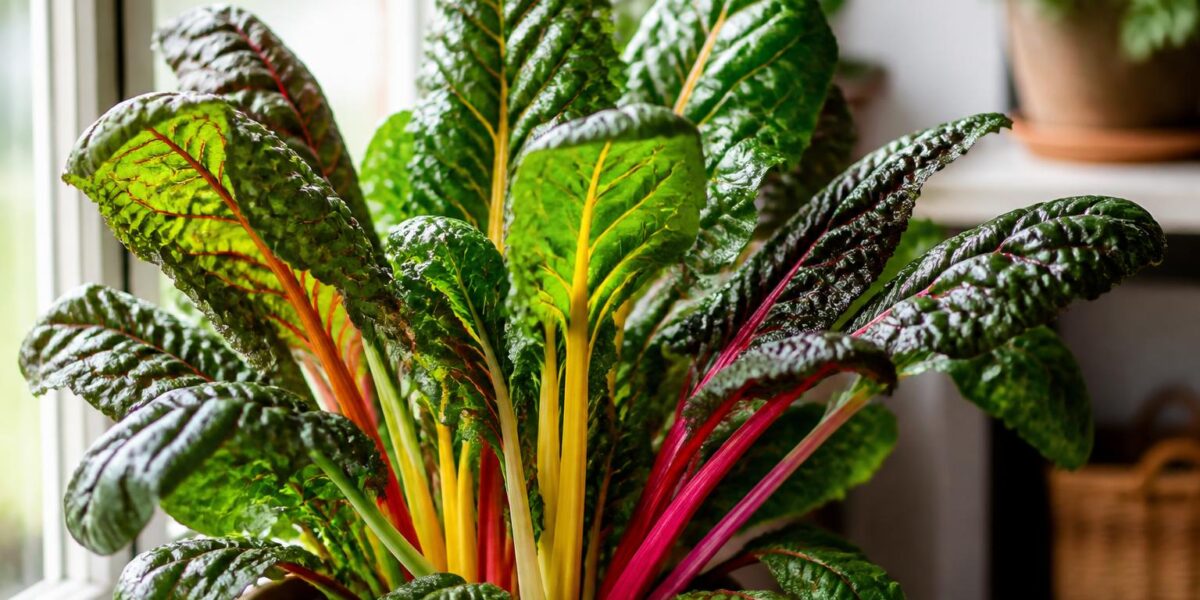
The “rainbow” or “Bright Lights” varieties are simply Swiss chard cultivars selected for vivid red, yellow, orange, and pink stems. From a chemistry standpoint they’re the same plant. The colorful stems and crinkled green leaves are the parts your pet is most likely to encounter, and they’re what gives Swiss chard the oxalate footnote.
The Oxalate Footnote — Why Chard Is Not “Just Like Kale”
Soluble oxalates are organic acids found in many leafy greens. In moderate amounts they pass through the digestive system uneventfully. In large amounts, they can bind calcium in the bloodstream (causing low ionized calcium) and form calcium oxalate crystals in the kidneys. The species in this neighborhood — rhubarb leaves at the high end, Swiss chard and spinach in the middle, beet greens, purslane, and lambsquarter also in this group — share that chemistry.
The clinically relevant facts for pet owners:
- Casual nibbles are not the dose that causes poisoning. A dog who grabs a chard leaf in passing isn’t suddenly facing kidney crystals.
- Large or repeated feedings change the picture. A pet who repeatedly eats large servings of Swiss chard is in a different risk category than one who tasted it once.
- Cats are generally more sensitive to oxalates than dogs when the dose is high.
- Pets with chronic kidney disease are especially vulnerable.
For the higher-end version of this story, see our guides on rhubarb leaves and cats and rhubarb leaves and dogs. Rhubarb leaves are the textbook high-oxalate poisoning case; Swiss chard sits well below them in concentration but lives in the same chemistry family.
Cats and Swiss Chard
Cats are obligate carnivores, so they don’t gain meaningful nutrition from leafy greens. Most cats nibble plants for fiber, hairball management, or simple curiosity. A typical cat will not eat enough Swiss chard to cause an oxalate problem — they tend to chew a leaf, decide it isn’t food, and walk away. The casual encounter is generally fine.
The cat where this matters more is the one with chronic kidney disease, calcium oxalate stones in their history, or a habit of grazing one specific plant heavily. For those cats, Swiss chard is worth keeping out of reach. If your vet manages your cat’s diet around kidney disease, run any leafy green past them rather than allowing free garden access. Our guide on chronic kidney disease in cats covers the broader dietary picture.
Dogs and Swiss Chard
Dogs are the more common chard-bed offenders. The colorful stems and accessible leaves attract attention, and many dogs will graze a few leaves out of pure interest. A casual mouthful from a chard plant is not a vet emergency. The volume that matters for oxalates is well above “my dog grabbed a leaf in passing.”
Where the picture changes is if your dog cleared a large area of mature chard, or if your dog has a history of calcium oxalate bladder stones, chronic kidney disease, or a known sensitivity. Watch for vomiting, drooling, lethargy, or decreased urination — those are the signs that would push the visit from “monitor” to “call the vet now.” For broader context on canine kidney concerns, see our guides on chronic kidney disease in dogs and acute kidney injury in dogs.
What Volume Is “Too Much” Swiss Chard?
There isn’t a clean published threshold for pet exposure, and we won’t fabricate one. The practical framing is qualitative:
- A few leaves grabbed in passing: low concern for a healthy pet. Watch and wait.
- A meal-sized portion: moderate concern. Call your vet, especially for a small dog, a cat, or a pet with kidney disease.
- An entire row of mature chard, or repeated large feedings over days: higher concern. Vet visit recommended.
- Any amount in a pet with kidney disease, oxalate stones, or symptoms after eating: call now.
Symptoms to watch for include vomiting, drooling or pawing at the mouth (oxalate crystals can irritate), lethargy, weakness, tremors, or changes in urination. These are qualitative — symptom severity varies a great deal by pet size, dose, and underlying health.
Other Oxalate-Family Plants to Recognize
If your pet has shown any oxalate sensitivity, knowing the wider neighborhood helps. The high-oxalate plants worth recognizing include rhubarb (especially the leaves), spinach, beet greens, purslane, lambsquarter, and starfruit. Our companion guides on purslane and pets, lambsquarter and pets, and starfruit trees and pets walk through the rest of the family. None of these need to be dramatic worries for healthy pets in casual amounts, but they belong on the same mental shelf when the conversation turns to kidney concerns.
One important reframing: Swiss chard often grows alongside Brassica greens in a “salad bed” that feels like one homogeneous category. It isn’t. The Brassica family — kale, collards, broccoli, cabbage, bok choy, arugula, radish — is in a different chemistry group, and most are simpler safe-with-volume-caveats. Compare with our guides on kale plants and pets and collard greens and pets to see the difference.
Designing a Bed Around Sensitive Pets
If you have a pet with kidney disease or known oxalate stones, the simplest move is to keep Swiss chard, spinach, beet greens, and purslane in a fenced or raised section your pet can’t browse. You don’t need to remove them from your garden — you just need to remove the grazing access. The rest of a leafy green bed can lean on Brassica family vegetables (kale, arugula, collards, bok choy) plus lettuces, which carry less oxalate concern.
For a wider menu of pet-friendly garden choices, see our pet-safe garden plants roundup. The point is not to give up on Swiss chard if you love it; it’s to know which of your pets needs the bed protected.
If Your Pet Just Ate Swiss Chard
For a small amount of chard leaves or stems in a healthy pet, the right move is usually to watch and wait. Offer fresh water, hold the next meal for an hour or two if your pet seems off, and observe energy, appetite, urination, and stools through the next day.
If the amount eaten was large, if your pet has kidney disease, oxalate stones, or any chronic condition, or if you see vomiting, drooling, lethargy, weakness, or any urination change, contact your veterinarian without delay. You can also call the ASPCA Animal Poison Control Center at (888) 426-4435 or the Pet Poison Helpline at (855) 764-7661 for around-the-clock guidance. Do not induce vomiting at home unless a veterinarian instructs you to.
Frequently Asked Questions
Is Swiss chard on the ASPCA toxic list?
The ASPCA does not specifically list Swiss chard, but related Beta vulgaris cultivars (beet greens) are generally treated as non-toxic with an oxalate caveat. The practical framing is “low concern for casual exposure, watch volume in pets with kidney issues.”
Are the colorful “rainbow” chard varieties more dangerous than green Swiss chard?
No. The pigments in the stems are betalains and carotenoids, which are not toxic. The oxalate content is similar across cultivars, so the safety footnote is the same.
Can I feed cooked Swiss chard to my dog deliberately?
In small, occasional amounts, plain cooked chard (no garlic, onion, butter, or salt) is generally fine for healthy dogs. Cooking actually reduces some soluble oxalate content as the leaching liquid carries it out — so cooked-and-drained chard is friendlier than raw. Talk to your vet first if your dog has kidney disease.
My cat licked at chard once and seems fine — should I still worry?
Almost certainly not. A single lick or chew rarely delivers a meaningful oxalate dose. Watch for normal urination, energy, and appetite over the next day. Call your vet if anything seems off.
Where can I read more about pet kidney health?
Start with chronic kidney disease in cats or chronic kidney disease in dogs, and visit our adopt a cat hub or adopt a dog hub for broader pet-care resources.


