
Last updated: May 4, 2026
In this article
- The Short Answer on Cats and Soy Milk
- Why Cats Need Taurine — And Why Plants Cannot Provide It
- Dilated Cardiomyopathy and Retinal Degeneration
- Other Soy Concerns for Cats
- The “Lactose-Free Milk” Confusion
- What to Use for Nursing Kittens Instead
- Symptoms of Taurine Deficiency
- What to Do If Your Cat Drinks Soy Milk
- Better Hydration and Treat Options
- Reading Cat Food Labels for Taurine
- Frequently Asked Questions
The Short Answer on Cats and Soy Milk
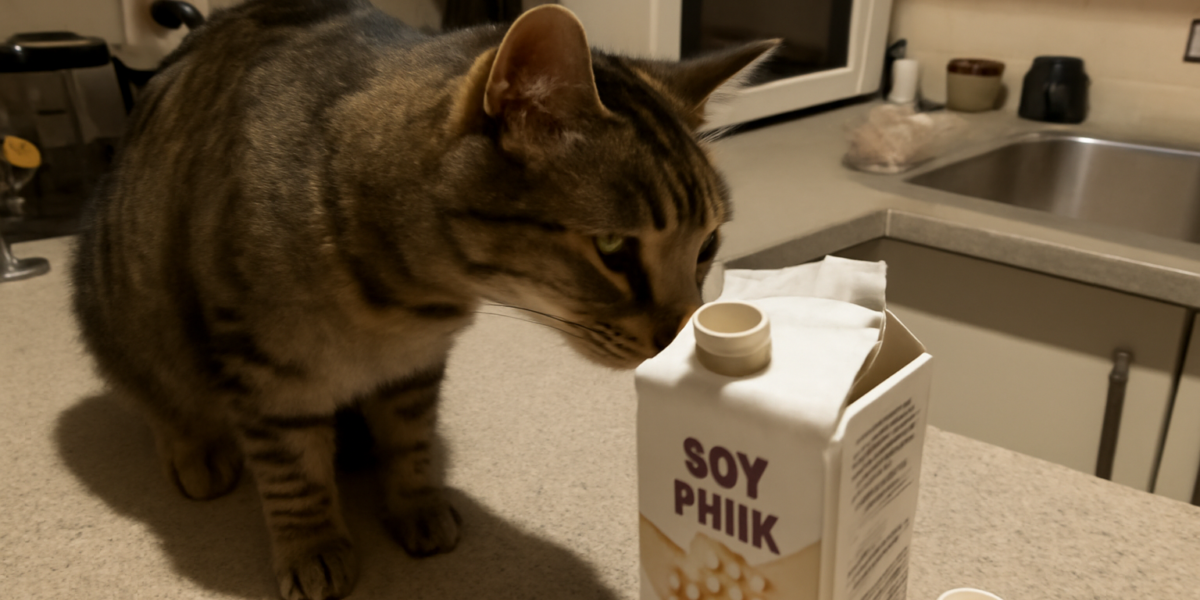
Cats should not drink soy milk as a regular beverage or as a milk substitute. Cats are obligate carnivores, and one of the most defining features of obligate carnivory in cats is their absolute dietary requirement for taurine — an amino acid found only in animal tissue. Soy milk is plant-based and contains no taurine. A cat that drinks soy milk regularly, especially as a replacement for water or animal-based food, can develop taurine deficiency, which causes dilated cardiomyopathy and progressive retinal degeneration. Both conditions can be irreversible by the time symptoms appear.
A small accidental lick of soy milk is not an emergency. The answer to “can cats eat soy milk” is a clear no for any meaningful or repeated consumption. The myth that “cats can drink milk” — already inaccurate for dairy milk because of lactose intolerance — does not transfer to plant milks. Plant-based milks are not feline-appropriate, period. For nursing kittens or hand-rearing situations, use a commercial cat milk replacer formulated specifically for cats.
Why Cats Need Taurine — And Why Plants Cannot Provide It
Taurine is a sulfur-containing amino acid found in muscle meat, organ meat, and seafood. Most mammals can synthesize taurine from precursor amino acids (cysteine and methionine). Cats lost this ability over evolutionary time because their diet always provided abundant taurine — there was no selection pressure to maintain the synthesis pathway. As a result, modern cats must get taurine from food, every day, throughout their lives.
Taurine is essential for cardiac function, retinal function, bile salt formation, reproduction, neurological development, and immune function. The 1980s pet-food industry crisis around taurine deficiency in commercial cat foods is the reason every modern complete-and-balanced cat food now lists taurine on the guaranteed analysis. AAFCO requires minimum levels of 0.10 percent dry matter (dry food) or 0.20 percent dry matter (wet food).
Soy and other plant proteins do not contain taurine in any meaningful amount. The methionine and cysteine in soy could theoretically supply precursors — but cats cannot perform the synthesis. Feeding soy milk to a cat is the equivalent of giving them flour and expecting bread.
Dilated Cardiomyopathy and Retinal Degeneration
Taurine deficiency in cats causes two devastating progressive diseases. Dilated cardiomyopathy (DCM) is a heart disease in which the cardiac muscle weakens, the heart chambers enlarge, and pumping efficiency drops. Symptoms include lethargy, weight loss, exercise intolerance, increased respiratory effort, and eventually heart failure. Caught early, taurine supplementation can partially reverse DCM in cats. Caught late, DCM is fatal.
Retinal degeneration from taurine deficiency is called feline central retinal degeneration (FCRD). It begins in the central retina and spreads outward, causing progressive vision loss. By the time owners notice the cat bumping into things or being startled by movement, significant retinal damage has already occurred. Unlike DCM, retinal degeneration from taurine deficiency does not reverse — the lost photoreceptors do not regenerate.
For breeds already prone to cardiac disease — see our HCM guide — adding taurine deficiency on top of existing cardiac vulnerability is particularly dangerous. While DCM and HCM are different diseases, both compromise cardiac function and any insult to heart muscle is poorly tolerated.
Other Soy Concerns for Cats
Beyond the absence of taurine, soy itself has features that make it a poor cat food. Soybeans contain phytoestrogens (isoflavones like genistein and daidzein) that can interfere with thyroid function and reproductive hormones in mammals. The clinical relevance in cats is not fully established, but cats with thyroid disease or reproductive issues are best kept away from soy.
Soy also contains goitrogenic compounds that interfere with iodine uptake. Hyperthyroidism is the most common feline endocrine disease, affecting roughly 10 percent of cats over age 10. Whether dietary goitrogens trigger or worsen feline hyperthyroidism is debated, but conservative feeding practice avoids them. Soy is a known allergen for some cats, presenting as chronic GI symptoms or skin issues.
Many commercial soy milks are sweetened with sugar, cane juice, or in rare cases sugar substitutes. Xylitol toxicity is the most studied in dogs, but cats can also be affected, with potential for hypoglycemia and liver damage. Always check labels — but better, do not give soy milk at all. For other plant-based items in cat diets, see our tofu guide, edamame guide, and tempeh guide.
The “Lactose-Free Milk” Confusion
Owners of lactose-intolerant cats sometimes reach for plant milks (soy, almond, oat, coconut) thinking that “no lactose” means “safe.” This is a misunderstanding. Plant milks are not feline-appropriate replacements for dairy milk because cats do not need any kind of milk in their adult diet. Replacing lactose-containing dairy with lactose-free plant milk solves the lactose problem and creates a different problem — lack of species-appropriate nutrition.
Cats over weaning age (around 8 weeks) get all their hydration from water and the moisture in wet food. Adult cats do not need a milk-like beverage as part of their diet, and offering one — dairy or plant — is more about owner habit than feline need. For comparison, see our coconut milk article and coconut yogurt article — neither is recommended as a regular item, for similar reasons.
What to Use for Nursing Kittens Instead
Nursing kittens that have lost their mother or cannot nurse for medical reasons need a species-appropriate milk replacer. Cow’s milk is too low in fat and protein for kittens and can cause diarrhea. Soy milk lacks taurine and other essential nutrients. The correct product is a commercial kitten milk replacer (KMR) formulated specifically to match queen’s milk in protein, fat, taurine, calcium, phosphorus, and other nutrients.
Kitten Milk Replacer (KMR) by PetAg is the most widely available brand. Other reputable options include Royal Canin Babycat Milk and Pet-Lac. These are formulated with proper feline nutrition in mind. They come in liquid ready-to-feed and powdered formats, and your vet can advise on feeding schedules. Our kitten feeding guide covers the transition from milk replacer to solid food. Never substitute soy milk, almond milk, oat milk, or human infant formula for KMR.
Symptoms of Taurine Deficiency
Taurine deficiency develops slowly. A cat fed an inappropriate diet for weeks may show no symptoms; over months to years, the deficiency manifests. Watch for these signs in any cat with a known dietary irregularity.
- Reduced exercise tolerance, getting tired more quickly during play
- Increased respiratory rate at rest (more than 30 to 35 breaths per minute)
- Open-mouth breathing during mild exertion
- Visible weight loss or muscle loss along the spine
- Hesitancy to jump up or down from furniture
- Bumping into objects, missing jumps, startle response to movement
- Pupils that appear unusually wide even in bright light
- Pale gums or slow capillary refill
If your cat shows any combination of these symptoms, especially if you have been giving them a non-traditional diet, see your vet promptly. Bloodwork to measure plasma and whole-blood taurine levels can confirm deficiency, and supplementation started early can partially reverse the cardiac effects.
What to Do If Your Cat Drinks Soy Milk
For a single small lick or sip, the typical outcome is no clinical effect. Provide fresh water, watch for any GI upset, and resume the regular diet. The risk from soy milk is from chronic exposure, not a single accidental drink.
For a cat that has been drinking soy milk regularly (perhaps because an owner thought it was a “safe milk”), discontinue it immediately, ensure the cat is on a complete and balanced commercial cat food, and schedule a vet visit for a cardiac and ophthalmologic exam. Bloodwork including taurine levels can establish a baseline. The longer the inappropriate feeding has gone on, the more important early veterinary assessment becomes.
Better Hydration and Treat Options
Cats that seem interested in milk-like liquids are often looking for novelty, attention, or hydration. Better solutions exist than plant milks.
- Fresh water in multiple locations — cats prefer water away from food bowls
- Cat water fountains for cats that prefer running water
- Wet cat food, which is roughly 70 to 80 percent water
- Plain unsalted bone broth — see our bone broth guide
- Lactose-reduced cat-specific “cat milk” products if you really want a milk-like treat (e.g., CatSip)
- Small amounts of plain water from canned tuna packed in water (not oil)
For increased water intake during illness or in older cats, see our wet versus dry food guide and senior cat care checklist. Hydration matters most for cats with kidney disease — see our CKD overview.
Reading Cat Food Labels for Taurine
Every commercial cat food sold in the US that meets AAFCO complete-and-balanced standards must list taurine in the guaranteed analysis or in the AAFCO statement on the package. Look for the phrase “complete and balanced for [life stage]” plus a taurine percentage in the guaranteed analysis. Adult maintenance foods should provide at least 0.10 percent taurine on a dry-matter basis for dry food and 0.20 percent for wet food. Foods marketed as “supplemental” or “for intermittent feeding” may not meet these levels and should not be the cat’s sole diet.
Cats fed homemade or raw diets need careful taurine supplementation, because cooking and freezing can reduce the bioavailable taurine in meat. Owners pursuing home-prepared cat diets should work with a veterinary nutritionist (board-certified through the American College of Veterinary Nutrition) to formulate recipes that meet feline requirements. The DIY approach is technically possible but requires precise sourcing, accurate weighing, and supplement protocols. The same precision is impossible to achieve by feeding random plant milks or human foods.
For cats already on a balanced diet, additional taurine supplementation is unnecessary and not harmful in moderation, but it is also not protective against the consequences of feeding inappropriate plant-based products. The right protective approach is simple: feed a complete and balanced cat food, supplement with appropriate cat-specific treats, provide constant access to fresh water, and skip plant milks entirely. For cats transitioning life stages or diets, see our transition guide.
Frequently Asked Questions
Is unsweetened soy milk safer for cats than sweetened?
Slightly safer because it removes the sugar and potential xylitol risk, but the taurine deficiency issue remains. Unsweetened soy milk is still not appropriate for cats.
Can cats drink almond, oat, or rice milk instead?
No. None of these contain taurine, and all have similar issues to soy milk for cats. They are also not nutritionally complete and should not replace cat food or water.
What about soy-based commercial cat foods?
Some lower-cost commercial cat foods include soy as a protein extender. These are reformulated with added taurine to meet AAFCO requirements, so they are different from drinking plain soy milk. Even so, animal-protein-based foods are generally preferred for cats.
My cat seems to love soy milk. Why?
Cats cannot taste sweetness, so the appeal is likely the fat content, the smell, or simple novelty. Cats often show interest in foods that are bad for them — interest is not the same as appropriateness.
Is soy milk the same as soy formula for human infants?
No, but neither is appropriate for cats. Human soy infant formula is formulated for human babies, not feline metabolism. Always use a kitten-specific milk replacer for orphaned kittens.


